What this tool estimates
Pounds of salt to raise salinity by the gap between your current reading and a target. It does not diagnose a bad cell or low stabilizer.
Before you add salt
- Confirm volume and a trustworthy salt reading
- Read the SWG manual for min/max salinity
- Brush to dissolve; run the pump; retest after ~24 hours
Salt type comparison
Not all pool salt is identical. Differences matter for cell longevity, water clarity, and how fast the salt dissolves:
- Standard pool salt (NaCl, ≥99% purity). The default. Food-grade or solar-grade is fine. Avoid rock salt or ice-melt salt — too many impurities.
- Mineral pool salt. Blended with boron or silver for residual algaestatic effect. Works in standard SWGs but is more expensive per bag.
- Coarse vs fine grain. Fine dissolves faster (a plus for quick raises) but tends to bridge in the bag if stored in humid spaces. Coarse lasts longer in storage and is easier to broadcast across the deep end.
- Pool salt with metal-stain inhibitors. Useful if you have iron or copper in your fill water. Skip if you don’t — the additives are wasted.
Whichever you choose, verify the label says ≥99% pure sodium chloride with no added iodine or anti-caking agents at levels that could cloud your water.
When the math is wrong
If your salinity reading still doesn’t match your target after a full 24 hours of circulation, check for these:
- Volume estimate is off. Recalculate with the pool volume calculator — a 10% volume error means a 10% salt error.
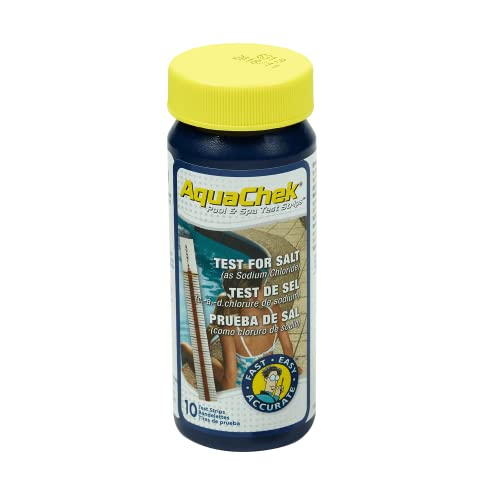
- Test strips are stale. Salt strips have shorter shelf life than pH strips. Replace any open bottle older than 3 months.
- Salt is settling to the deep end. Brush the bottom to bring undissolved salt into circulation before retesting.
- SWG cell is scaled. A scaled cell reads normal salinity even when the water is low — clean per your manual and retest.
For SWG owners, a salt-for-saltwater-pools buying guide helps avoid products that add iron or phosphates to the water.
Adding salt — best practice
- Test first. Confirm the actual current ppm with a fresh strip or your SWG’s built-in sensor.
- Calculate the gap. Use the calculator above. Don’t overshoot.
- Broadcast in the deep end. Pour slowly while walking the deep end so the salt dissolves in the heaviest water.
- Brush to dissolve. Any piles left on the floor won’t register until they dissolve.
- Run the pump 24 hours. Retest before adding more.
If your SWG is showing a low-salt warning immediately after a dose, give it a full 24 hours of circulation before assuming the dose was short. Most warnings clear once the salt fully mixes.
Storage and shelf life
Pool salt is essentially rock that absorbs water slowly. Store bags off the ground on a pallet or platform, in a dry shed if possible. Salt clumps from humidity are usable but slower to dissolve. Avoid storing near fertilizers or acids — cross-contamination can react and ruin nearby equipment.