

If your pool hits you with that sharp chlorine smell the moment you step outside, your first thought is probably “too much chlorine.” That’s almost always wrong — and the wrong fix (adding a small dose on top) just makes the smell worse and wastes money. The real culprit is combined chlorine, also called chloramines, and the fix is a specific shock dose at dusk followed by an overnight pump run.
Quick answer
A strong chlorine smell almost never means too much chlorine — it means too little free chlorine and too much combined chlorine (chloramines). Chloramines form when free chlorine reacts with sweat, oils, urine, and sunscreen, then off-gas as that sharp “pool smell.” The fix is breakpoint chlorination: test CC, dose enough shock to reach 10x the CC reading, run the pump overnight, and retest before swimming.
What this is not: the #1 myth about chlorine smell
The biggest misconception in pool care is that a strong “chlorine” smell means too much sanitizer. It doesn’t.
- Chloramines are not free chlorine. The smell you detect is combined chlorine off-gassing — chlorine that has already reacted with nitrogen-containing waste (sweat, urine, oils, sunscreen) and is mostly inactive as a sanitizer. What you smell is the byproduct, not the active ingredient.
- Adding small chlorine doses makes it worse. When CC is high, a top-up dose that doesn’t reach breakpoint just creates more chloramines. You need a large single dose — 10x your CC reading — to oxidize them all at once.
- Public pools that smell “strongly of chlorine” are typically under-chlorinated. The heavier the bather load, the more waste enters the water, and the faster free chlorine converts to chloramines if the dose can’t keep up.
- This is not a pH problem on its own. High pH can slow chlorine down, but the smell source is CC, not pH. That said, if your pH is above 7.8, chlorine works at roughly 25% effectiveness — so correcting pH is part of the fix.
A “shock” is also not the same as your routine sanitizer. A shock is a one-time high dose that oxidizes chloramines and organics. Non-chlorine shock (MPS) oxidizes organics but doesn’t kill algae or raise free chlorine — for real chloramine removal, you need cal-hypo.
Why a strong chlorine smell happens (chloramine chemistry)
Free chlorine vs combined chlorine (FC vs CC)
Free chlorine (FC) is the active sanitizer — the stuff that actually kills bacteria and algae. Combined chlorine (CC) is chlorine that has bonded with nitrogen waste and is mostly inactive, but it off-gasses as the smell. Total chlorine (TC) = FC + CC. If TC is higher than FC, you have CC.
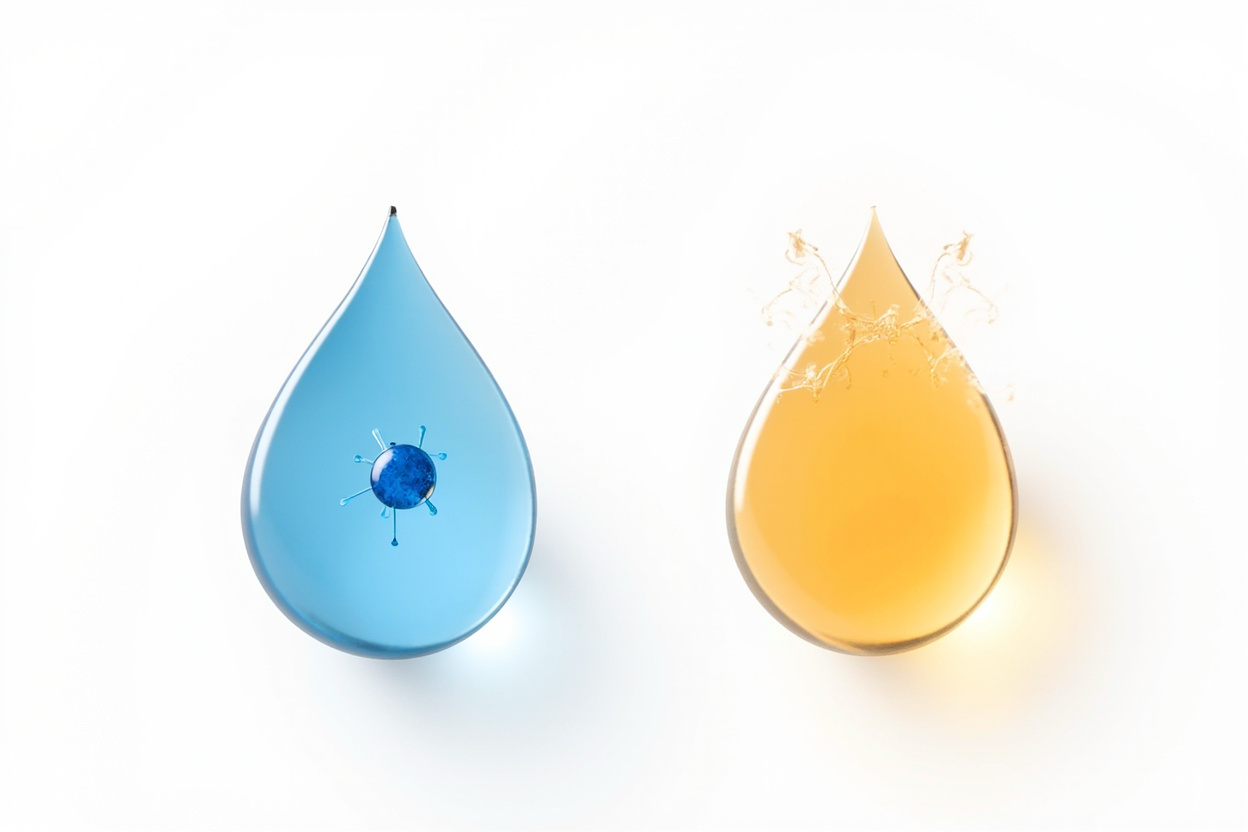
You can’t see the difference between FC and CC without a test that reads them separately. That’s why how to test pool water the right way matters — a DPD test gives you both numbers.
How chloramines form
Every swimmer adds sweat, body oils, urine, sunscreen, and cosmetics to the water. Fertilizers, leaves, and bird droppings contribute too. Free chlorine attacks these nitrogen compounds and converts to combined chlorine as a byproduct. Under normal conditions, FC keeps oxidizing CC until it disappears — but when FC drops too low to reach breakpoint, or when cyanuric acid (CYA) is so high that FC is locked, CC accumulates and the smell builds.
When CC becomes a problem (at or above 0.2 ppm)
The industry threshold is clear: CC at or above 0.2 ppm means you need to shock. Above 0.4 ppm, eye and skin irritation becomes likely. Above 0.6 ppm, the smell is unmistakable and the water is no longer sanitary — free chlorine is being consumed faster than it can sanitize.
Decision tree: what’s causing your chlorine smell
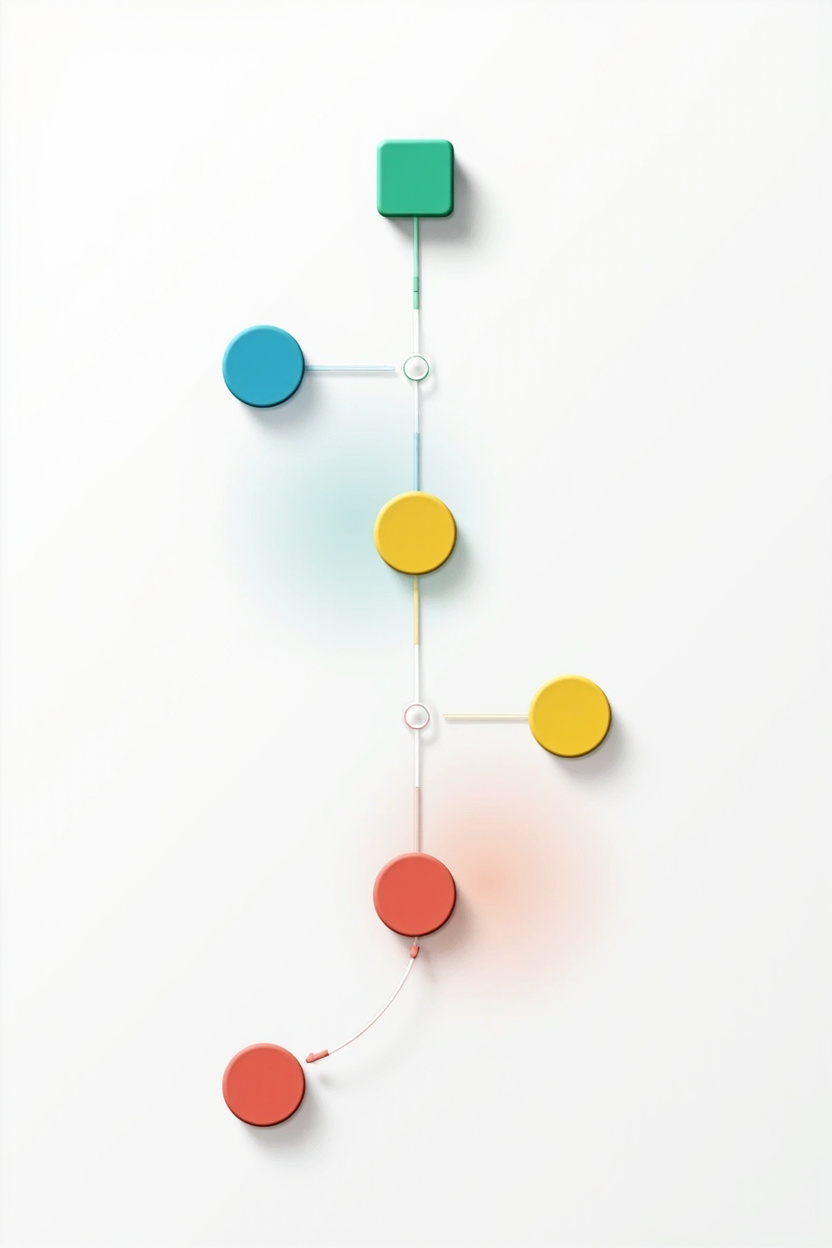
Before you dose anything, figure out which branch you’re on. The pool type and recent history change the approach.
Chlorine pool with CC at or above 0.2 ppm (most common)
This is the standard case. Test FC and TC, compute CC, then shock with cal-hypo at 10x CC at dusk. Run the pump 8+ hours overnight. Retest the next morning — CC should read 0.0 ppm. If it doesn’t, shock again.
Saltwater pool with chlorine smell
Salt cells generate FC slowly and continuously, but a heavy bather load (pool party, kids all afternoon) can overwhelm the cell’s output and produce CC faster than it can oxidize. Two options:
- Run the cell at a higher output percentage for 24 hours and retest CC. This works if the cell is clean and salt is in range (2,700–3,400 ppm).
- Do a one-time cal-hypo boost — the same 10x CC dose you’d use in a chlorine pool. Saltwater pools aren’t immune to chloramines; they just produce FC differently.
Skip the boost if your salt cell is fouled with calcium scale — clean it first, or you’ll burn out the unit trying to push more current through a blocked plate.
Smell persists right after a recent shock
You probably didn’t reach breakpoint. If your CC was 0.5 ppm but you only added enough shock to raise FC by 2 ppm, you landed in the middle of the chloramine hump — CC went up, not down. Retest CC, calculate the true 10x dose, and re-shock at dusk. Also check pH (above 7.8 slows the reaction) and CYA (above 70 ppm locks FC).
Spa or hot tub with chlorine smell
Hot water accelerates chloramine formation — the warmer the water, the faster waste reacts with chlorine. Drain one-third of the water, refill, and shock with dichlor or MPS. Spas need more frequent partial drains than pools because the bather-to-water ratio is much higher.
After a pool party or heavy bather load
A weekend party with 10+ swimmers dumps a massive amount of nitrogen waste (sweat, oils, sunscreen) in a few hours. Even if FC was fine beforehand, CC can spike to 0.5 ppm or higher overnight. The fix is the same breakpoint dose (10x CC), but prevention is easier: shock the evening after any heavy-use day, not the next morning when chloramines have already built up.
Test before you treat: what to measure first
Don’t reach for shock before you have numbers. You need three readings minimum.
Free chlorine (FC)
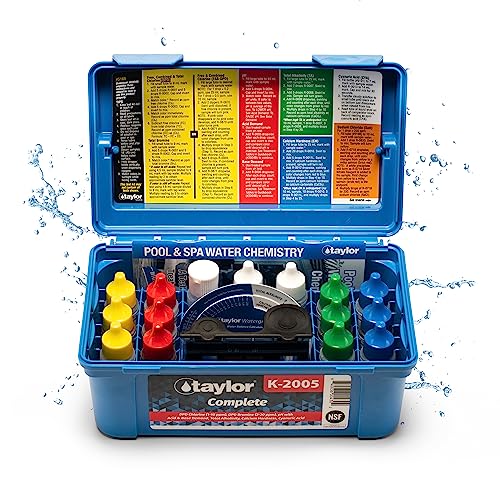
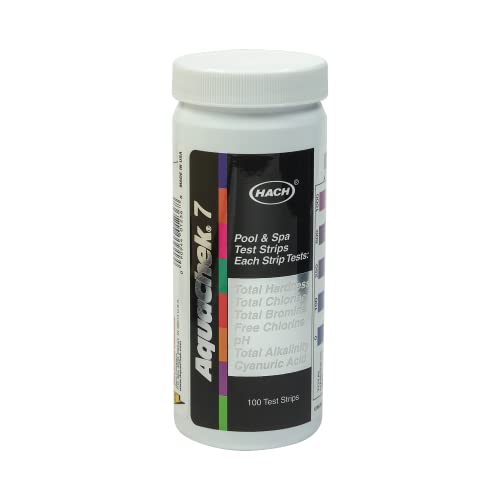
Target range: 1–3 ppm without CYA, or 3–5 ppm with CYA at 30–50 ppm. Use a DPD test like the Taylor K2005 test kit or a 7-way strip that reads FC and TC separately. If you only have strips, the AquaChek 7-way strips are the budget option — they read both pads so you can subtract.
Combined chlorine (CC) — the smell number
This is the only number that confirms the smell source. CC = TC minus FC. If CC is above 0.2 ppm, the smell is real and breakpoint shock is the cure. Without a test that reads TC, you can’t compute CC — and you’re guessing.
pH and CYA context
pH must sit between 7.2 and 7.8 for chlorine to work. At pH 8.0, free chlorine is roughly 25% as effective as at pH 7.4 — chloramines win the race. If pH is above 7.8, bring it down with Clorox pH Down (sodium bisulfate) before you shock. Wait 30 minutes between adjusting pH and adding shock. High total alkalinity can buffer pH so hard that it resists correction — if TA is above 150 ppm, lower it first (see the pH guide for the acid-demand method).
CYA above 50 ppm locks a portion of your FC. If CYA is above 70 ppm, much of what your test reads as “free chlorine” is actually bound and unavailable to oxidize chloramines. The only fix for high CYA is a partial drain and refill — no chemical will lower it.
Saltwater pool: also check the cell
Confirm the salt cell is clean and the salt level is in range (2,700–3,400 ppm). A fouled cell produces less FC and lets CC accumulate. Inspect every 3 months — calcium scale on the plates is the usual culprit.
The fix: breakpoint chlorination, step by step

Breakpoint chlorination means adding enough chlorine to oxidize all combined chlorine in one dose. The magic number is 10x your CC reading — that’s the ratio that pushes past the chloramine hump on the breakpoint curve.
Calculate your shock dose (10x CC rule)
Breakpoint = 10 × CC (ppm). For example, if CC is 0.3 ppm in a 10,000-gallon pool, you need enough shock to raise FC by about 3 ppm above current levels. For higher CC, multiply accordingly. Use the chemical dose calculator to translate ppm targets into pounds of shock for your pool volume.
Skip the calculator if you already know your pool volume and the cal-hypo percentage on your container label — the math is straightforward: pounds = (ppm needed × gallons × 8.34) ÷ (active ingredient % × 10,000).
Choose your shock type
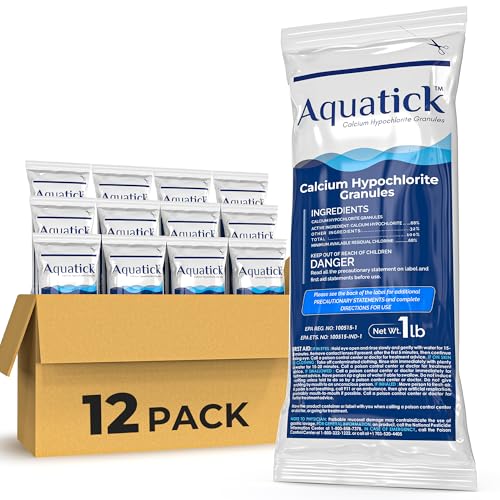
- Cal-hypo (65–73%) is the residential default for breakpoint. It’s strong, fast, and adds zero CYA. The HTH Shock Advanced in 1 lb packets is the standard pick, or the POOLACC cal-hypo in bulk if you stock up.
- Dichlor adds CYA — skip it if CYA is already above 50 ppm. It dissolves fast, but you’re trading a short-term fix for a long-term CYA problem.
- Lithium hypochlorite dissolves instantly and adds no calcium or CYA, but it’s expensive and harder to find.
Skip cal-hypo if your calcium hardness is already above 400 ppm — it will push CH higher. Skip dichlor if CYA is above 50 ppm. Liquid chlorine (sodium hypochlorite) is the fallback for both cases.
Add at dusk, run pump overnight
UV destroys free chlorine, so always shock at dusk. Pre-dissolve cal-hypo in a clean bucket of pool water — add chemical to water, never water to chemical — then pour slowly around the pool perimeter. Never pour shock through the skimmer.
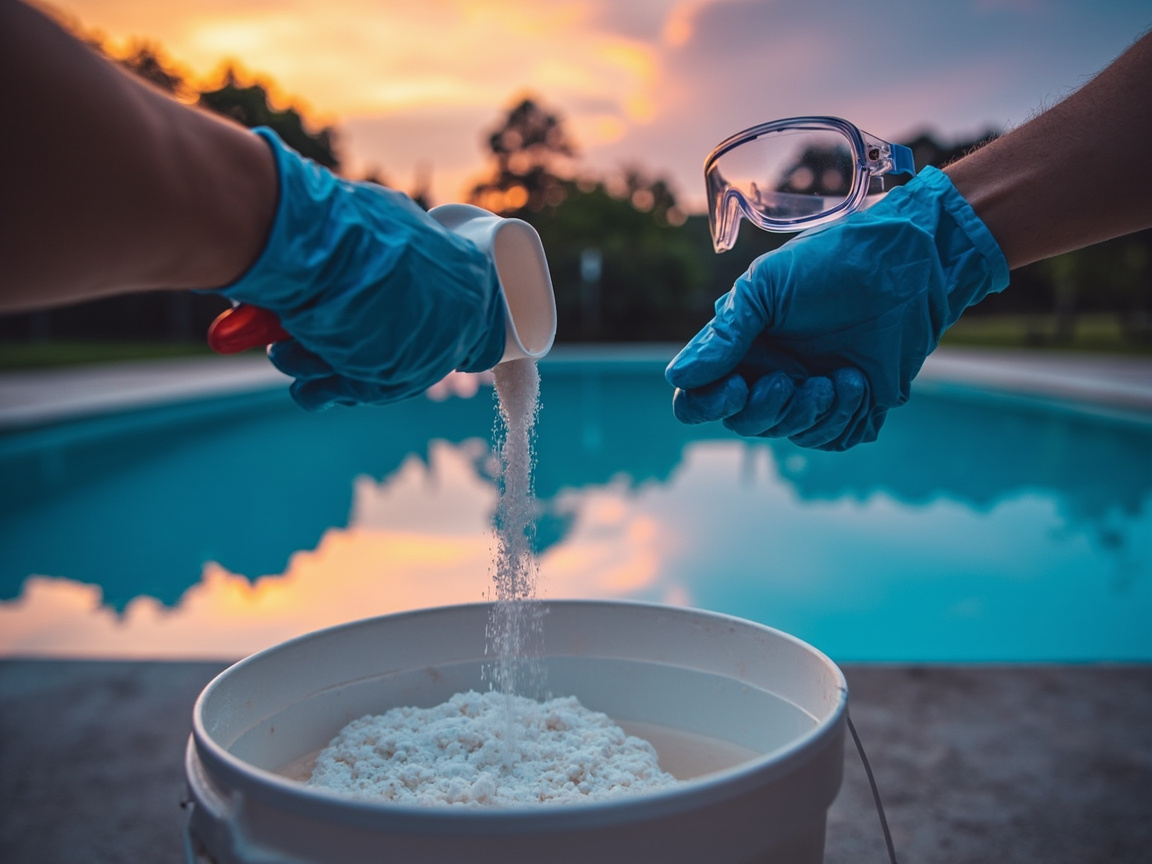
Run the pump for at least 8 hours to circulate the shock evenly. The goal is to keep all the water moving through the return jets so the dose reaches every corner.
Retest FC and CC before swimming
Wait until FC drops below 5 ppm before anyone gets back in. CC should read 0.0 ppm — if it’s still above zero, shock again at the recalculated 10x dose. Swimming in superchlorinated water irritates skin and lungs.
What you’ll need
Test kit that reads CC (mandatory)
You can’t diagnose chloramine smell without a test that reports FC and TC separately. The Taylor K2005 DPD kit is the gold standard — it reads FC, TC, pH, TA, CH, CYA, and acid/base demand in a single kit, and the reagents last a full season. For a budget alternative, the AquaChek 7-way strips read both FC and TC, so you can subtract to get CC. See liquid DPD kits vs test strips for the trade-offs.
Shock (cal-hypo) for breakpoint
For the breakpoint dose itself, the HTH Shock Advanced (68% cal-hypo, 12 single-dose 1 lb packets) is the residential default. The POOLACC cal-hypo is the same active ingredient from a different brand if you prefer bulk options. For a deeper dive on shock types and when to use each, see pool shock explained.
Optional: pH balancer
If pH is above 7.8, pick up Clorox pH Down (sodium bisulfate, 5 lb). Adjust pH first, wait 30 minutes, then shock. Don’t add acid and shock at the same time — the interaction reduces shock effectiveness.
Common mistakes that make the smell worse
- Adding more chlorine without testing CC. If CC is high, you need a large enough dose to hit breakpoint — a small top-up just creates more chloramines and the smell gets worse.
- Using test strips that don’t read TC. Without TC, you can’t compute CC. You’re flying blind. The AquaChek 7-way strips read both FC and TC pads so you can subtract. See what to look for in pool test strips.
- Ignoring pH. FC at pH 8.0 is roughly 25% as effective as at pH 7.4. High pH means sluggish chlorine, which means more CC buildup, which means more smell.
- Skipping the CYA check. If CYA is above 70 ppm, much of your FC reading is locked and unavailable. No amount of shock will fix the smell if CYA is too high — you need a partial drain. A full-service kit like the Taylor K2005 includes the CYA turbidity test so you catch this early.
- Shocking during the day. UV burns off FC fast. A dose added at noon might lose half its strength before it finishes oxidizing chloramines. Always shock at dusk.
When to call a pro
Keep DIY if: you can test water, brush, run the filter 24 hours, and the numbers are moving the right direction after a shock.
Call a pro if:
- CC stays above 0.5 ppm after two consecutive breakpoint shocks at the correct dose
- The smell is accompanied by cloudy or green water that doesn’t clear in 48 hours after shocking — jump to the cloudy pool guide first
- Heavy bather load (party, swim meet) overwhelms your sanitizer routine repeatedly
- You suspect CYA is above 100 ppm — a pro can advise on partial drain/refill volumes and the right chemistry reset
- The pump won’t prime or you suspect electrical issues with the salt cell
What to buy only if needed
Only if your current test kit can’t read CC
Upgrade to a DPD kit. Without a TC reading, you cannot diagnose the smell — you’ll keep guessing. The Taylor K2005 is the one-time investment that covers every parameter you need.
Only if CYA is above 70 ppm
You don’t need a product — you need a partial drain and refill. Drain 25–50% of the pool, refill with fresh water, and retest CYA. No chemical will lower CYA. See how cyanuric acid locks your chlorine for the full dilution math.
Only if pH is above 7.8
Use pH Down (sodium bisulfate). Adjust pH first, wait 30 minutes, then shock. Don’t combine acid and shock in the same addition cycle.
Only if you want a fast oxidizer without raising FC
Non-chlorine shock (MPS) oxidizes organics in lightly used pools without adding chlorine. For true chloramine removal at high CC, cal-hypo shock is more effective — MPS alone won’t reach breakpoint.
Safety notes (read this)
- Never mix different shock types (cal-hypo with trichlor or dichlor). They can react violently and release toxic chlorine gas — this is a hospital-visit mistake, not a minor error.
- Add shock to water, not water to shock. Pre-dissolve cal-hypo in a clean bucket of pool water. Dumping water onto dry concentrate causes splashing and heat release.
- Never pour shock through the skimmer if you have an inline chlorinator. Concentrated chlorine can react with residual trichlor in the feeder and pressurize the line.
- Store shock in its original sealed container, in a cool, dry, well-ventilated area. Keep it away from acids, fertilizers, and flammable liquids — cross-contamination can cause spontaneous combustion.
- Wear gloves and eye protection when handling granular shock. The dust is corrosive and can burn skin on contact.
- Keep swimmers out until FC drops below 5 ppm. Superchlorinated water irritates skin, eyes, and lungs. People with asthma should avoid the pool area entirely until CC reads 0.0.
Related
- Free chlorine explained — what FC actually does and the right target range.
- Pool shock 101 — breakpoint chlorination in depth, shock types, and dosing.
- Cloudy pool — the next problem to fix once the smell is gone.
Key takeaways
- A strong chlorine smell = combined chlorine (chloramines), not excess chlorine.
- Test CC first — TC minus FC. If CC is at or above 0.2 ppm, the smell is real and you need breakpoint shock.
- Breakpoint dose = 10x your CC reading. A smaller dose creates more chloramines.
- Always shock at dusk and run the pump 8+ hours — UV destroys FC during the day.
- Check pH (7.2–7.8) and CYA (below 70 ppm) before blaming the chlorine — both can silently slow FC down.
- Prevent recurrence with a weekly shock and care routine.
- Retest CC the next morning — it should read 0.0 ppm before anyone swims.