


Quick answer
You shocked the pool and it’s still cloudy. The shock did not solve the root cause, or it worked but the particles are too fine for the filter to catch. Before adding another bag, test free chlorine (FC), pH, CYA, and combined chlorine. The usual culprits are FC dropping to zero overnight, CYA locking your chlorine, pH too high for chlorine to work, or a clogged filter. Diagnose first, then target the actual bottleneck.
What this is not
A cloudy pool after shocking is not always an algae problem, and adding more chlorine will not always help.
Cloudy is not the same as green. Green usually means live algae or oxidized metals. Cloudy — milky, dusty, hazy, or grey-green — usually means fine suspended particles the filter cannot catch. Different causes, different fixes. See our cloudy pool guide for the full taxonomy.
Shock is not everyday chlorine. A shock dose is a concentrated, one-time chlorine application that raises FC high enough to break apart chloramines. Daily tabs or a saltwater generator at normal output are maintenance, not shock. A working shock can still leave water cloudy because dead algae and precipitated metals need to be filtered or flocked out — see our weekly pool care guide.
If your FC is already 3 to 5 ppm and the water is hazy, the bottleneck is filtration or particle size, not sanitizer. Adding more shock costs money and raises CYA.
Safety notes
Working with shock, clarifier, and pool chemicals requires basic precautions. None are medical-grade hazards but they cause skin and lung irritation if mishandled.
- Never mix different chlorine products dry or in the same bucket. Combining cal-hypo with trichlor or dichlor causes a violent reaction, fire, and toxic chlorine gas.
- Never pour shock through a skimmer that feeds an automatic chlorinator — you can get a dangerous reaction. Dose into the pool directly with the pump running.
- Never add muriatic acid and chlorine at the same time. Acid-to-chlorine contact in a confined space releases chlorine gas. Add acid to water, not water to acid. Run the pump at least 30 minutes between doses.
- Never swim in cloudy water you cannot see through. Cloudy water can hide a suction hazard or a child in distress.
- Avoid storing shock near fertilizers, gasoline, or organic material. Cal-hypo is an oxidizer and contact with hydrocarbons can trigger fire or release chlorine gas.
- Always wear gloves and eye protection when dosing. See our chemical safety basics for full acid handling.
What to test first
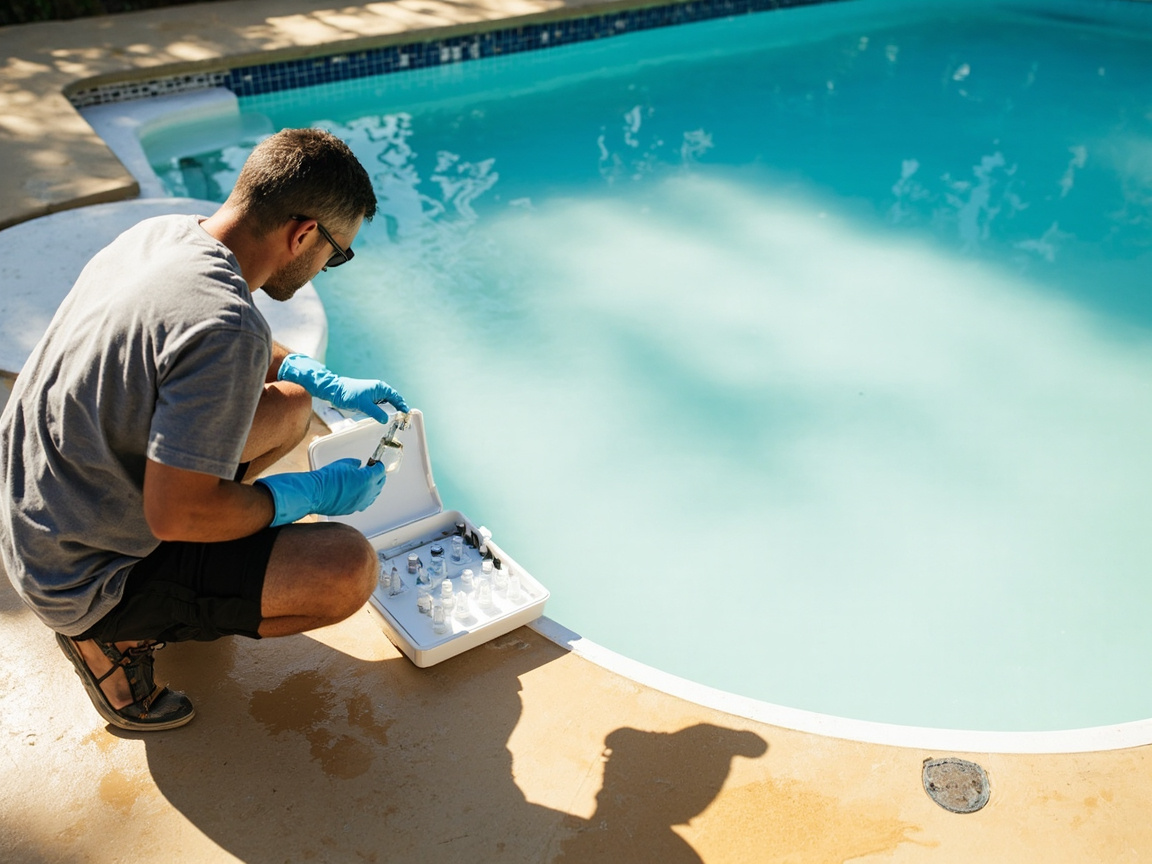
Before any more chemical, get four numbers and one observation:
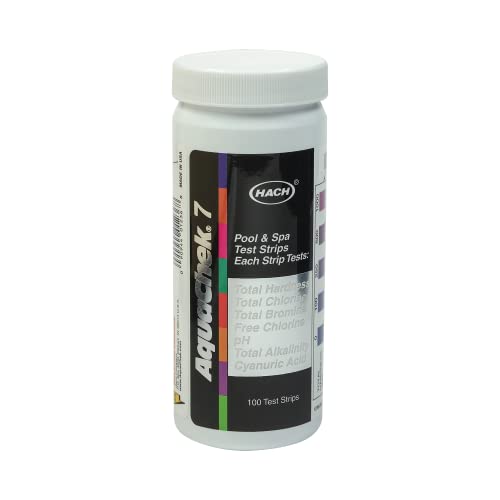
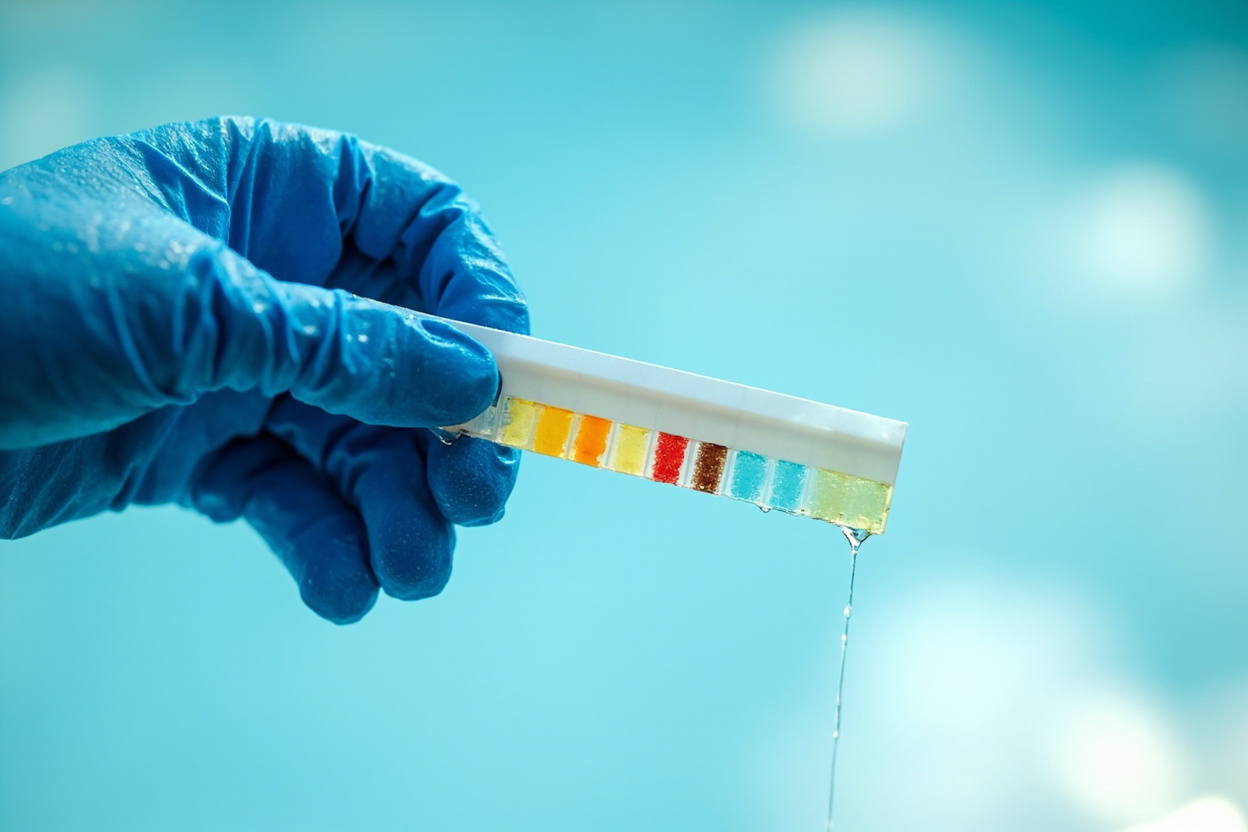
- Free chlorine (FC): Is there residual sanitizer or did the shock get consumed? Use a 7-way test strip for an FC reading within 12 hours of shocking.
- pH: Was the chlorine effective or did high pH neutralize it before it could oxidize anything?
- Cyanuric acid (CYA): Is your chlorine locked by stabilizer? Above 50 ppm and your shock is mostly bound.
- Combined chlorine (CC): If above 0.5 ppm, chloramines are present. The shock reached breakpoint but combined chlorine is still tying up active chlorine.
- Filter pressure: Compare to your clean baseline. If 8 to 10 psi above baseline, the filter is clogged.
For testing methods, see our pool water testing guide. For weekly testing rhythm, see our weekly pool care guide.
Read the strip against the pool, not the chart
Decision tree: why the pool is still cloudy after shock
Work through these branches in order. Each tests a specific variable and gives a specific action. Skip branches that do not match your numbers.
Branch 1: Free chlorine dropped to zero overnight
Measure FC 12 hours after shocking. If FC is 0 to 1 ppm, the shock was consumed by the organic load and never reached breakpoint.
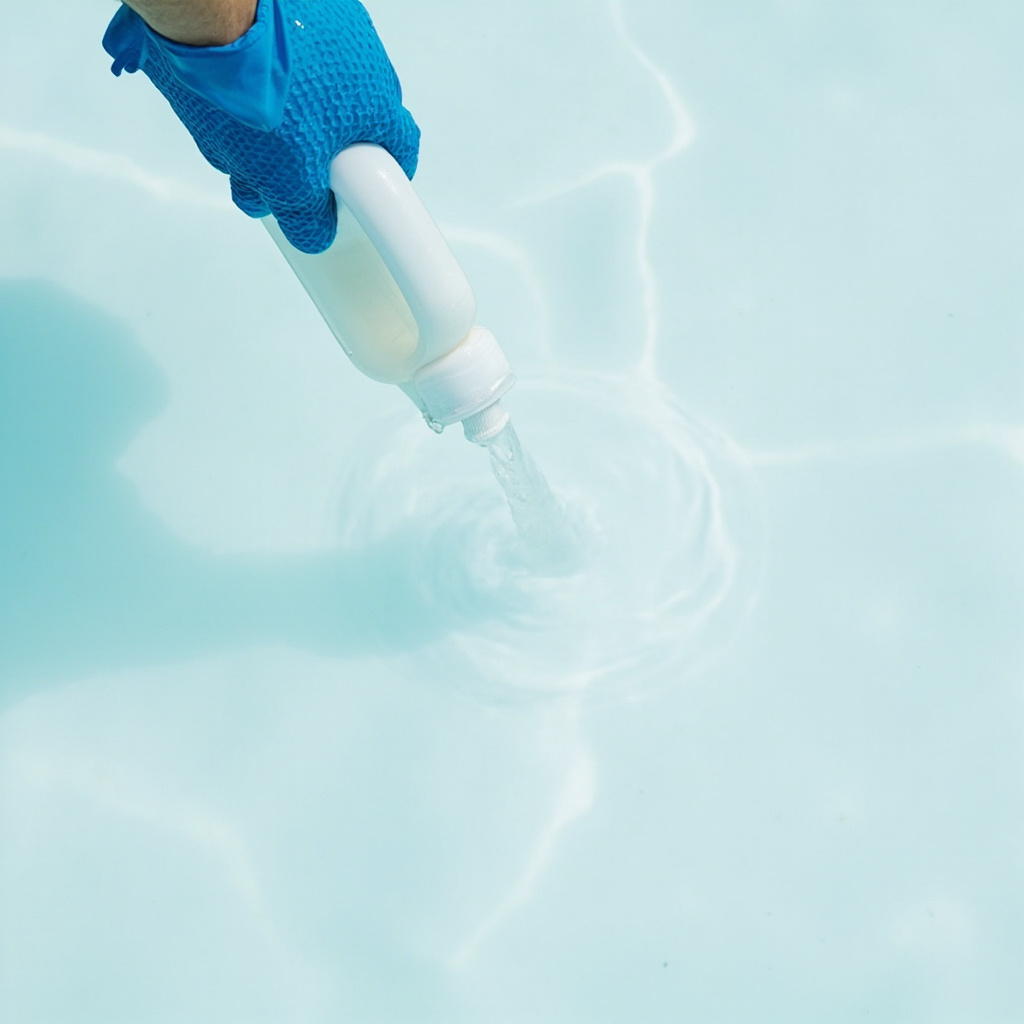
Re-shock at dusk with a cal-hypo shock at the label dose for your pool volume. Brush first, run the pump overnight, retest FC at dawn. If FC drops to zero again, brush, vacuum, and possibly drain and refill.
Skip this branch if FC is above 3 ppm after 12 hours.
Branch 2: CYA is above 50 ppm (chlorine is locked)
Measure cyanuric acid (CYA). If CYA is above 50 ppm, your FC is bound to stabilizer and a fraction is unavailable to oxidize particles.
Do not add stabilized chlorine (dichlor or trichlor) — they raise CYA further. Use cal-hypo or liquid chlorine. If CYA is above 80 ppm, the fastest fix is a partial drain and refill to dilute stabilizer, then re-shock. Use the chemical dose calculator to estimate dose for your volume.
Skip this branch if CYA is below 50 ppm.
Branch 3: pH was above 7.8 when you shocked
Check your pH from before you shocked. At pH 8.0, only about 20% of your free chlorine is in the active form. At pH 7.2, nearly 70% is active. A shock dose at high pH is mostly wasted.
Before re-shocking, adjust pH to 7.2 to 7.4 with a dry acid like Clorox pH Down or muriatic acid. Wait 30 minutes for circulation, then re-shock. If TA is also high, pH will bounce back — fix total alkalinity first to 80 to 120 ppm.
Skip this branch if pH was already 7.2 to 7.6.
Branch 4: Combined chlorine is above 0.5 ppm
Subtract FC from total chlorine (TC) to get combined chlorine (CC). If CC is above 0.5 ppm, chloramines are present. The shock reached breakpoint but combined chlorine is still tying up active chlorine.
The fix is breakpoint chlorination: raise FC to 10× CC and hold it there for several hours. Re-shock, run the pump overnight, retest. A non-chlorine shock (MPS) oxidizes chloramines without raising CYA but does not add residual chlorine.
Skip this branch if CC is below 0.5 ppm.
Branch 5: Filter pressure is 8 to 10 psi above baseline
Check your filter pressure. If 8 to 10 psi above baseline, the filter is loaded with debris and cannot catch new particles.
Backwash a sand filter or rinse a cartridge filter. For a sand filter more than three years old, the sand may be channeled — see our filter types guide for media life.
Skip this branch if pressure is at or below baseline.
Branch 6: Dead algae or particles are too fine for the filter
If FC is holding above 3 ppm and the water is lighter but still hazy, the dead organic matter is too fine for your filter media to catch. A 20-micron sand filter cannot catch 5-micron particles.
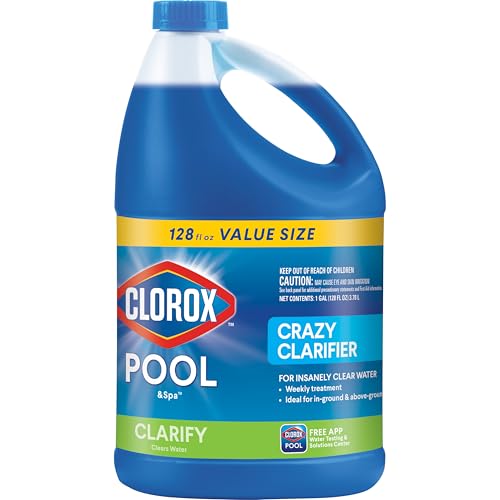
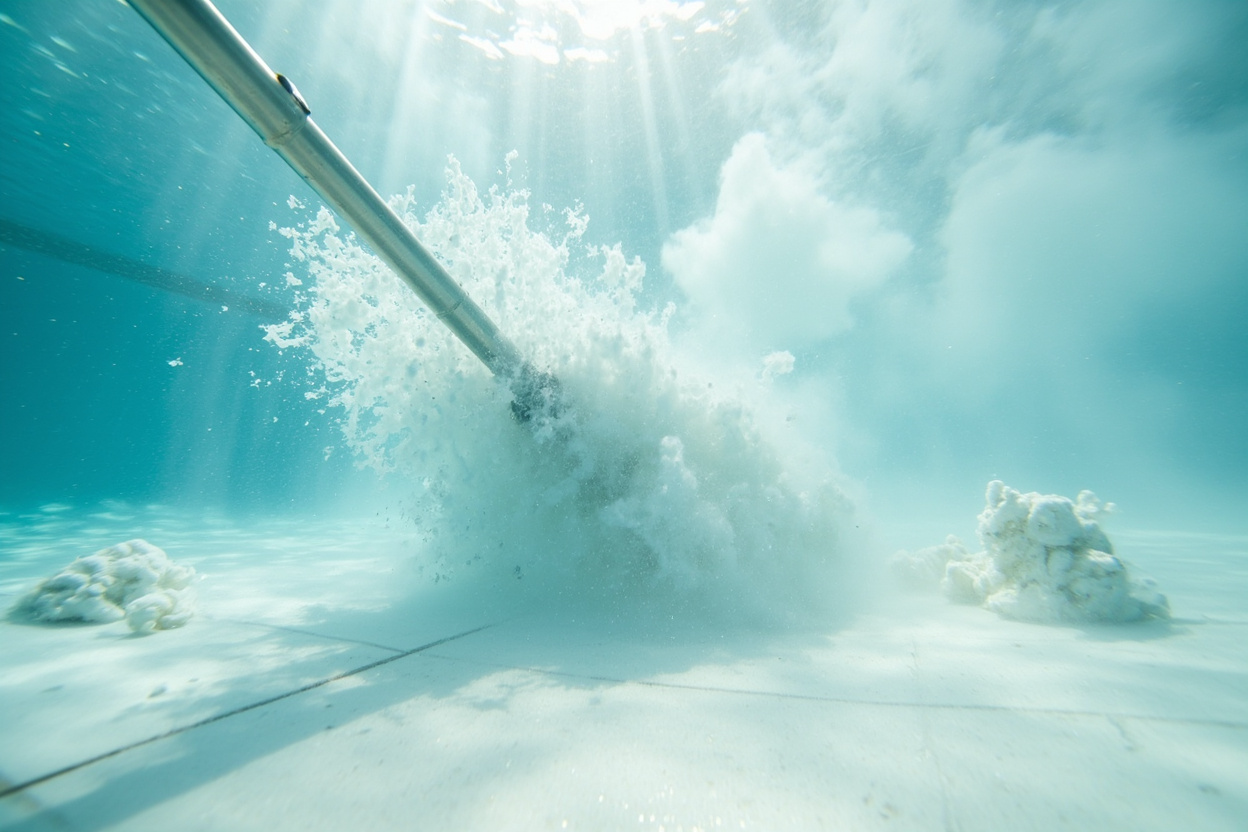
Add a clarifier to coagulate fine particles into clumps. Run the pump 24/7. If still hazy after 24 hours, use a flocculant to drop everything to the floor, then vacuum to waste.
Skip this branch if particles are visible and settling already.
Branch 7: Algae is still alive (slight green tint and FC keeps falling)
If the water has a slight green tint, is hazy, and FC keeps falling back to zero overnight, live algae is consuming your shock. Algae forms a protective film chlorine cannot penetrate without brushing.
Brush all surfaces first to break the film. Re-shock at dusk with cal-hypo at the label rate. Add an algaecide 60 plus for residual protection. Run the pump continuously for 48 hours and retest.
Skip this branch if the water is just hazy with no green tint.
Once you have a diagnosis, retest to confirm
What you’ll need
| Item | Why | Product |
|---|---|---|
| 7-way test strips | Read FC, pH, TA, CYA, CC before adding more shock | AquaChek 7-Way Strips |
| Cal-hypo shock | Re-shock when FC keeps dropping to zero | In The Swim 68% Cal-Hypo 12×1lb |
| Clarifier | Clump fine particles the filter cannot catch | Clorox Pool Crazy Clarifier |
| Flocculant | Drop dead algae to the floor for vacuum-to-waste | Clorox Sink to Clear |
| pH down | Lower pH before re-shocking if pH is above 7.6 | Clorox pH Down 5 lb |
| Algaecide 60 plus | Residual algae protection after re-shock | In The Swim Algaecide 60 Plus |
For pool volume and dose math, use the chemical dose calculator — it accounts for current readings and target ranges.
Step-by-step: fix a pool still cloudy after shocking
Test all five numbers and identify your branch
Use a 7-way test strip or a liquid kit. Write down FC, pH, TA, CYA, CC, and your clean filter pressure baseline. Match your numbers to a branch: FC zero → Branch 1. CYA above 50 → Branch 2. pH above 7.8 → Branch 3. CC above 0.5 → Branch 4. Filter pressure high → Branch 5. FC holding but hazy → Branch 6. Slight green tint + FC keeps falling → Branch 7. Skipping the test means guessing with chlorine.
Fix the root cause before re-shocking
If CYA is high, partially drain and refill. If pH is high, lower to 7.2 to 7.4 with dry acid, then shock. If the filter is clogged, backwash first. If live algae is present, brush before shocking. Use the chemical dose calculator to confirm every dose matches your volume.
Re-shock at the correct dose if FC keeps dropping
Brush all surfaces first. Live algae forms a protective film chlorine cannot penetrate without physical disruption. Add cal-hypo shock at dusk to minimize UV loss. Run the pump overnight. Retest FC at dawn. If FC drops again, move back to Branch 1 and add algaecide.
Run the filter continuously and clean as pressure rises
Dead organic matter loads the filter fast. Check pressure every 4 to 6 hours. Backwash or rinse when pressure rises 8 to 10 psi above baseline. Keep a spare cartridge if you run cartridges. See our weekly pool care guide for filter maintenance intervals.
Add a clarifier if the water is still hazy
If FC is holding and the water is lighter but still hazy, dead organic matter is too fine for your filter. Add a clarifier to clump the particles. If still hazy after 24 hours, use a flocculant to drop everything to the floor and vacuum to waste. Flocculant is faster but uses more water.
Retest before anyone swims
Wait until FC is within the label range for your sanitizer, pH is 7.2 to 7.6, the water is clear enough to see the drain at the bottom, and the filter is running normally. See our parent cloudy pool guide for the swim-readiness checklist.
What to buy only if needed
Only if FC is dropping to zero overnight: You need more shock, not a new product. The fix is a larger dose of cal-hypo shock at dusk, brush first, run overnight, retest at dawn.
Only if pH was above 7.8 when you shocked: Use dry acid or muriatic acid to bring pH to 7.2 to 7.4 before re-shocking.
Only if CYA is above 80 ppm: You cannot lower CYA with a chemical. The fix is a partial drain and refill. Then re-shock.
Only if filter pressure keeps rising despite backwash: Your filter media may be worn out. Replace sand every 3 to 5 years, DE grids every 5 to 10 years, or cartridges annually. See our filter types guide for media life.
Only if water has a green tint and FC keeps falling: Live algae is still present. Add algaecide 60 plus after re-shocking.
Common mistakes
These are the most common reasons a cloudy pool stays cloudy after a second or third shock.
- Adding more shock without testing first. If CYA is 100 ppm and pH is 8.0, your next shock dose is mostly wasted.
- Shocking in the morning or midday. UV destroys unstabilized chlorine fast. Shock at dusk so the chlorine works overnight. See our pool shock guide for timing.
- Brushing after shocking instead of before. Live algae forms a film chlorine cannot penetrate. If you shock first, the chlorine is wasted on the surface film.
- Adding clarifier to a pool with live algae. Clarifier clumps particles, including live algae cells. Kill the algae first, then clarify.
- Using trichlor or dichlor when CYA is already high. Both stabilized chlorines raise CYA. Switch to cal-hypo or liquid chlorine when CYA is above 50 ppm.
When to call a pro
Most cloudy-after-shock pools respond to the steps above in 24 to 72 hours. Call a pool service professional if any of the following apply.
The water has not cleared after 5 days of consistent testing, shocking, and filter cycling. There is a metal staining pattern (green, blue, brown, or black) that does not brush off. The filter pressure stays 8+ psi above baseline after a full backwash and the water does not clear within 24 hours. The pool has a vinyl liner and you see wrinkles or tears near cloudy zones — this can indicate a leak pulling water from under the liner. Or you cannot tell whether the cloudiness is algae, metals, or particles because the test results are inconsistent.
A pool pro has access to a commercial water lab that resolves ambiguity and can run a filter inspection that most homeowners cannot. See our weekly pool care guide for what monthly pro service typically covers.
Related
- Cloudy pool water: full diagnosis guide — the parent hub covering every cause of cloudy water
- Pool water testing: how to choose a kit — pick the right testing method for your situation
- Chemical dose calculator — size every dose to your pool volume
Key takeaways
- Test FC, pH, CYA, CC, and filter pressure before adding any more chemical.
- The most common causes are CYA above 50, pH above 7.8, FC dropping to zero, or particles too fine for the filter.
- Match your numbers to a branch in the decision tree before re-shocking.
- Fix the root cause first: drain if CYA high, lower pH, backwash the filter, then shock.
- Use cal-hypo or liquid chlorine, not stabilized chlorine, when CYA is already above 50 ppm.
- Clarifier clumps fine particles; flocculant drops them to the floor. Pick the right one for your patience.
- Do not swim in cloudy water you cannot see the drain through.