


If your FC reading sits at 0, your eyes burn, or your tablets seem to do nothing — the fix is not always more chlorine. Free chlorine is the active sanitizer residual, but it works only when cyanuric acid (CYA), pH, and combined chlorine (CC) line up with it. Done wrong, you waste money and the water stays a mess. Done right, it is a short sequence: test, interpret against CYA, dose, circulate, retest.
This guide covers what FC actually does, why the target depends on CYA, how to read FC vs CC vs TC, when to shock versus just add chlorine, and what to skip when a cheap strip says one number and your pool says another.
Quick answer
Free chlorine (FC) is the chlorine still available to sanitize pool water and oxidize fresh contaminants. Match FC to your CYA: 1–3 ppm with no CYA, 4–6 ppm at CYA 30, 5–7 ppm at CYA 50, 3–5 ppm in a saltwater pool. Test FC and CC before dosing, retest after circulation, and only reopen once FC is back in the CYA-adjusted target range.
What free chlorine actually does
FC sanitizes the water
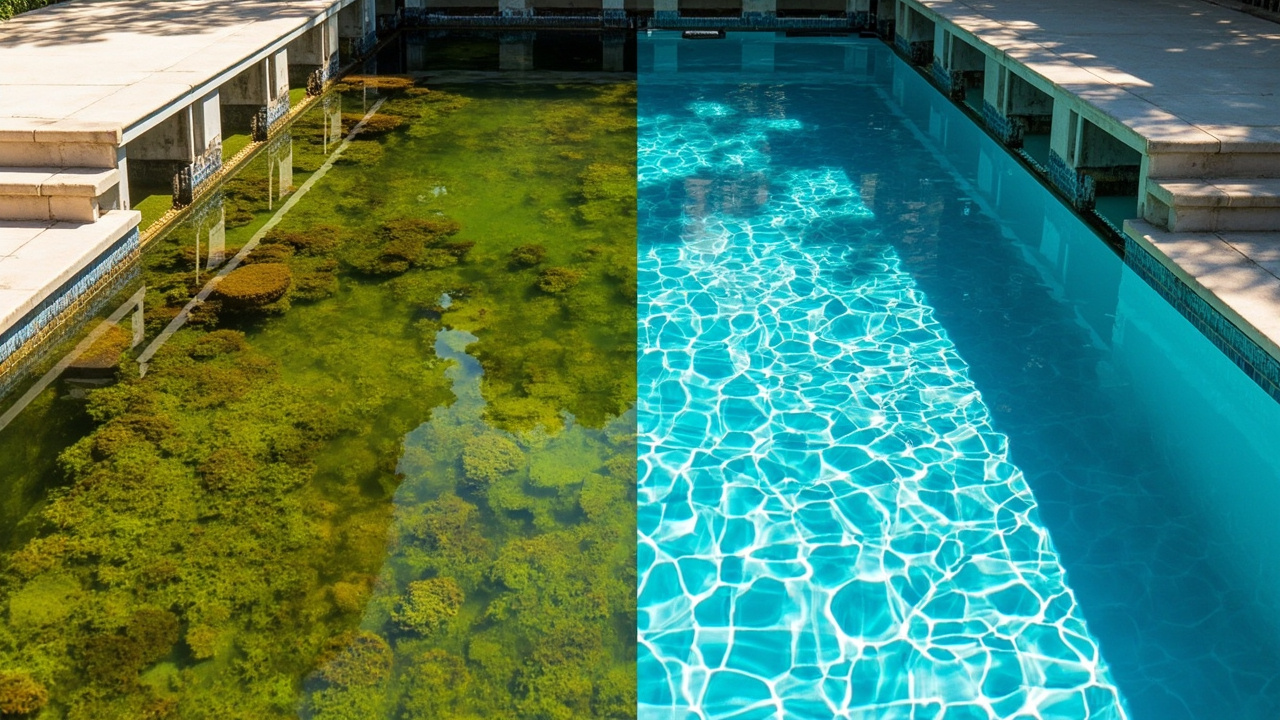
Free chlorine inactivates bacteria and helps stop algae before growth becomes visible. With enough FC, swimmer waste is neutralized within seconds. With too little, the same waste feeds algae colonies that turn the water green in two or three days — that’s the first branch on the green-pool recovery path.
FC oxidizes fresh contaminants
FC also breaks down sweat, sunscreen, leaves, and other organics. Oxidation is the daily cleanup load; sanitization is the kill step. Both happen at the same time, but they pull FC down at different rates. A heavy bather day consumes more FC than a quiet afternoon.
FC demand
FC demand is the FC your pool eats before the reading stabilizes. A pool with high FC demand (sun-heavy, low CYA, heavy bather load, developing algae) loses FC faster than a calm, shaded, well-stabilized pool. If FC keeps dropping despite fresh doses, the demand is the problem — not the chlorine product.
What free chlorine is not
- FC isn’t shock. Shock is a one-time high dose used to oxidize bather waste or burn off CC. FC is the daily residual you keep in range. Full procedure lives on how to shock a pool safely.
- FC isn’t salt. Salt is feedstock for a salt cell. The cell turns salt into chlorine, and that chlorine becomes your FC reading.
- FC isn’t CYA. CYA buffers chlorine against UV. It doesn’t sanitize on its own, and high CYA actually makes a given FC reading weaker.
- FC isn’t “chlorine smell.” A strong chlorine odor means chloramines (CC), not high FC. Pools with a strong pool smell usually have an FC problem, not too much chlorine.
Ideal FC range depends on CYA
There is no universal FC number. A pool with CYA 0 ppm and FC 0.5 ppm is roughly as sanitized as a pool with CYA 50 ppm and FC 5 ppm — only because the active chlorine fraction (HOCl/OCl⁻) is similar at those two ratios. The pH guide shows how pH shifts the same FC reading between stronger and weaker active forms.
| Pool setup | CYA | Target FC | Operating band |
|---|---|---|---|
| No stabilizer (indoor or fill-water only) | 0 ppm | 1–3 ppm FC | Tight; pH changes hit hard |
| Outdoor, low stabilizer | 30 ppm | 4–6 ppm FC | Common starting point |
| Outdoor, standard stabilizer | 50 ppm | 5–7 ppm FC | Most residential pools |
| Outdoor, high stabilizer | 70–80 ppm | 7–9 ppm FC | Lock risk rises |
| Saltwater cell | 50–70 ppm | 3–5 ppm FC | Cell sets the band |
A saltwater pool is not separate chemistry — it’s the same CYA-buffered system, with a chlorine generator replacing your tablet or liquid dose. The 3–5 ppm band is typical for a properly sized cell.
Match the FC target to your measured CYA and your pool’s system. For the buffer that holds those targets steady, see total alkalinity and pH stability.
FC vs CC vs TC (and when breakpoint kicks in)
Free chlorine (FC)
The sanitizer still available to work — the reading that protects the pool.
Combined chlorine (CC)
Chlorine already bound into chloramines, mostly nitrogen-based bather waste. Calculate CC from two test readings:
CC = TC − FCIf you only own a strip that reads “total chlorine,” you can’t compute CC. That’s the first reason a DPD kit that reads both FC and TC earns its shelf space.
Total chlorine (TC)
The full reading: TC = FC + CC. The CC component is what smells, irritates eyes, and resists further oxidation without a breakpoint dose.
Breakpoint chlorination when CC is high
When CC rises above about 0.5 ppm, add enough chlorine to break apart the chloramines — the working rule is roughly 10× the measured CC, then circulate and retest. The full procedure, dose math, and shock-type choice are covered in the pool shock guide. Breakpoint is not a daily goal; it’s a one-time fix for a CC problem.
Decision tree: which FC move fits your reading
- FC 0 ppm: treat as emergency. Shock to 10+ ppm with cal-hypo or liquid chlorine. Don’t swim. Test again in 24 hours.
- FC 0.5–1 ppm: algae risk. Add liquid chlorine or one trichlor tab in a floating dispenser or a vented feeder. Target the 4–7 ppm band for your CYA.
- FC 1–3 ppm: sub-ideal but workable for unstabilized water. For CYA 50, dose up to the band.
- FC 3–5 ppm: ideal for saltwater or low-CYA pools. Hold steady. Don’t over-chlorinate.
- FC 5–7 ppm: ideal for outdoor chlorine pools at CYA 30–50. Still safe to swim for most people.
- FC 7–10 ppm: high. Don’t swim for a few hours. Sunlight burns it off at roughly 0.5 ppm/hr at CYA 50.
- FC above 10 ppm: very high. Wait. Sunlight removes FC; aeration speeds it up. Add sodium thiosulfate only if you must swim.
If FC climbs without input, check for contaminated chlorine stock, an over-set salt cell percentage, or a stuck chlorinator feed wheel.
How to test free chlorine accurately
Take the sample at elbow depth, away from a return jet, the skimmer mouth, or a recent chemical dose. Read the result in natural daylight — color comparison shifts badly under a porch LED.
DPD liquid kit — primary recommendation
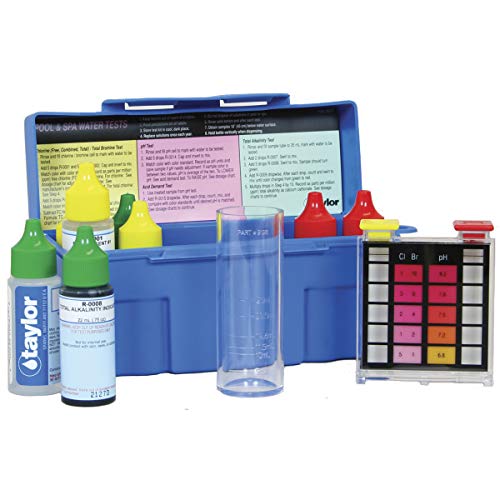
A DPD test uses a reagent that turns pink in proportion to FC. Match the color to the kit’s comparator block. For breakpoint decisions, you need a kit that also reads total chlorine — that’s where the Taylor K-1004-1 earns its keep. The smaller Taylor K-1001 reads FC and pH cheaply but skips total chlorine.
OTO and test strips — screening tools, not breakpoint tools
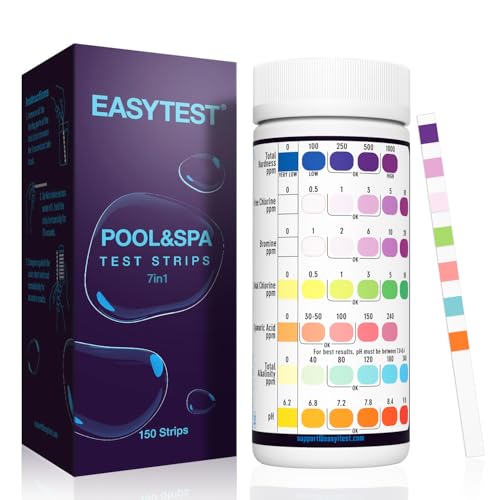
OTO (yellow-tone comparator) reads total chlorine in a broad band. Cheap 7-way strips like the EASYTEST 150-count read FC alongside pH, TA, CYA, and hardness. A strip is fine for “is anything obviously wrong?” but strip FC and TC blur at low readings, so they cannot separate CC. Confirm any dose or breakpoint decision with DPD. The full comparison lives on how to test pool water accurately.
Electronic testers — useful with calibration discipline
A digital probe or photometer removes the eye-match guess. They need regular calibration, fresh reagents, clean cells, and confirmation against a known liquid kit when a result looks implausible. Skip them as your only tester unless you’re already disciplined with reagent-based checks.
How to raise low free chlorine
Step-by-step: raise low FC
- Test FC, CC, pH, and CYA first. Don’t dose from one strip. If pH is below 7.2 or above 7.8, fix pH first. If CYA is at or above 100 ppm, switch to liquid chlorine.
- Pick the right chlorine. Trichlor tabs (slow, adds CYA), liquid chlorine (fast, no CYA added), cal-hypo shock (fast, adds calcium). For routine low-FC maintenance without raising CYA, the CPDI 4-pack liquid chlorine or the EZ POOLS 4-gallon pack covers most home doses.
- Calculate the dose. Use the chemical dose calculator for your pool volume and target ppm. A working rule for 10–12.5% liquid chlorine: roughly 1 gal per 10,000 gallons raises FC about 5–7 ppm.
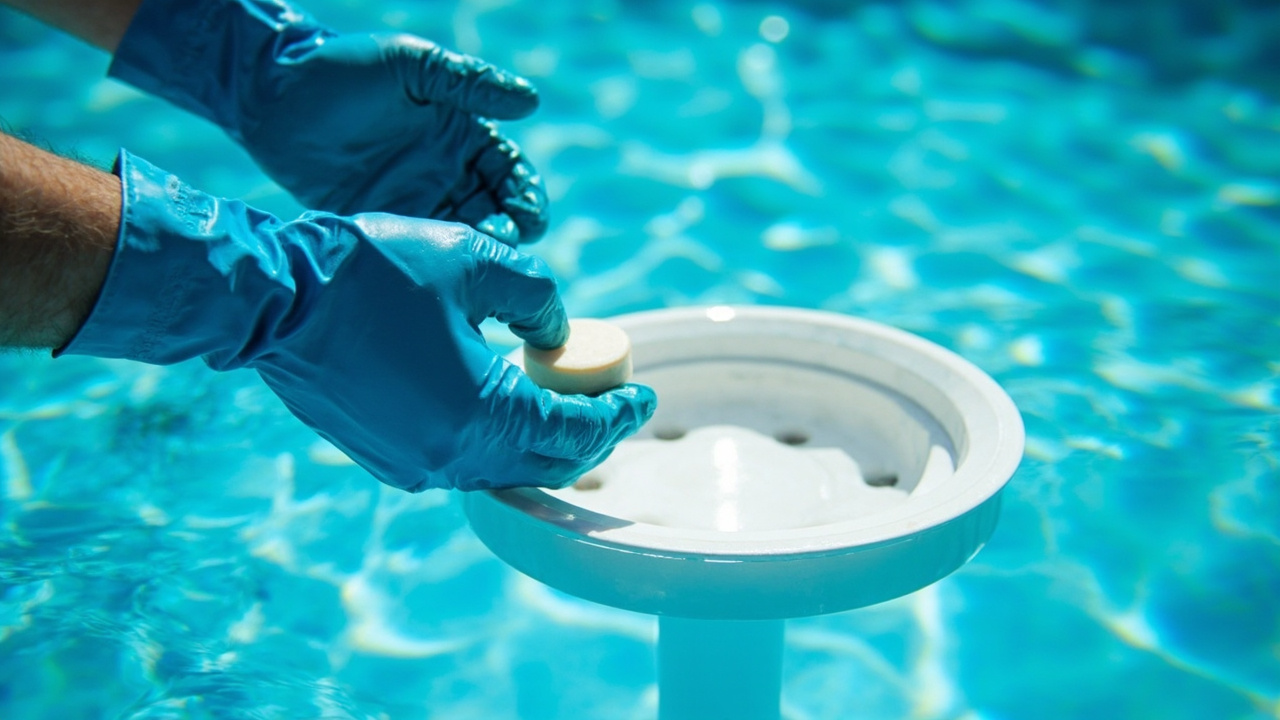
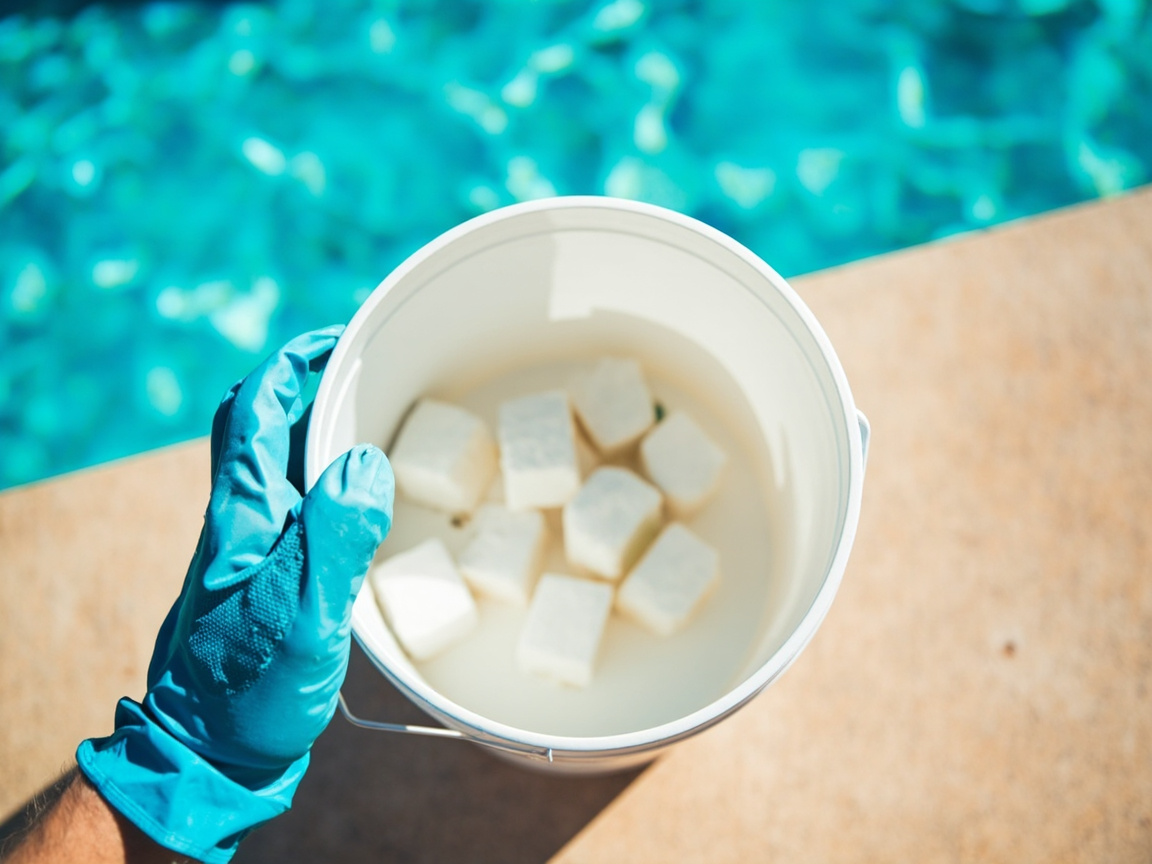
- Add it the right way. Pour liquid chlorine slowly across the return jet end with the pump running. For trichlor, drop one 3-inch tab into a feeder or floating dispenser — never directly into a chlorinator-fed skimmer. For cal-hypo, pre-dissolve in a clean bucket and walk it to the deep end, following the pool shock procedure.
- Circulate and retest. Run the pump 4–8 hours, brush settled granules, then retest FC and CC. Don’t swim until FC returns to your CYA-adjusted target.
Skip / Do not use if
Skip trichlor tabs if CYA is at or above 70 ppm. Skip liquid chlorine if the container has been sitting in a hot garage for months. Skip cal-hypo if calcium hardness is above 600 ppm and rising.
How to lower high free chlorine
High FC usually fixes itself with time, sunlight, and aeration. Most pools at FC 7–10 ppm drop back overnight.
Step-by-step: lower high FC
- Confirm the reading with a second test. A strip can over-read FC at high ppm. Use DPD if available.
- Stop adding chlorine. Remove trichlor tabs, set the salt cell to 0%, and skip the next dose.
- Speed up the drop with sunlight and aeration. Run the pump, point a return jet upward, and turn on any waterfall. Sunlight removes roughly 0.5 ppm/hr at CYA 50; aeration drives off dissolved chlorine gas without affecting CYA.
- Wait for the CYA-adjusted target. Once FC returns to the band for your CYA, retest before anyone swims.
- Use sodium thiosulfate only if you must swim soon. Pool-labeled chlorine reducer neutralizes FC quickly but adds sulfates. Skip it for routine corrections — time and sunlight almost always win.
FC loss by sunlight and the CYA buffer
Unstabilized loss: plan around 2 ppm per hour
Outdoor FC without CYA burns off fast. A working summer assumption is roughly 2 ppm FC per hour under strong midday UV. That number is the worst-case operating scenario, not a universal lab constant.
At CYA 50 ppm: plan around 0.5 ppm per hour
CYA buffers FC against UV. At CYA 50, the same exposure removes roughly 0.5 ppm per hour — about a quarter of the unstabilized rate. That’s why “I add a tab and it’s gone by evening” almost always traces back to CYA at or near zero.
More is not always better
CYA in the 30–50 ppm band is the sweet spot for most outdoor chlorine pools. Above 70 ppm, FC is over-protected — chlorine is locked and works slowly. Above 100 ppm, your effective FC is so weak that algae can grow in plain sight even with a “5 ppm” reading. Trichlor tabs and dichlor shock add CYA every dose; when CYA climbs past 100 ppm, the answer is partial drain and refill, not more chlorine. For the stabilizer side, the Pool Mate CYA raises CYA into the 30–50 band from a confirmed low reading.
FC in a saltwater pool
The salt cell is a chlorine generator
Saltwater pools don’t escape chlorine chemistry — they automate it. Salt passes through the salt cell, the cell produces chlorine, FC sanitizes and oxidizes, CC can form, UV consumes the residual. Salt itself is not a sanitizer.
Target and output adjustments
A properly sized cell holds 3–5 ppm FC with the pump running for most of the day. If FC drifts low, raise the cell output percentage in 10–20% steps and retest after 24 hours. If FC drifts high, lower the percentage or trim pump runtime. Verify salt level, flow light, cell cleanliness, and water temperature before assuming the cell has failed — most “the cell is dead” calls turn out to be scale on the cell plates or a low-salt reading.
What you’ll need
(Listed here as products first appear — IA §9 embed mode 1.)
- A DPD test kit that reads FC and TC (Taylor K-1004 is the workhorse)
- A 7-way test strip for trend checks (EASYTEST 150-count)
- Trichlor 3-inch tablets for feeder use — In The Swim 25 lb or Doheny’s 50 lb — never directly into a chlorinator-fed skimmer
- Liquid chlorine for routine FC correction without raising CYA (CPDI 4-pack or EZ POOLS 4-gallon)
- Cal-hypo shock for breakpoint or algae recovery — HTH 12-pack
- CYA stabilizer only when a CYA test confirms a low reading (Pool Mate 4 lb)
- Gloves and eye protection
For daily chlorination where ongoing CYA addition is fine, our pick for most backyard pools is In The Swim 3-inch trichlor tablets in the 25 lb bucket covers a backyard pool across a full season. For a larger pool, Doheny’s 50-pound trichlor bucket is the cost-per-tab winner. Skip bulk trichlor if your CYA test is already at 50 ppm or higher.
For routine FC correction without raising CYA, our pick is the CPDI Champion 4-pack 12.5% liquid chlorine — a 1-gallon-per-bottle format that fits most dose calculations cleanly. The EZ POOLS 4-gallon pack is the alternative four-pack at the same price band. Skip either if the container has been stored hot.
What to buy only if needed
Buy trichlor tablets only when ongoing CYA addition is acceptable
If your CYA is at 30–50 ppm and stable, trichlor tabs are the most convenient daily chlorinator. Skip routine tablet feeding the moment CYA crosses 50 ppm.
Buy cal-hypo only for a shock path that does not add CYA
Cal-hypo is the right pick for breakpoint and algae recovery when CYA is already high. HTH 52037R cal-hypo 12-pack covers most home shock doses without touching CYA. Skip it if calcium hardness is above 600 ppm. Never combine cal-hypo with trichlor, dichlor, or acid.
Buy CYA stabilizer only after a confirmed low CYA test
Pool Mate 4-pound CYA raises outdoor pools into the 30–50 ppm band where the FC-vs-UV math actually works. Skip it once a CYA test is already at 30 ppm or higher.
Buy a salt cell only for a saltwater system decision
A failing FC reading is not enough evidence to replace the generator. Verify salt level, flow light, cell scale, output setting, and water temperature first.
Common mistakes
- Treating every low FC reading as a shock emergency — A single low test is not a 0 ppm emergency. Check FC against the CYA-adjusted target, retest at the same time tomorrow, and decide. A pool at FC 2 ppm with CYA 30 is one small dose from target — not the same job as a 0 ppm pool with visible algae. Use the green-to-clear triage tool before committing to a multi-day shock.
-
Trusting a cheap strip for FC/CC separation — A 7-way strip is a screening tool, not a breakpoint calculator. For a shock dose or a CC interpretation, use DPD and read TC as well as FC.
-
Adding trichlor tabs while CYA is already high — Trichlor adds CYA. If CYA is at 70 ppm, every tab pushes the next dose further out of reach. Switch to liquid chlorine until a partial drain brings CYA back into the 30–50 ppm band.
-
Raising FC without checking pH and pool volume — A wrong pool volume produces a wrong dose. Run the chemical dose calculator with measured volume and a fresh pH reading before adding chlorine.
-
Assuming a salt cell removes the need to test — The cell automates production, not verification. Test FC, CC, pH, CYA, salt, and cell condition on a routine schedule — the first-year pool owner routine lays out the cadence.
When to call a pro
Keep the job DIY when FC responds to a measured dose within 24 hours, your tests repeat, and CC stays under 0.5 ppm.
Call a pro if FC keeps slipping despite correct dosing, the salt cell won’t prime or scale keeps returning, you suspect structural leak or electrical issues, or you’re not comfortable handling acid and chlorine in the same session. For a pool that won’t clear after a correct shock, run the green-to-clear triage tool before booking service.
Safety notes (read this)
- Never mix different chlorine products dry or in a bucket — cal-hypo, trichlor, dichlor, liquid chlorine, and acid must stay separate.
- Never pour chlorine through a skimmer that feeds an automatic chlorinator or salt cell — a concentrated slug can damage plates or release gas.
- Add chemical to water, not water to chemical, when pre-dissolving.
- Gloves and eye protection; don’t breathe dust from containers.
- Store locked away from kids and pets, upright, dry, in original containers.
- Liquid chlorine degrades fast — rotate stock every 4–6 weeks in summer heat.
- Reopen only after FC returns to your CYA-adjusted target range and the product label’s waiting rule has passed.
Related
- Pool shock — breakpoint procedure and shock-type comparison.
- Pool water testing — full DPD vs OTO vs strip comparison.
- Green-pool recovery path — full algae recovery when FC has dropped to zero.
Key takeaways
- FC is the available sanitizer residual; shock is the action, not a separate chlorine species.
- Match FC to your measured CYA and pool type — there is no universal target.
- Calculate CC as TC minus FC; reach for breakpoint only when the result calls for it.
- Use a DPD kit for FC/CC decisions; reserve strips for screening.
- CYA protects FC from UV, but past 70 ppm, FC locks.
- Sunlight, bather waste, and salt-cell output are different FC losses with different fixes.
- Never mix chlorine products, never pour through a chlorinator-fed skimmer.