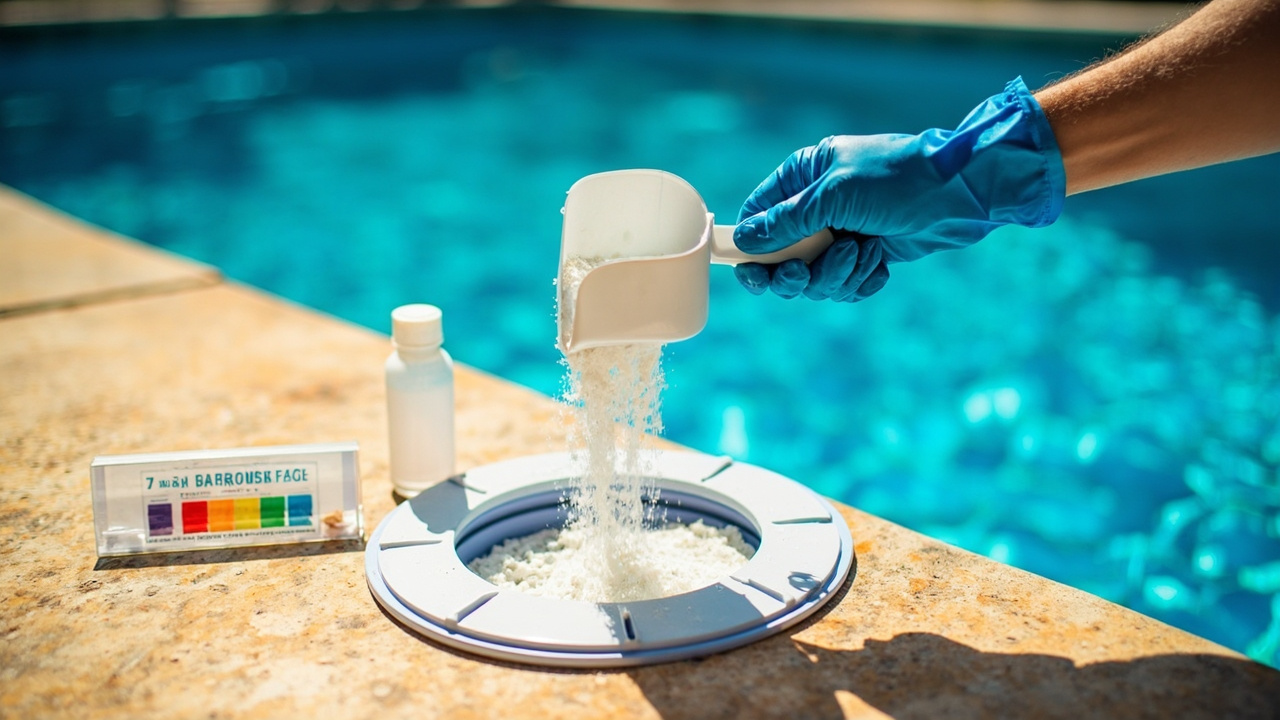



If the strip reads TA under 80 ppm and pH has wandered, you don’t need a full water change — you need sodium bicarbonate. Dose wrong and you overshoot past 150 ppm and spend the next weekend chasing pH bounce; dose right and it’s a 30-minute session.
Quick answer
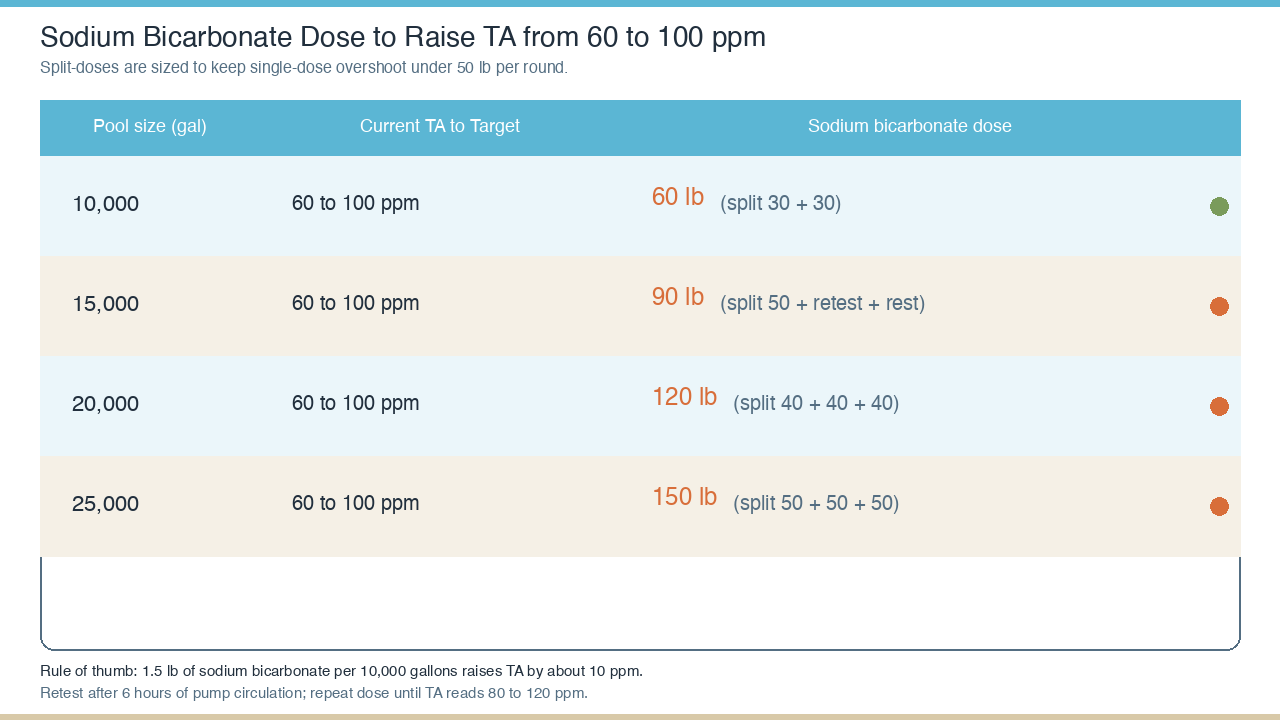
Target: 80–120 ppm TA. Standard dose: ~1.5 lb of sodium bicarbonate per 10,000 gallons raises TA by ~10 ppm. Pre-dissolve, broadcast, run pump 6 hours, retest. Skip if pH above 7.8 — lower pH first, or bicarbonate locks in the high pH. Raise TA before shock on a green pool — high FC with low TA burns off sanitizer in hours.
| Pool size (gal) | Current TA → Target | Sodium bicarbonate dose |
|---|---|---|
| 10,000 | 60 → 100 ppm | 6 lb — single dose |
| 15,000 | 60 → 100 ppm | 9 lb — split 5 + 4 |
| 20,000 | 60 → 100 ppm | 12 lb — split 6 + 6 |
| 25,000 | 60 → 100 ppm | 15 lb — split 8 + 7 |
A single 5 lb alkalinity increaser covers the 10,000-gallon case. Skip if pH is above 7.8 — see Branch 2.
What this is not: TA is its own number
Pause before you dose — pool owners often reach for the wrong bag.
Raise TA is not raise pH
TA is the bicarbonate reserve; pH is the active acidity right now. Sodium bicarbonate raises TA and nudges pH up only slightly. To raise pH without changing TA, use soda ash. See the pH Hub.
Baking soda is not pool shock
Pool shock is chlorine or a non-chlorine oxidizer (calcium hypochlorite, dichlor, lithium hypochlorate, or potassium monopersulfate). It sanitizes water; it does not raise TA meaningfully. For green water: fix TA → fix pH → shock. See pool shock order rules.
Alkalinity increaser is not borax
Borax is sometimes sold as a “TA booster,” but borate buffering is a different system that interacts with pH and CYA in ways most homeowners should not improvise.
Aeration is a slow TA-lower, not a TA-raise
“Aerate to raise alkalinity” is reversed. Aeration raises pH and gradually lowers TA. To raise TA, you must add bicarbonate.
Decision — what to do based on your readings
Run the right test before opening any chemical.
Branch 1 — TA under 60 ppm AND pH 7.2-7.6
Dose now. Follow the step-by-step method; target 80-120 ppm.
Branch 2 — TA under 80 ppm AND pH above 7.8
Do not dose yet. Add pH-down first to bring pH into 7.2-7.4, then dose bicarbonate the next day. Sequence detail at pH guide.
Branch 3 — TA under 80 ppm AND pool is green or cloudy
Fix TA before shock. Sequence: brush → test TA → raise TA → circulate 6 h → shock. See green-pool recovery.
Branch 4 — TA under 80 ppm AND CYA over 100 ppm
Over-stabilized cyanuric acid locks chlorine. Drain-and-refill is the standard correction. Drain math at cyanuric acid.
Branch 5 — Saltwater pool (SWG) AND TA consistently under 60 ppm
Salt cells generate sodium hydroxide at the plates, raising pH and consuming TA. Expect monthly bicarbonate in heavy swim season. Keep TA closer to 80-100 ppm. SWG cell inspection at saltwater basics.
Branch 6 — Strip reads TA under 30 ppm AND liquid kit disagrees
Two methods disagreeing by 50 ppm or more means don’t dose. Re-sample from elbow depth; re-test with a fresh liquid kit. Test method at test-strip accuracy.
What you’ll need
You can raise TA with kitchen baking soda or a pool-packaged increaser — same chemical.
Sodium bicarbonate in a small bag (5 lb)
Best for one-time corrections on a 10,000-15,000 gallon pool. The Clorox Pool & Spa 5 lb alkalinity increaser covers most seasonal corrections without waste.
Sodium bicarbonate in a bulk bag (50 lb)
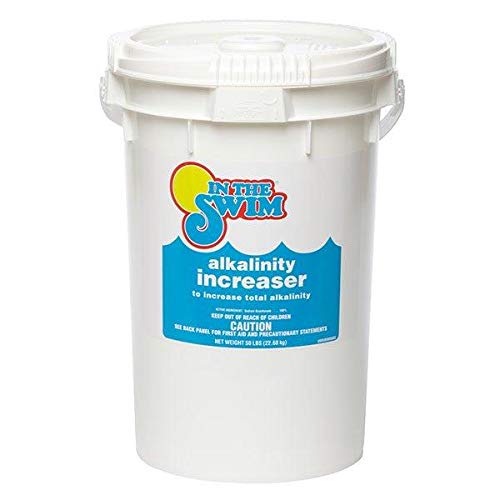
Best for very large pools or repeat corrections across seasons. In The Swim Alkalinity Increaser (50 lb) is the standard bulk pick. Buy only with dry storage — bicarbonate absorbs moisture and clumps. For mid-size pools, the Pool Mate 10 lb increaser hits the middle.
7-way test strips for weekly trend checks
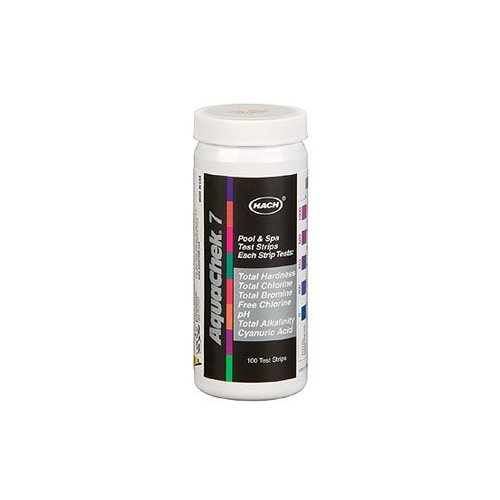
Best for fast weekly re-tests. Hach AquaChek Silver 7-Way strips show TA alongside pH, FC, CYA, calcium hardness, and borate.
Optional liquid titration kit
If you own a Taylor K-2006 or similar, use it on dose day. The strip reading suffices for most corrections.
Step-by-step method
Hands-on time: about 30 minutes.
Step 1 — Test your current TA (5 minutes)
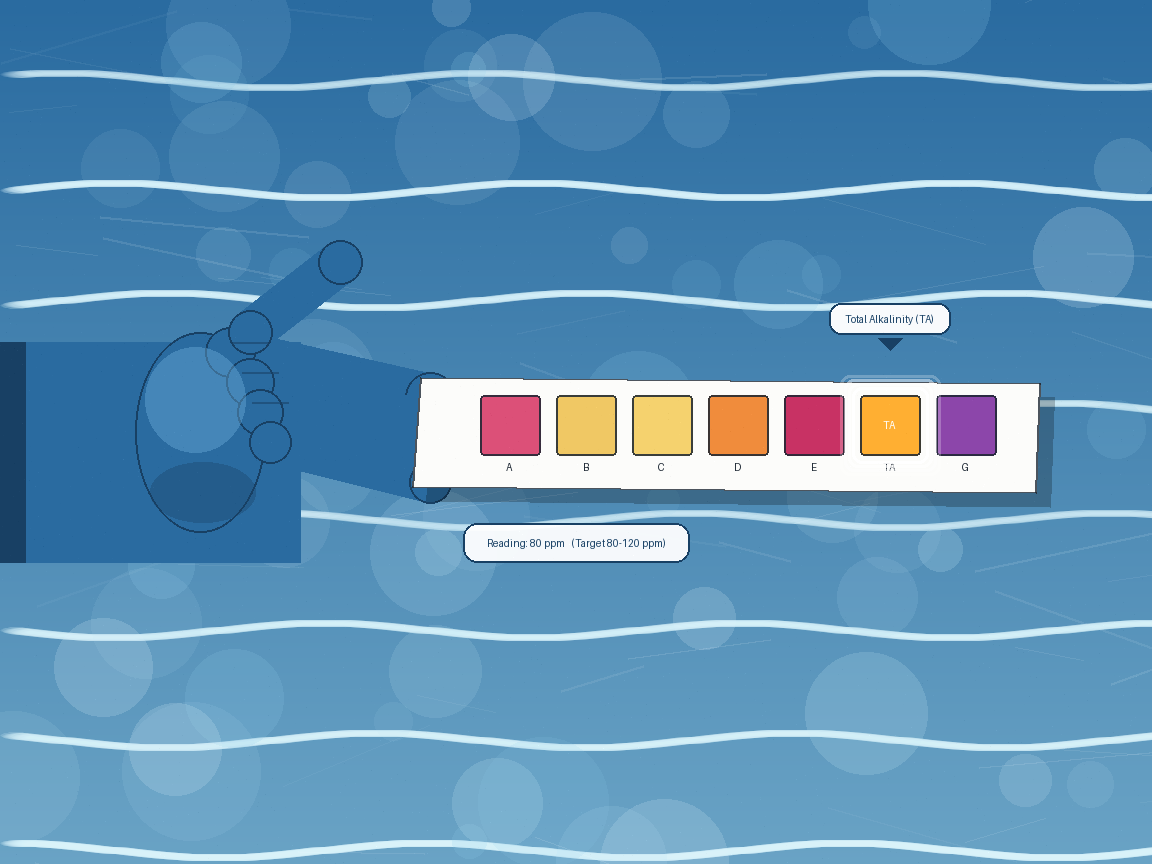
Draw the water sample from elbow depth, mid-pool, at least 2 feet from any return jet. Record the ppm. Below 60 means a substantial dose; 60-80 needs a smaller one. Confirm with a fresh 7-way strip when in doubt.
Step 2 — Calculate the dose (5 minutes)
Rule: 1.5 lb of sodium bicarbonate per 10,000 gallons raises TA by 10 ppm. A 15,000-gallon pool moving TA from 60 to 100 ppm needs 1.5 × 1.5 × 4 = 9 lb — fits in one small bag, or split 5 + 4 with a 6-hour wait between doses.
Step 3 — Pre-dissolve in a 5-gallon bucket (10 minutes)
Fill a clean 5-gallon bucket halfway with pool water. Slowly pour the measured bicarbonate in while stirring with a wooden paint stick. Add bicarbonate to water, not the other way. Let sit 2-3 minutes. The 10 lb Pool Mate mid-size bag splits evenly into two doses for mid-size pools.
Step 4 — Broadcast slowly with the pump running (10 minutes)
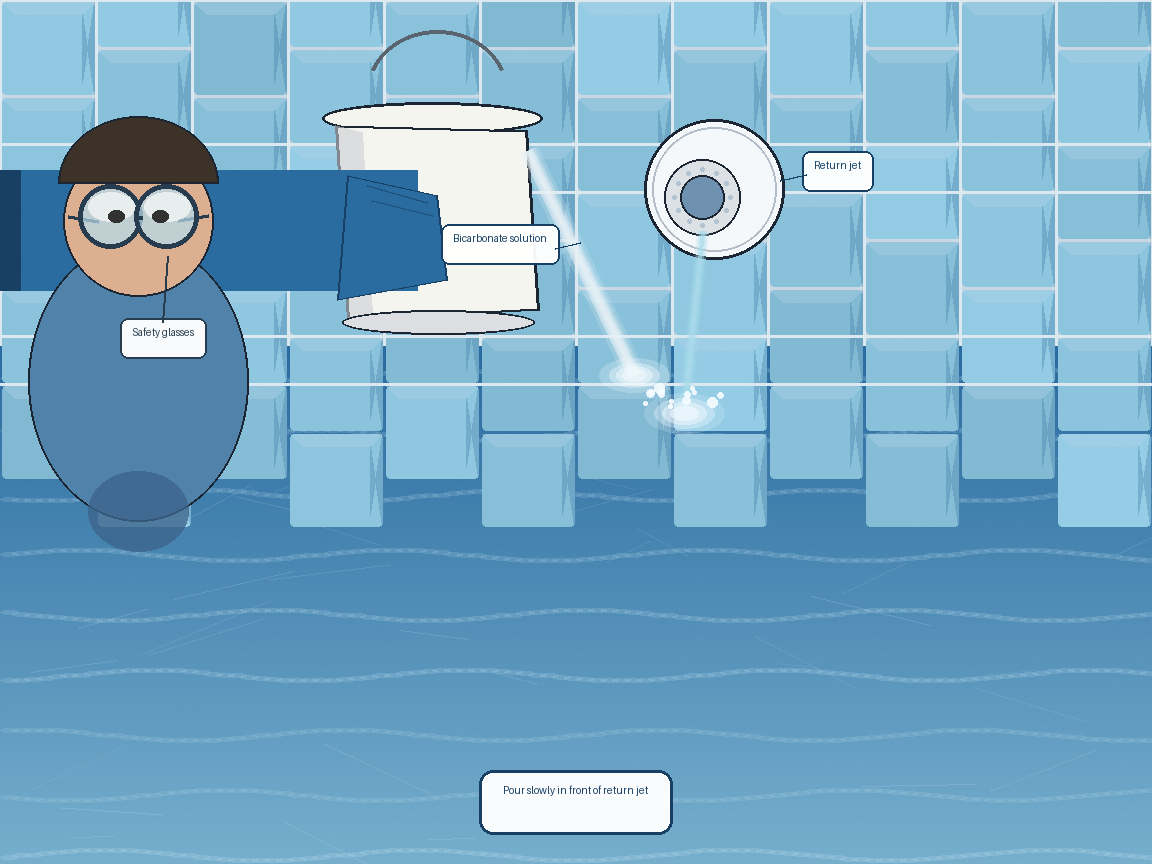
With the pump on high, slowly pour the dissolved solution in front of a return jet — a small stream, not a dump. Keep the pump running 6 hours minimum. Big-pool corrections or repeat fixes across multiple seasons often use the bulk 50 lb increaser.
Step 5 — Wait 6 hours, then re-test
Re-test TA at the same sample location with a fresh 7-way strip. Expect roughly 10 ppm rise per 1.5 lb dosed per 10,000 gallons — a 5 lb dose in a 15,000-gallon pool lifts TA about 22 ppm. If still below target, repeat Steps 2-4.
Step 6 — Retest pH the next day
Bicarbonate nudges pH upward. If pH is above 7.8, let it drift down naturally over 24-48 hours. If pH is 7.4-7.6, you’re done. For pH sequencing, see the pH guide.
Safety notes
Sodium bicarbonate is mild, but dose quantities are large enough that basic precautions matter.
Wear a dust mask when handling bulk powder
A 50 lb bag releases enough fine particulate to irritate airways. An N95 or cloth mask cuts the irritation.
Use eye protection during broadcast
Splashing a 5-gallon bucket around a return jet can splash back into your eyes. Standard safety glasses work.
Never mix bicarbonate with another chemical in the same bucket
Do not combine with chlorine, acid, or shock — even small amounts. Combine only with pool water.
Store bags off the floor and away from children and pets
A 25 lb bag on a garage floor is a pull-up-toddler accident waiting to happen.
Dose during pump-running hours only, never while swimmers are in the water
Even mild bicarbonate dust irritates open eyes and mouths. Reopen 6 hours after dosing.
Common mistakes
- Dose without testing first. Many owners add “a scoop” because they remember TA being low a month ago. Conditions change weekly. Test, decide, dose — every time.
- Use soda ash when pH is the actual problem. If pH is below 7.2 and TA is in range, the fix is soda ash or aeration. Sodium bicarbonate raises both TA and pH slightly.
- Confuse baking soda with borax or washing soda. Read the label — you want “sodium bicarbonate” only.
- Misread the dose rule or dump the whole bulk bag at once. The rule is 1.5 lb per 10,000 gallons per 10 ppm rise — a 10,000-gallon pool going 60 → 100 ppm needs 6 lb total, not 60 lb. Single doses over 5 lb risk overshooting past 150 ppm; split into 3-4 lb batches and wait 6 hours between them.
- Skip the 6-hour circulation wait. Adding and immediately re-testing reads a pool whose dose has not yet mixed. Plan on 6 hours minimum before re-test (your dose lives on the full pool maintenance schedule).
When to call a pro
Most TA corrections are well within a homeowner skill set, but three situations warrant a paid service visit.
TA reads near zero on two separate test methods
A reading under 10 ppm on both strips and a fresh liquid kit usually means a partial drain with very soft refill water, or massive dilution. A pro can assess the pool surface and plan a staged refill.
TA swings more than 30 ppm per week without dosing
A sign of contamination (acid rain, algaecide breakdown, SWG cell failure). A pro can rule out SWG output issues, check for hidden leaks pulling CYA down, and test source water.
You can’t identify a test kit you trust
If every strip is past its expiration date and your local pool store tests for free, that 5-minute test is faster than second-guessing. Use it as a sanity check, then dose from your own liquid kit at home.
What to buy only if needed
Three products solve edge cases most pool owners will not face in year one.
Bulk 50 lb sodium bicarbonate bag
Needed only if your pool is over 25,000 gallons or you expect multiple corrections per season.
Sodium bisulfate dry-acid pH-down (Branch 2 only)
If TA is low but pH is high (Branch 2), the next purchase is a dry acid — MAV AquaDoc pH Down (sodium bisulfate, 5 lb) handles a typical pH correction before you dose bicarbonate the next day.
Borate buffer (only after TA and pH are settled)
Borate supplements sit on top of the TA/pH system as a secondary pH buffer. They work with TA, not as a substitute. Skip borates until you’ve held TA in 80-120 ppm for at least one full season.
Related
- Total Alkalinity: What It Is, Ideal Range, and How to Raise or Lower It — parent Hub; defines TA, ideal 80-120 ppm range, why it matters as a pH buffer.
- Pool Water Testing: Methods, Frequency, and Reading Order — sequence your tests in the right order (TA first, then pH, then chlorine) before any dose.
- Pool Alkalinity Dose Calculator — calculate the exact bicarbonate dose from your current TA, target TA, and pool gallons.
Key takeaways
- Test before you dose — never dose from memory.
- Standard dose — 1.5 lb of sodium bicarbonate per 10,000 gallons raises TA by ~10 ppm.
- Pre-dissolve, broadcast with pump on high, wait 6 hours.
- Fix pH first when pH already sits above 7.8.
- Raise TA before shock on a green pool.
- Address CYA first if CYA is over 100 ppm.
- Retest pH the next day — bicarbonate nudges pH up by 0.1-0.2; let it re-equilibrate (low TA → pH bounce can manifest as cloudy water).