
You dip a strip, match the colours, and the bottle says your chlorine is fine — but the water turned green two days later. Was the strip wrong? Probably not wrong, but probably not tight enough for the decision you based on it. Pool test strips are fast, cheap, and accurate enough for routine weekly checks. They are not accurate enough for every dose decision, and knowing the difference saves you money on chemicals you didn’t need and fixes you delayed.
Quick answer
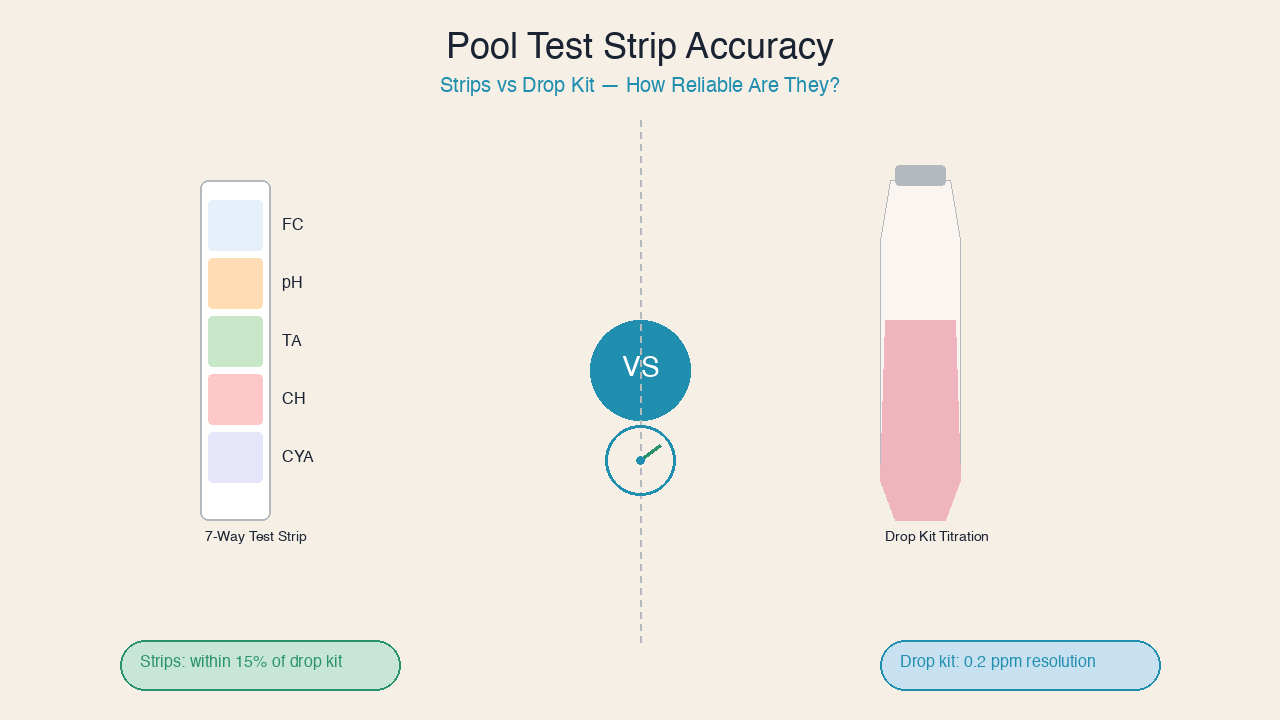
Pool test strips are accurate enough for routine weekly checks when fresh, dry, and read in daylight at the printed time window. A mid-tier strip typically lands within 15% of a Taylor K-2006 drop kit on free chlorine, pH, and total alkalinity. Strips lose accuracy after expiration, after 90 days opened, in humidity, or in dim light. For dose decisions that need a tight band, confirm the strip with a drop kit before adding chemicals.
What this is not
This is an accuracy article, not a buyer’s guide
This article answers “can I trust the strip in my hand right now?” — not “which strip should I buy?” For the buying decision, see our sister guide on how to choose pool test strips.
This is not a kit-type comparison
We do not re-litigate strips versus liquid versus digital here. That lives in our liquid test kits vs strips comparison. Here we assume you already own a strip and want to know whether today’s reading is trustworthy.
Accuracy is not a single chemistry parameter
This is not a deep dive on free chlorine, pH, or total alkalinity themselves — those have their own parameter hubs. We treat “accuracy” as a meta-parameter of measurement quality that sits alongside pool water testing, which covers what to measure and in what order.
What accuracy means for a pool test strip
The three layers of accuracy
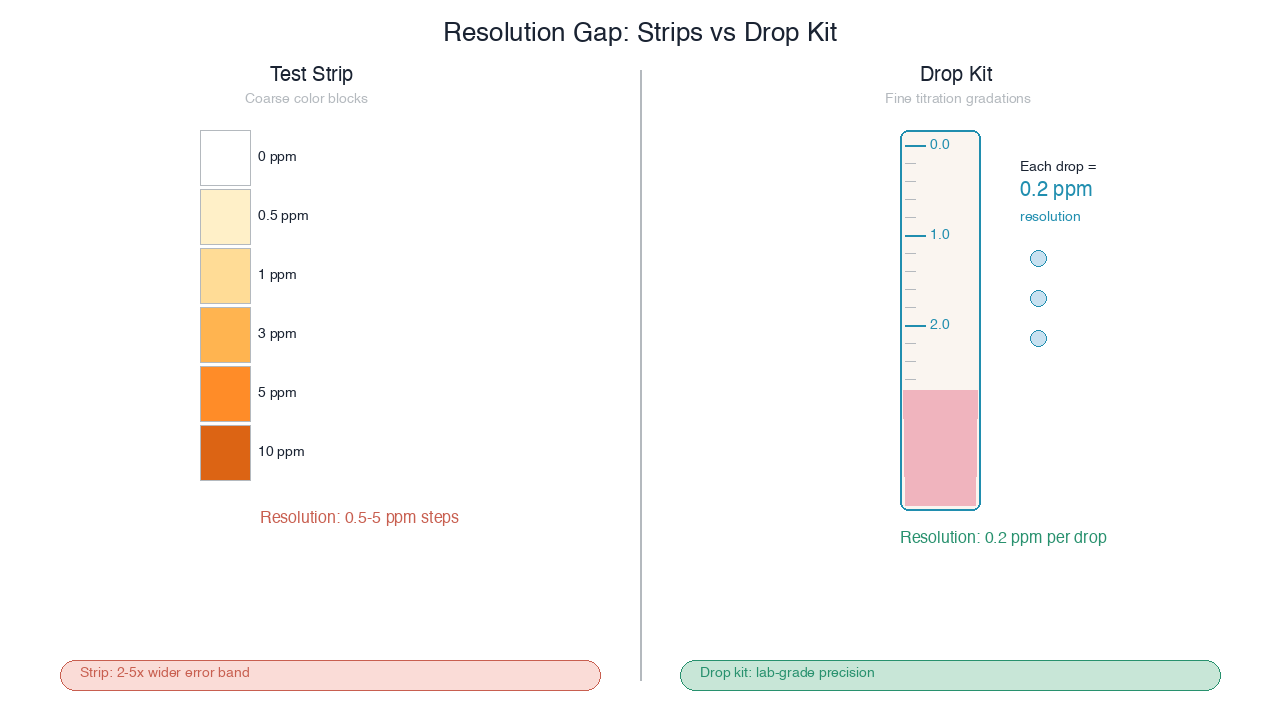
A test strip is a piece of paper with dried chemical reagents on each pad. “Accuracy” has three layers: trueness (how close the strip’s average reading is to a lab value), precision (how repeatable the same pad is across 10 dunks from the same sample), and resolution (the colour-block step size on the bottle chart). FC pads jump in 0.5 ppm increments, while a drop kit reads to 0.2 ppm. Strips are usually precise but have coarse resolution, which is why a 3 ppm FC reading on a strip and a 3.2 ppm on a Taylor K-2006C are not in conflict — they are reporting at different step sizes.
What accurate enough means in practice
For routine pool care (twice-weekly trend checks), “accurate enough” means the strip tells you whether FC is in the 1-5 ppm safe band, whether pH is in 7.2-7.8, and whether TA is roughly balanced. Strip precision is fine for that. Strips stop being accurate enough when you need to dose: adding 1 quart of muriatic acid to drop pH from 7.8 to 7.4 in 15,000 gallons requires knowing pH to within 0.05, which a strip cannot deliver. Cross-check any dose that depends on a tight band against a drop kit before adding chemicals, then verify with the chemical dose tool.
The 5 factors that affect pool test strip accuracy
Storage and expiration — the biggest accuracy killer
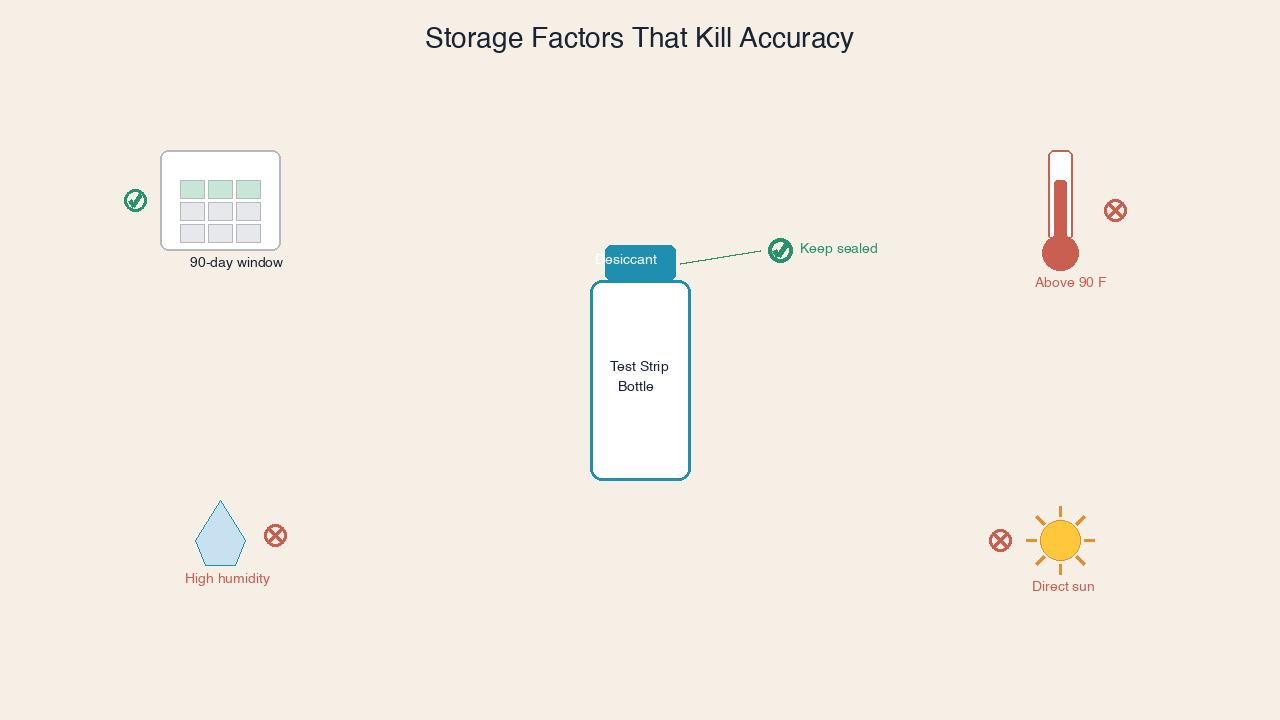
The reagent pads are hygroscopic — they absorb humidity from the air and degrade. An unopened bottle lasts 24-36 months from manufacture. An opened bottle loses meaningful accuracy after 90 days, even with the desiccant cap closed. Three storage mistakes destroy accuracy faster than expiration: leaving strips in a hot pool shed (above 90 degrees Fahrenheit), leaving them in direct sunlight, and opening the bottle poolside where humidity is 70% or higher. The bottle cap is a desiccant — keep it sealed between pulls.
Sampling and dipping technique
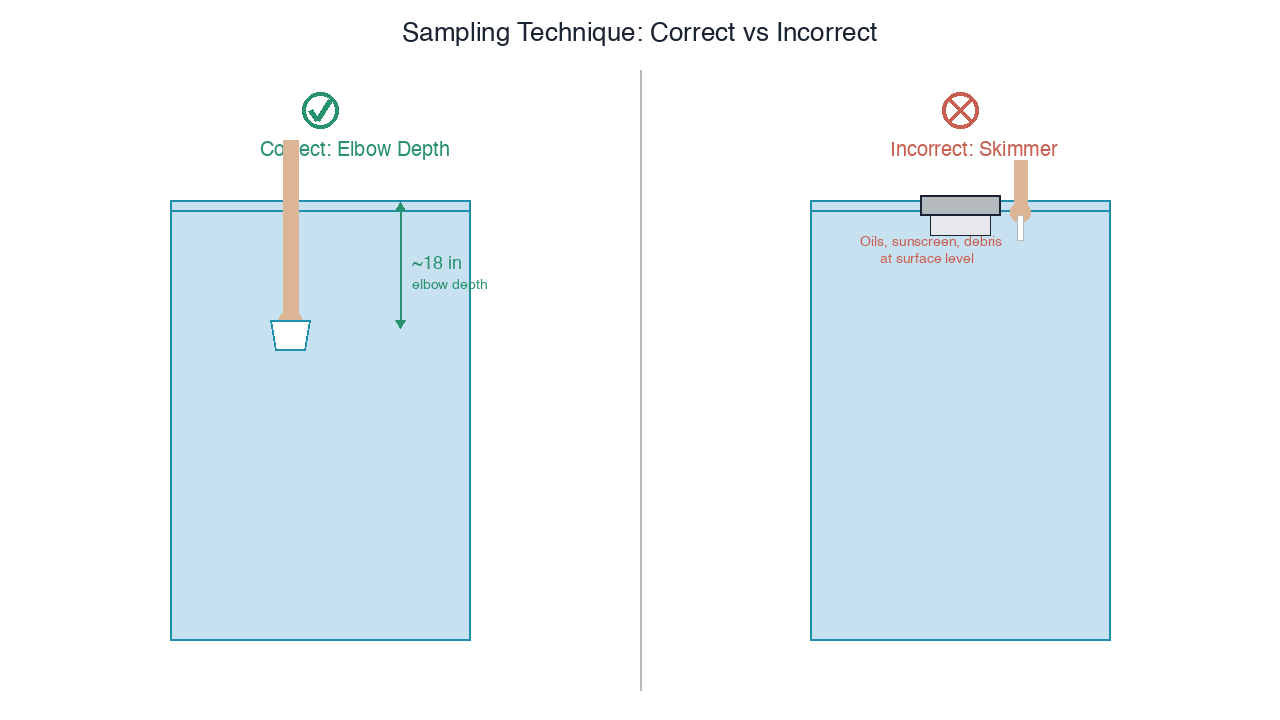
Strips are calibrated for elbow-depth sample water (about 18 inches below the surface), not skimmer water (which is concentrated by leaves, debris, and recently-added chemicals) and not surface water (affected by sunscreen, oils, and UV). Dip the strip statically for 1-2 seconds — do not swish, wave, or hold it under a return jet. Moving the strip through water washes reagent off the pad and shifts the colour read.
Reading timing and lighting
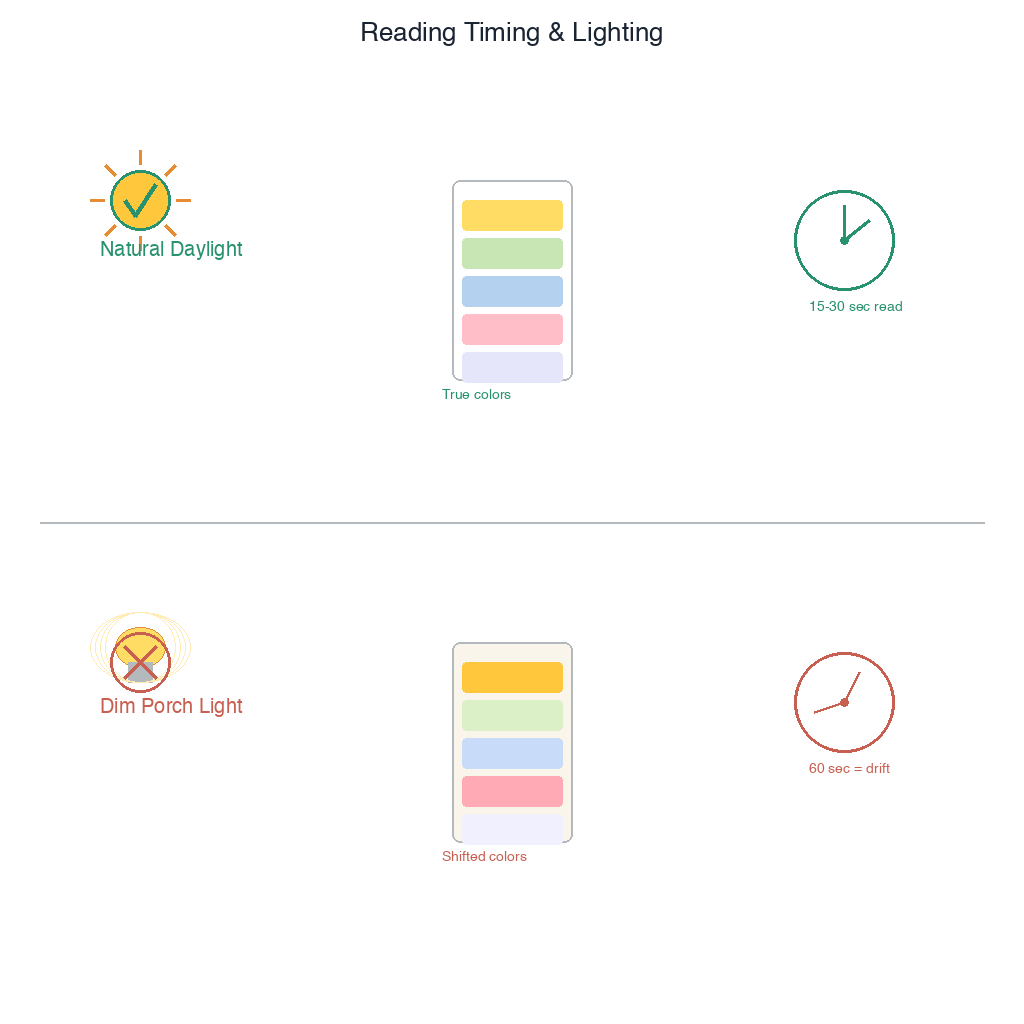
Each pad has a printed read window — usually 15 seconds for FC, 30 seconds for pH, longer for CYA. Reading too early understates the reaction. Reading late lets colour drift as the reagent keeps oxidising. Read strips in natural daylight (north-facing window or shaded outdoor area). Dim indoor lighting, warm porch bulbs, and coloured patio string lights all shift the perceived colour and produce phantom 0.5-1.0 pH errors.
Water chemistry interference
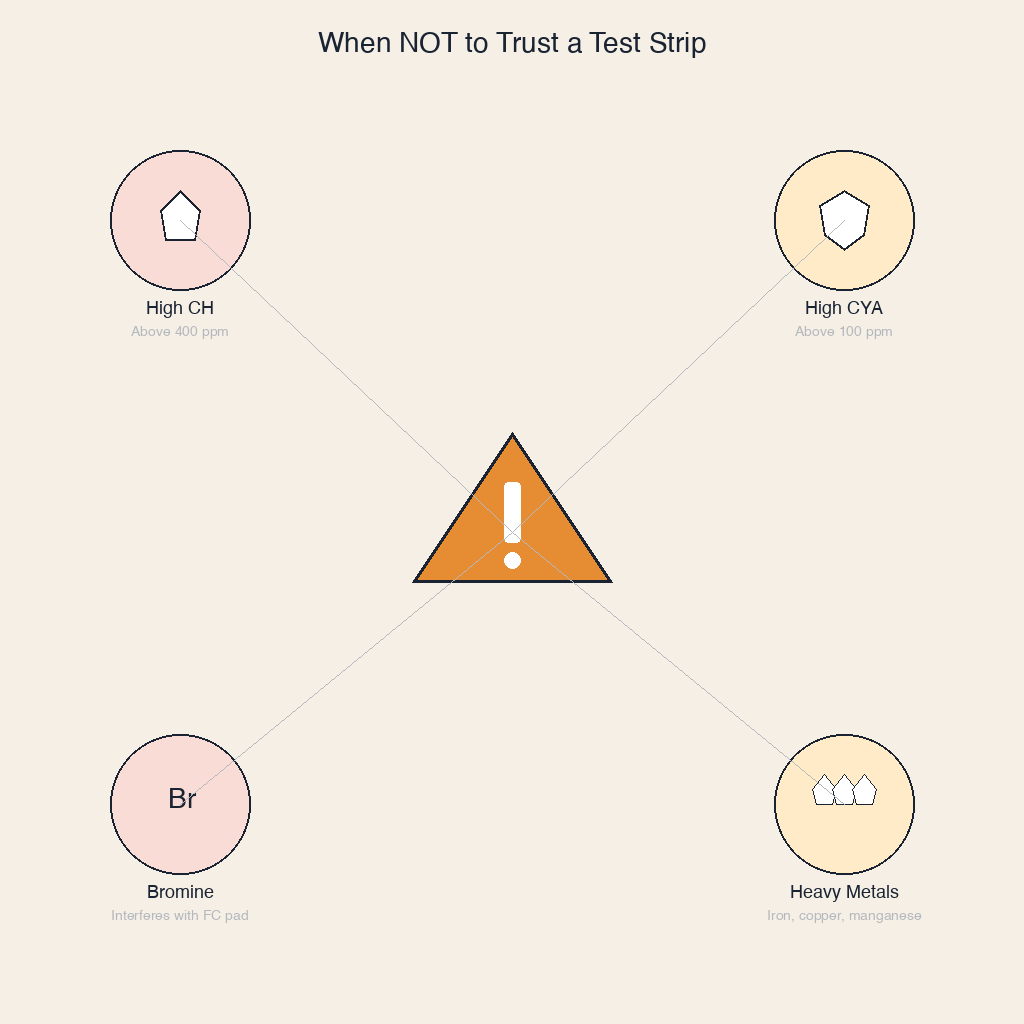
High calcium hardness (above 400 ppm), high cyanuric acid (above 100 ppm), very high bromine, and heavy metals (iron, copper from a heater or algaecide) all interfere with specific pads. The FC pad over-reads when CYA is high, and the pH pad shifts false-low in very soft water. The CYA pad is the least reliable pad on any strip — treat most strip CYA readings as “above 30 / above 50 / above 100” rather than as a precise ppm.
Brand and manufacturing quality
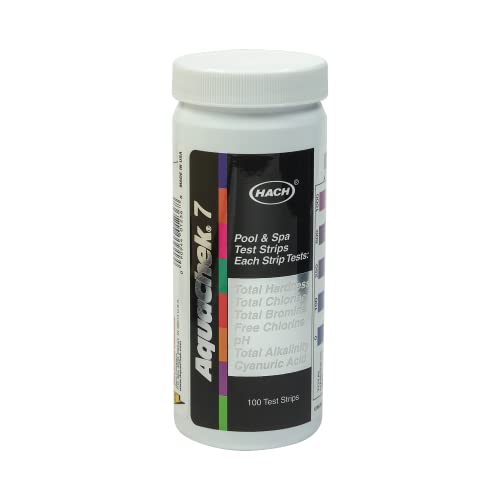
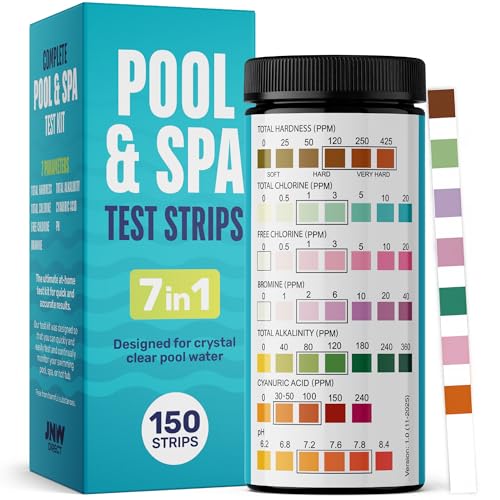
Not all strips use the same chemistry. AquaChek 7-Way Silver (US-made, 35+ years) uses a medical-industry paper substrate that controls colour bleed between pads. Budget imports can show pad bleed — the FC pad colour wicks into the pH pad and confuses the read. JNW Direct 7-Way uses a similar substrate but with looser QC. For accuracy-critical decisions, stick with one brand for a full season so you learn that brand’s colour quirks. Don’t switch brands mid-season and assume the new bottle reads the same.
Pad-by-pad accuracy: which pads can you trust?
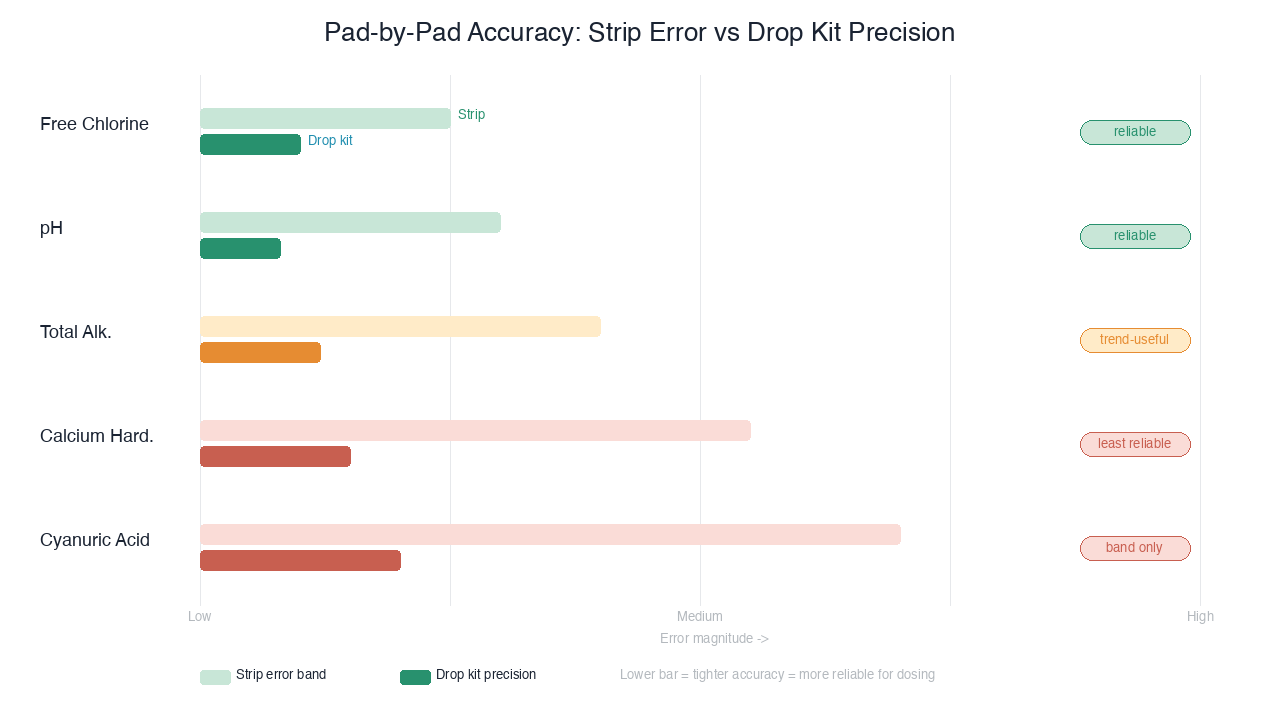
Free chlorine pad — generally reliable
Within 0.5 ppm of a drop kit for the 1-5 ppm range. Loses accuracy above 10 ppm FC (after shocking) — the pad saturates and reads “10” for anything 10-20. Wait until FC falls back below 10 before relying on the strip. For free chlorine parameter details, see the dedicated hub.
pH pad — reliable when read in daylight
Within 0.2-0.3 of a drop kit between pH 7.0 and 8.0. The pad is most sensitive at the 7.4-7.6 transition (colour steps are tightest there). False-low readings appear in very soft water (low TA). See the pH parameter hub for what each reading means.
Total alkalinity pad — coarser but trend-useful
Strips resolve TA in 30-40 ppm steps (0 / 40 / 80 / 120 / 180 / 240). Within about 30 ppm of a drop kit. Good enough for “is TA roughly balanced?” — not good enough for “is TA 90 or 110?” See the total alkalinity hub for dosing guidance.
Calcium hardness pad — least reliable of the 5
CH strips resolve in 250-ppm increments and are heavily affected by sample temperature. Treat CH strip readings as “low / OK / high” rather than as a number. For a real CH number, use a drop kit — see the calcium hardness hub.
Cyanuric acid pad — treat as a band, not a number
Strip CYA readings have a 20-50 ppm error band and are affected by water temperature and dip angle. Use the strip to confirm “is CYA above 30?” (the minimum for an outdoor chlorine pool) and “is CYA above 100?” (the dilute-or-drain trigger). For a precise CYA value, use the turbidity test in a drop kit — see the cyanuric acid hub.
Strips vs liquid kit accuracy: a lab-grade comparison
Taylor K-2006 vs AquaChek 7-way
A Taylor K-2006C drop kit resolves FC to 0.2 ppm, pH to 0.1, TA to 10 ppm, CH to 20 ppm, and CYA to 10 ppm via turbidity. An AquaChek 7-Way strip resolves FC to 0.5 ppm, pH to 0.3-0.4, TA to 30-40 ppm, CH to about 250 ppm, and CYA to 30-50 ppm. Strips are about 2-5x coarser than a drop kit on every parameter. The drop kit is also immune to humidity, lighting, and the wet-finger problem.
When the difference matters
For a homeowner doing weekly checks on a stable pool, the strip’s coarser resolution does not change the action: if FC reads 3, pH reads 7.5, and TA reads 100 on the strip, you don’t need the drop kit’s tighter read to know the pool is balanced. The drop kit earns its cost when (a) you are about to add chemicals and need a tight band, (b) the pool is unstable and you are troubleshooting, (c) you are tuning a salt cell where 0.2 ppm FC swings matter, or (d) you suspect the strip is wrong. Read our full kit-type comparison for the buying decision.
When NOT to trust a pool test strip
High calcium hardness — above 400 ppm
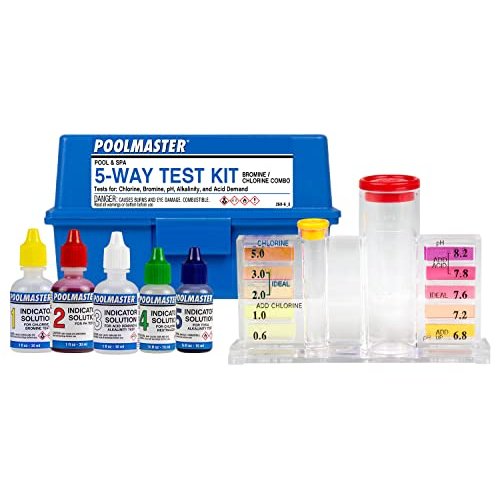
High CH suppresses the FC pad reaction and over-saturates the CH pad. If your fill water is hard and you haven’t drained in 2+ years, suspect CH interference on every strip reading. Confirm with a Poolmaster 5-Way drop kit before trusting the FC reading.
High cyanuric acid — above 100 ppm
High CYA makes the FC pad read high (false sense of security) and makes the CYA pad useless. Confirm CYA with a drop kit turbidity test before trusting an FC strip reading above 5 ppm.
Bromine-sanitized pools or hot tubs
Bromine cross-reacts with the FC pad — the strip reads bromine as chlorine at roughly 2x the actual bromine value. Use bromine-specific strips or a drop kit with a bromine reagent set.
Heavy metals — iron, copper, manganese
Metals from well water, copper algaecide, or a failing heater coil stain the pH and TA pads and produce false colours. If the water has a green or brown tint and metals are suspected, the strip is unreliable until metals are sequestered.
Strips past expiration or opened more than 90 days
Reagents decay. If you can’t remember when you opened the bottle, assume it is expired and replace it before trusting any reading.
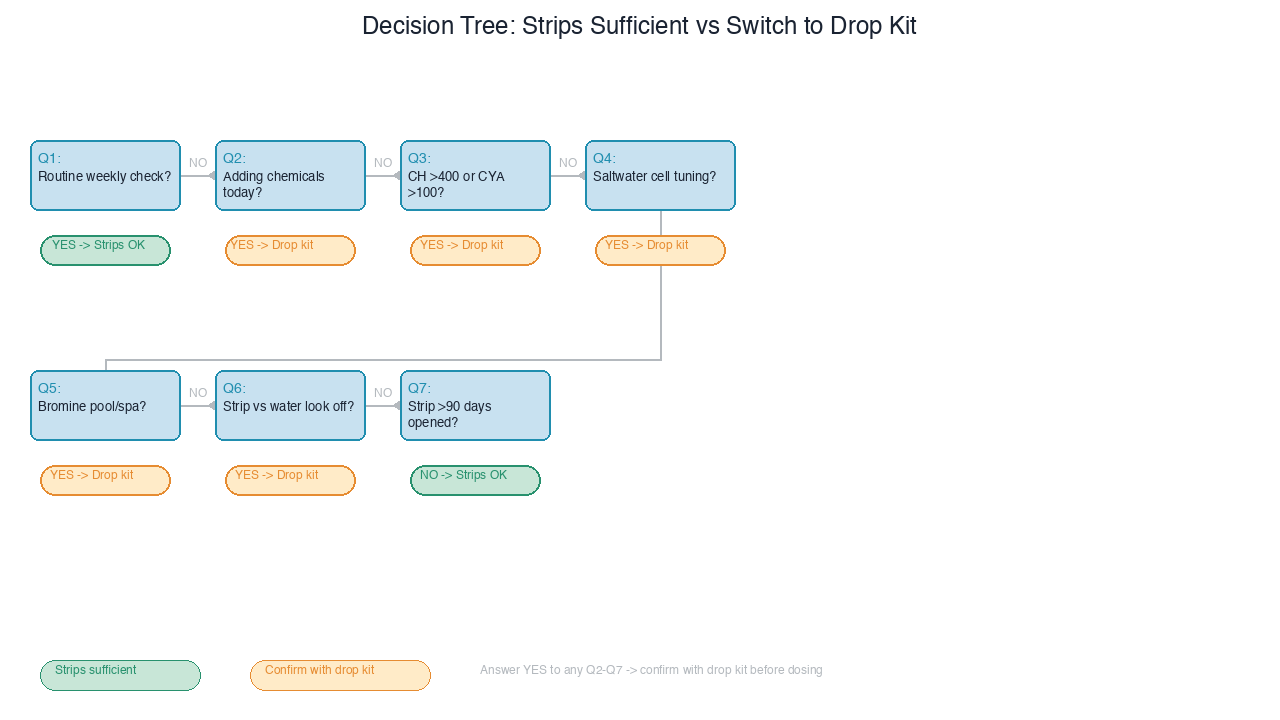
Decision tree: when strips are sufficient vs when to switch to a drop kit
Q1 — Routine weekly check on a stable pool?
Yes — strips are sufficient. Log the reading and move on. No — continue.
Q2 — Are you about to add chemicals?
Yes — confirm the relevant parameter with a Taylor K-2006C drop kit before dosing. The error band on a strip is too wide to dose precisely against. No — continue.
Q3 — Calcium hardness suspected above 400 ppm or CYA above 100 ppm?
Yes — drop kit only. Strip FC, CH, and CYA readings are unreliable in this range. No — continue.
Q4 — Saltwater pool being tuned for cell output?
Yes — drop kit plus salt test. Salt cells fine-tune within a 0.2 ppm FC band that strips cannot resolve. No — continue.
Q5 — Bromine pool or hot tub?
Yes — use bromine-specific strips or a drop kit with bromine reagent. Standard FC strips will false-read. No — continue.
Q6 — Strip result disagrees with how the water looks?
Yes — confirm with a drop kit. A clear pool with a strip reading of FC=0 is almost always a strip error, not a real zero. No — continue.
Q7 — Strips older than expiration date or opened more than 90 days?
Yes — replace the bottle before re-testing. Old strips produce confidently wrong readings. No — strips are sufficient for this check.
What you’ll need
To get the most accurate readings out of pool test strips you need three things: a fresh, well-stored strip bottle, a clean sampling cup (not the skimmer), and a daylight-lit reading spot. Add a drop kit for confirmation on dose days.
A fresh, mid-tier strip bottle
AquaChek 7-Way Silver is the reference strip most pool pros use for cross-checking: medical-grade paper, sealed desiccant cap, full 7 parameters including CYA. About $0.22 per test.
A budget 7-way for high-volume checking
JNW Direct 7-Way at $0.07 per test is the best value for homeowners who test 2-3 times per week and burn through strips. Open a fresh bottle every 90 days.
A drop kit for dose-day confirmation
Taylor K-2006C is the lab-grade kit that resolves FC to 0.2 ppm and CYA to 10 ppm. $145 upfront but reagents last 2-3 seasons and pay back the first time it prevents a wrong dose.
A clean sampling cup
A clean, rinsed plastic cup (any 16-oz deli cup works) to sample from elbow depth. Don’t sample from the skimmer basket.
Common mistakes
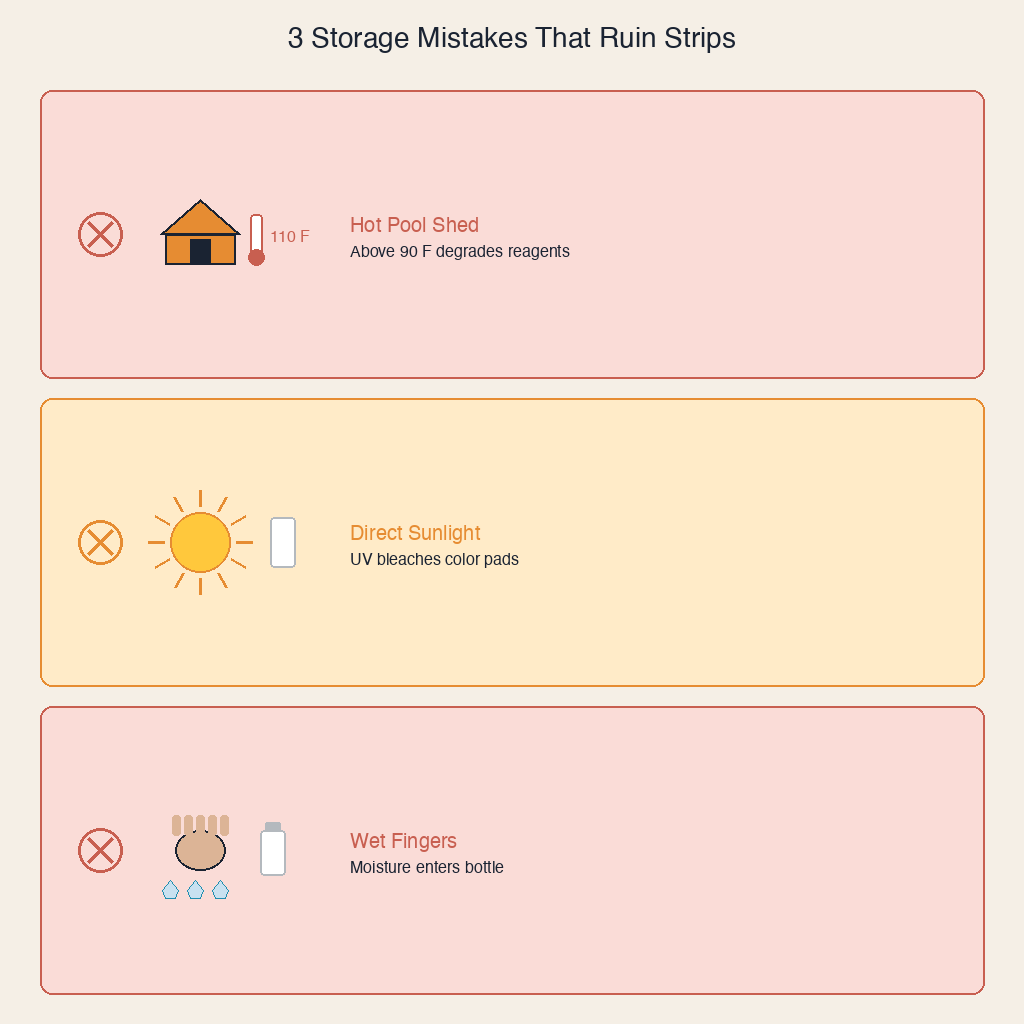
- Storing strips in a hot pool shed or direct sunlight. Heat above 90 degrees Fahrenheit and UV both accelerate reagent degradation. A bottle that lives in a 110-degree shed from June through August can read 30% or more off by mid-July, even if it is still in date. Store strips indoors in a climate-controlled cabinet.
- Reading the strip 30+ seconds after dipping. Every pad has a printed read window (15-30 seconds typically). After that, the reagent keeps oxidising and the colour drifts — usually toward a darker, falsely-high reading. Read at the printed time, every time.
- Reading strips in dim or coloured lighting. Warm porch bulbs shift the pH pad perceived colour by 0.5-1.0 unit. Read strips outdoors in natural daylight, in the shade (not direct sun, which can wash out pale colours).
- Dipping the strip in the skimmer or under a return jet. Skimmer water is concentrated by debris and recently-added chemicals (especially chlorine tablets in the skimmer). Return jets dilute the sample with freshly-chlorinated water. Sample from elbow depth in the open pool, in a clean cup.
- Trusting strips past the expiration date or past the 90-day open window. Reagents decay. An in-date bottle that has been open 6 months reads with the same drift as an expired bottle. Mark the open date on the bottle with a Sharpie and replace at 90 days.
What to buy only if needed
You don’t need to replace a working strip bottle just because you read this article. Buy only if your situation matches one of the branches below.
If your strips are past 90 days opened or past expiration
Replace with a mid-tier 7-way bottle. AquaChek 7-Way Silver is the safest single choice. JNW Direct 150-pack is the best budget pick if you test often.
If you are about to dose and need a tight error band
Add a Taylor K-2006C drop kit for confirmation. For saltwater pools, use a Taylor K-2006-SALT which adds a salt test — see the kit comparison.
If you are on a tight budget and just need a basic weekly check
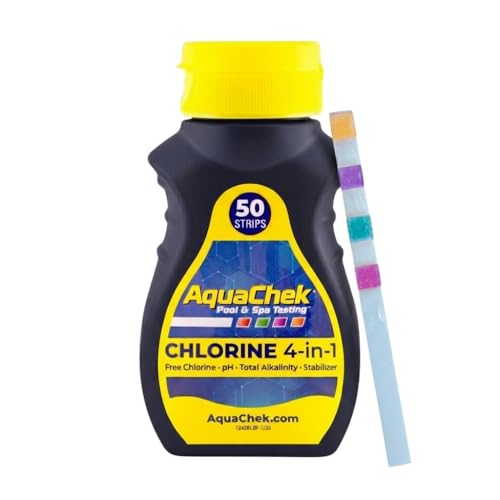
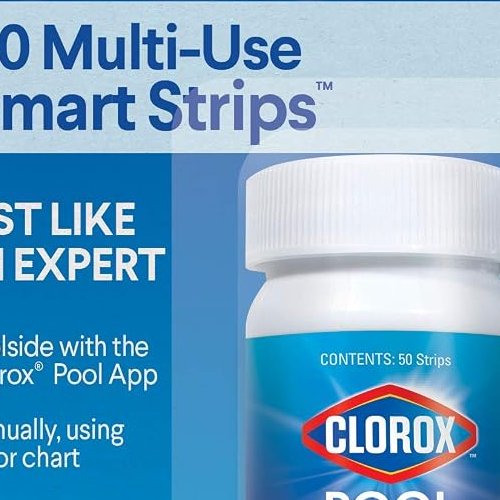
Clorox Pool and Spa 50-strip is a mid-tier brand-name pick at $12.98. AquaChek Yellow 4-Way drops calcium hardness if you don’t need it.
If you want a non-strip alternative without spending $145 on Taylor
Poolmaster 5-Way liquid kit at $23.65 is a titration-style drop kit that resolves FC to 0.5 ppm and pH to 0.2 — better than strips, much cheaper than Taylor.
Safety notes
Reagent pad disposal
Used test strips contain dried reagents (DPD, phenol red). They are not hazardous in single-strip quantities but should not be composted or left where pets can chew them. Trash is fine.
Liquid kit reagent safety
If you upgrade to a drop kit for confirmation, the reagents (especially the FAS-DPD titrant in a Taylor K-2006) are stronger chemicals. Wear gloves, avoid splashing eyes, store reagents out of reach of children, and never mix reagents from different kits. Mixing DPD reagents across brands can produce false readings and, in rare cases, exothermic reactions in the test vial.
When to call a pro
Call a pool service professional when (1) your drop kit and strip readings persistently disagree by more than the expected error band, (2) your water has visible metals staining that confounds every test, (3) your pool is on well-water fill with very high CH or iron and you need a lab-grade water test (most pool stores offer free computerised testing), or (4) you have shocked, balanced, and brushed but the water still fails to clear — at that point the problem is not chemistry you can read with a strip.
Related
- Pool water testing — what to test, in what order, and how often
- Free chlorine — what the FC reading means and what to do about it
- How to choose pool test strips — the buying decision that comes before this accuracy question
Key takeaways
- Fresh, dry, in-date strips read within 15% of a drop kit on FC, pH, and TA — fine for routine weekly checks.
- Strips lose accuracy fast after expiration, after 90 days opened, in heat, and in humidity — the most common cause of confidently wrong readings.
- Strip CYA and CH pads are coarse — treat them as bands, not numbers, and confirm with a drop kit before dosing.
- Read strips in natural daylight, at the printed time window, from an elbow-depth sample — not the skimmer, not under a return jet.
- Use a strip for the trend; use a drop kit for the dose. Any chemical addition that depends on a tight error band should be cross-checked.
- High CH (above 400 ppm), high CYA (above 100 ppm), bromine pools, and metals all interfere with specific pads — identify interference before trusting a reading.
- When the strip and the water disagree, trust the water and re-test with a drop kit.