Quick answer
Pool test strips tell you what’s in your water in about 15 seconds — pH, chlorine, alkalinity, and sometimes cyanuric acid (CYA). You don’t need the biggest pack or the most pads. Most pool owners need a 7-way strip that covers the core readings. Saltwater pools add salt to that list. Buy enough for twice-weekly testing, check the expiration date, and store them dry. Here’s how to avoid paying for pads you’ll never read.
What “good enough” testing means for homeowners
Test strips are semi-quantitative. They give you a range — pH 7.2 or 7.4, free chlorine at 1 or 3 ppm — not a lab-precise decimal. That’s fine for routine maintenance. You need to catch a pH swing before it etches your plaster, not publish a research paper.
Liquid drop kits are more precise. They titrate to a clean color change that’s easier to read in low light. But they take longer, cost more per test, and require more technique. For 90% of weekly checks, a decent strip gets you the answer fast.
The other 10% — green water, persistent imbalance, a reading that doesn’t match what you see — calls for a liquid kit or a pool store test. Strips screen. They don’t diagnose complex problems on their own.
What test strips are (and what they’re not)
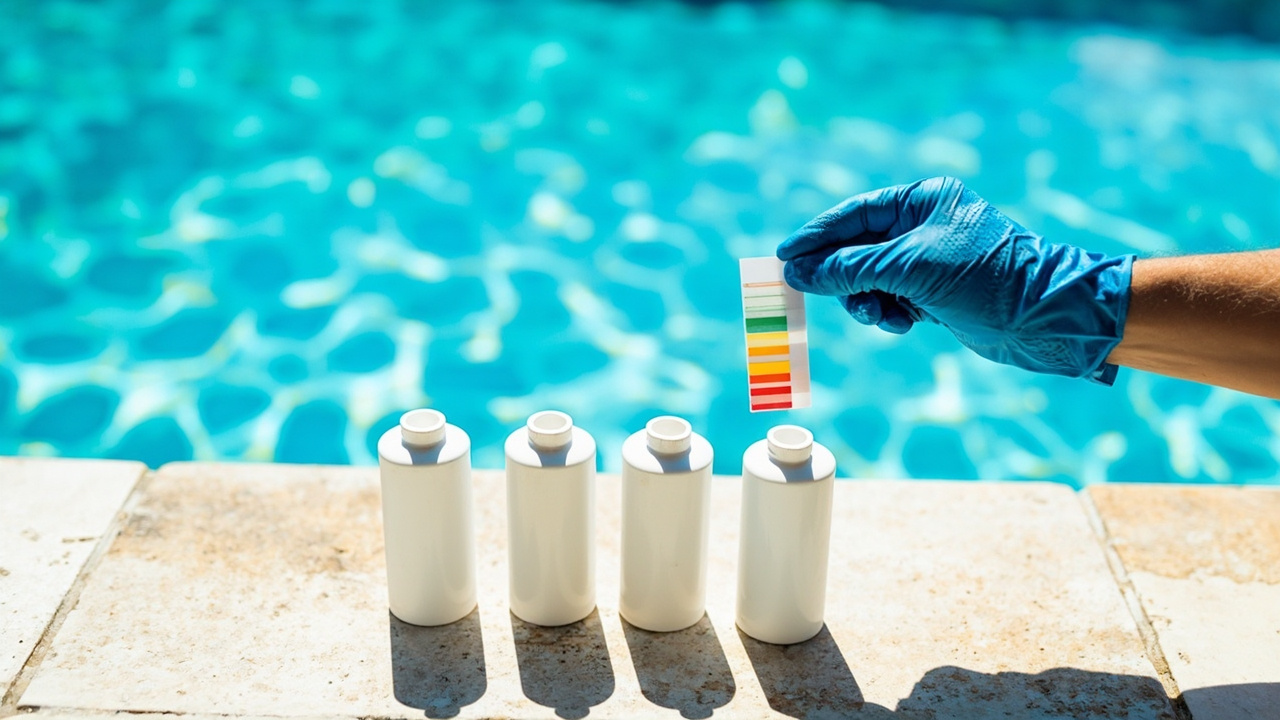
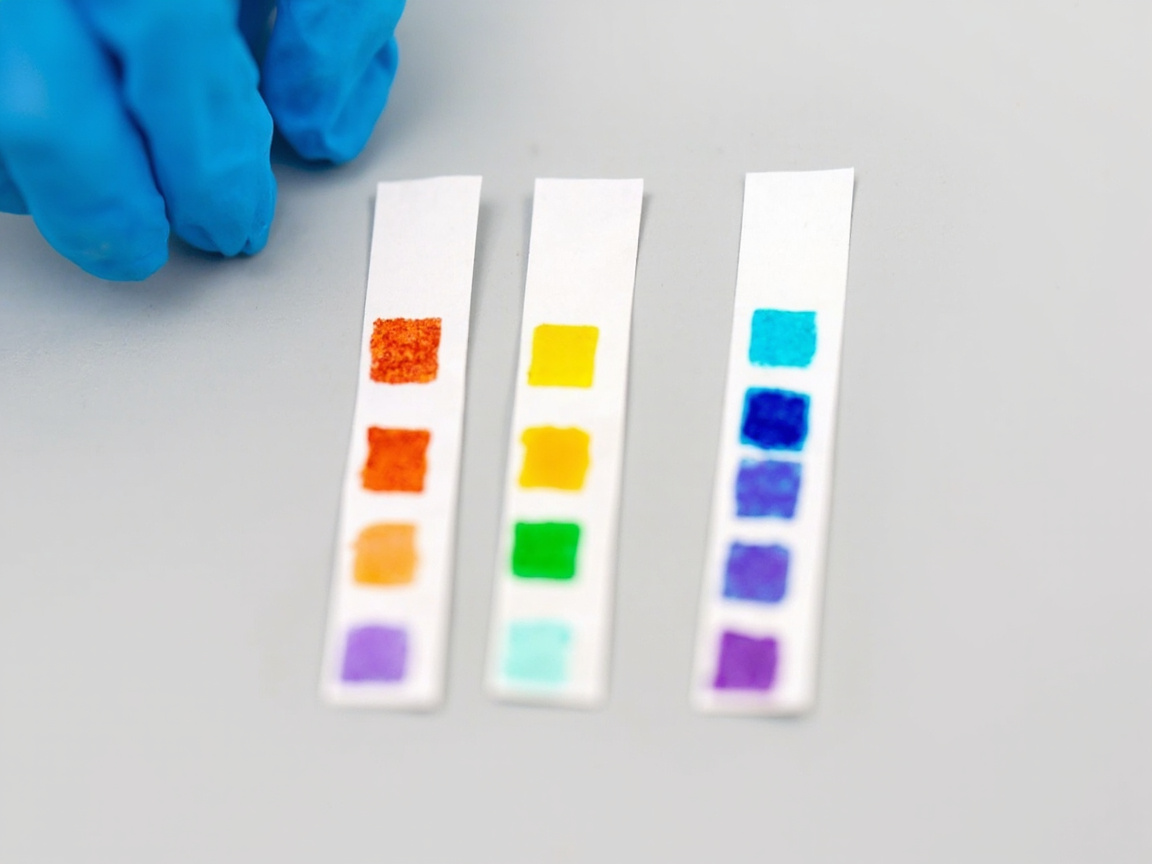
Strips are dip-and-read color pads. You dunk one for 1–2 seconds, wait 15–17 seconds, and match pad colors to the bottle chart.
What strips are not:
- Not a liquid drop kit. Liquid kits use reagent drops titrated to a precise color-change endpoint. More accurate, but slower and harder to read at dusk. Strips trade precision for speed.
- Not a digital reader. Digital testers use photometric sensors to read chemical levels electronically. Most precise, most expensive, and overkill for routine home testing.
- Not a diagnostic tool for sick water. If your pool is green or cloudy, strips tell you part of the story. Confirm with a liquid kit before dosing based on a color match that might be off by half a shade.
Decision tree: which strip fits your pool
Six common situations. Pick the one that matches your setup — each points to a different strip type.
Do you have a saltwater pool?
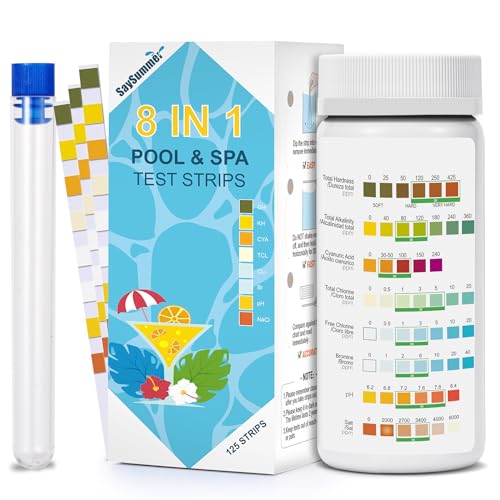
If yes, you need a strip that reads salt (sodium chloride) alongside the standard parameters. Standard 7-way strips don’t read salt. Without that reading, you can’t tell if your salt cell is producing chlorine at the right output — salt should sit between 2,700 and 3,400 ppm. Look for an 8-way strip like the SaySummer Salt-Water 8-in-1, or use a dedicated salt tester alongside your regular strips.
Skip if: You have a standard chlorine pool — the salt pad is wasted money.
Do you only check chlorine and pH?
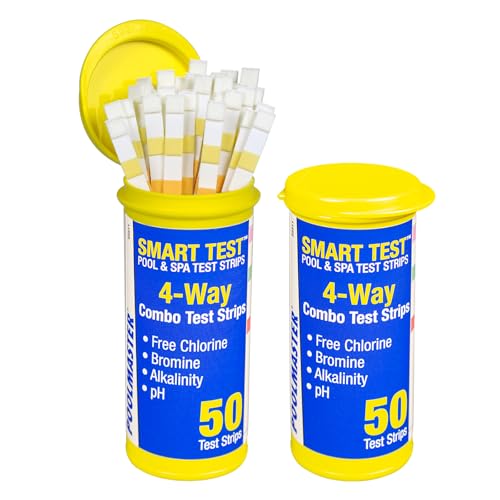
Small above-ground pool, short season, water generally stable? A basic 4-way strip covers pH, free chlorine, total alkalinity, and sometimes CYA. That’s the minimum viable test. The Poolmaster 4-Way reads FC, pH, TA, and bromine — no CYA, but for a simple seasonal pool, that’s often enough.
Skip if: You use trichlor tablets — you need CYA tracking (see next branch).
Do you need CYA tracking?
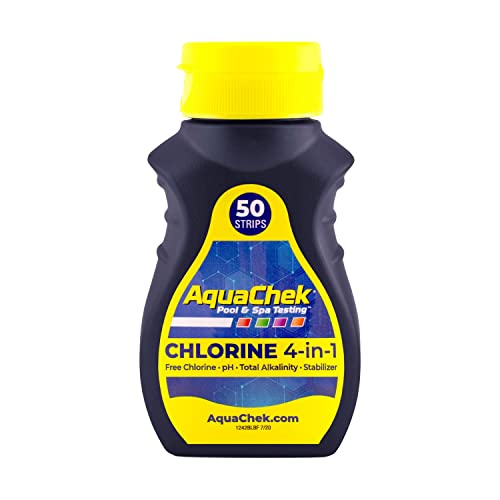
If you use trichlor tablets or dichlor, cyanuric acid builds up over time. As CYA rises, the free chlorine level needed for adequate sanitation rises too. You need a strip that reads CYA — that means a 4-way with CYA like AquaChek Yellow, or a full 7-way. If you only use liquid chlorine or a salt cell, CYA can still change through dilution or additions, so check it regularly.
Skip if: You just opened a fresh fill with no CYA added yet — test it once to get a baseline, then monitor quarterly.
Want a full chemistry panel?
A 7-way strip reads pH, free chlorine, total chlorine, total alkalinity, calcium hardness, CYA, and bromine. That covers everything a chlorine or saltwater pool needs for routine care. If you’re balancing water from scratch, fighting recurring issues, or just want the full picture each week, 7-way is the sweet spot.
Skip if: You already own a liquid kit for precision work — use strips for quick checks and drops for deep dives.
Testing multiple pools or on a tight budget?
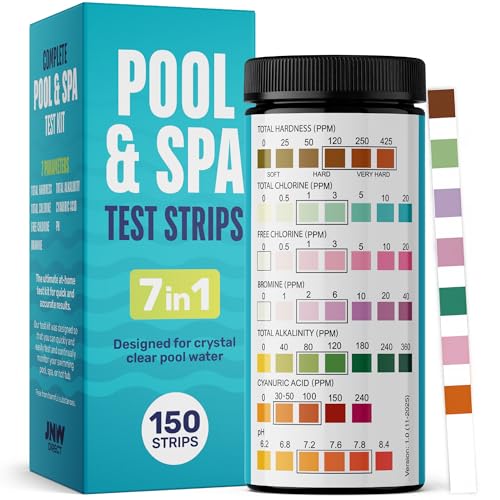
If you test 2–3 times per week, manage more than one pool, or just don’t want to think about reordering, a bulk pack of 150 strips makes sense. The JNW Direct 7-in-1 gives you 150 strips for under $9 — roughly $0.06 per test. Just make sure you can use them before the 90-day post-opening window.
Skip if: You test once a week or less — 150 strips will expire before you finish the bottle.
Want app logging and trend tracking?
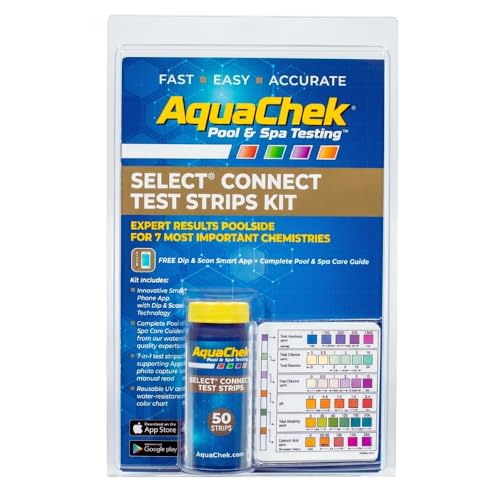
Some strips pair with a phone app that reads color pads through your camera and logs results over time. The AquaChek Select Connect does this via Bluetooth. The app isn’t perfect, but the trend chart is genuinely useful if you’re tracking recurring imbalances over a season. More expensive per strip, so it’s a tool for data-minded owners, not casual testers.
Skip if: You just want a quick chlorine check — the app adds steps you don’t need.
Features that matter (and which ones don’t)
Parameter count: 4-way vs 7-way vs 14-way
4-way (pH, FC, TA, CYA): Bare minimum. Good for simple pools where you mainly need to know chlorine is working and pH isn’t crazy.
7-way (adds total chlorine, calcium hardness, bromine): Covers everything a chlorine or saltwater pool needs. This is where most owners should land.
14-way (adds iron, copper, phosphates): Overkill for routine home testing. Metal and phosphate readings are better done by a pool store lab once per season. Don’t pay for pads you can’t act on accurately.
Read speed and pad quality
All strips work the same way: dip, wait 15–17 seconds, compare to the color chart. Quality shows up in pad separation — cheap strips bleed between adjacent pads, making it hard to tell if your total alkalinity pad is reading 80 or 120. Name brands like AquaChek and JNW tend to have cleaner pad separation.
Reading under natural daylight matters more than strip brand. Fluorescent light shifts color perception — the same strip looks different under a pool shed bulb than it does outside. If two people disagree on a reading, lighting is usually why.
Expiration and shelf life
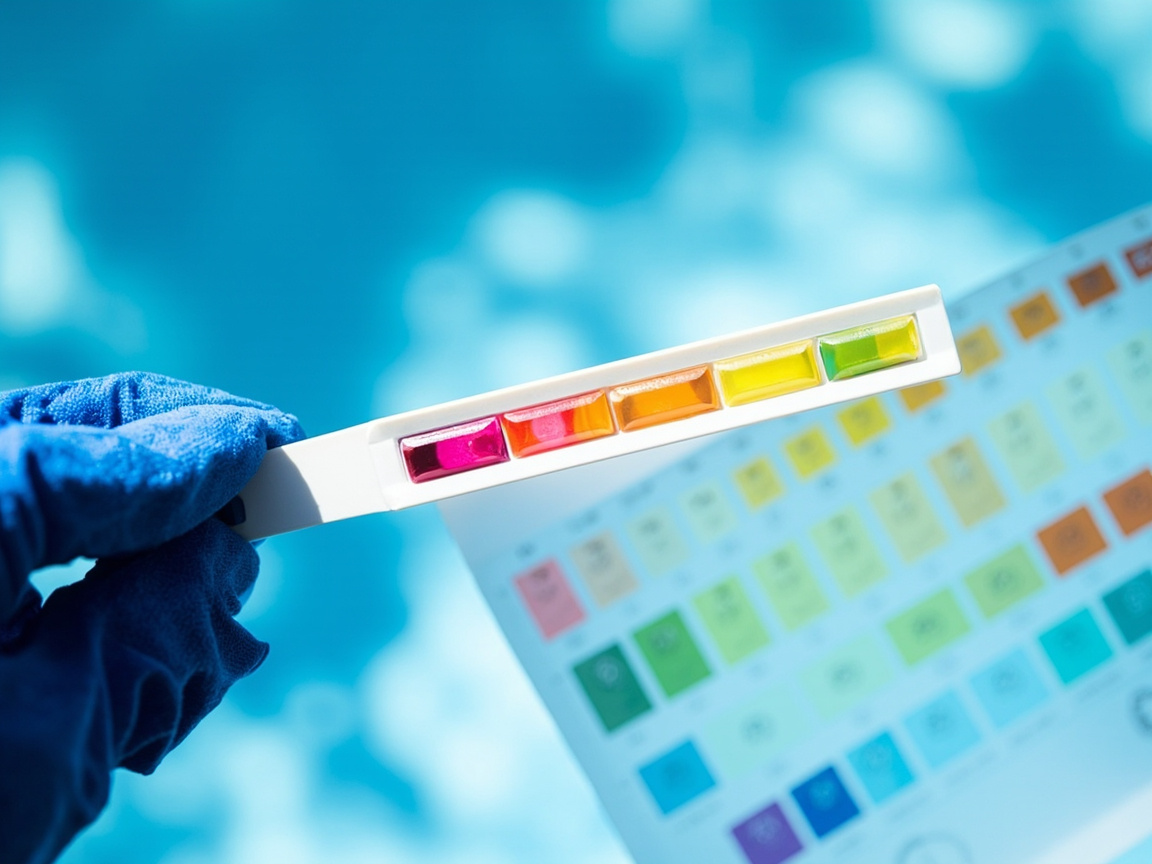
Strip reagent pads degrade over time. Sealed bottles last 2–3 years. Once opened, use within 90 days — some stretch that to 6 months, but moisture is the real enemy. A bottle stored in a humid pool shed degrades faster than one kept indoors.
Check the printed expiration date before buying. If a bulk deal looks too good, the strips might be near expiration. A 150-count bottle is only a bargain if you can use them before they go stale.
Price per test
Calculate cost per strip, not per bottle:
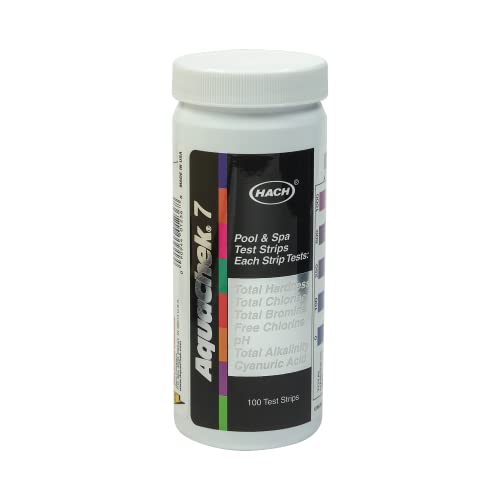
- AquaChek 7-Way: $22 for 100 strips = $0.22/test
- JNW Direct 7-in-1: $8.49 for 150 strips = $0.06/test
- AquaChek Select Connect: $21.95 for 50 strips = $0.44/test
A $0.06 test that lies because the strip is expired costs more than a $0.22 test that’s right. Price per test only matters if the strip is fresh.
What to skip (avoid over-buying)
Skip 14-way strips unless you have a specific metal or phosphate problem
14-way strips include iron, copper, and phosphates. If your fill water has known metals or you’re fighting persistent algae that won’t respond to chlorine, these readings can point you in the right direction. Otherwise, you’re paying for pads you’ll never read accurately — and acting on a false phosphate reading leads to unnecessary chemical purchases.
Get a pool store metals test once per season instead. It’s more reliable and usually free.
Skip strips bundled with spa-only parameters
Some “pool and spa” strips list bromine as a headline feature. Bromine is for hot tubs, not chlorine pools. It doesn’t hurt to have the pad on the strip, but don’t pay extra for it — a 7-way strip that happens to include bromine is fine. A “premium bromine” strip marketed at pool owners isn’t.
Skip bulk packs if you can’t use 150 strips in 90 days
A 150-count bottle is only cheaper if the strips don’t expire first. If you test once a week, 150 strips last nearly 3 years — long past their useful life. Buy 50–100 count unless you manage multiple pools or test daily during peak season.
Our picks by scenario
Best standard 7-way for chlorine pools
AquaChek 7-Way Silver — 100 strips, reads pH, FC, TC, TA, CH, CYA, and bromine. Consistent pad quality, clear color chart, and the brand most pool professionals reach for. At $0.22 per strip, it’s pricier than budget options, but the pad separation and color development are noticeably better. This is the strip to buy if you want one bottle that covers your entire season.
Skip if: You test more than twice a week — the 100-count won’t last, and you’d be better off with the JNW bulk pack.
Skip if: You have a saltwater pool — you need salt readings that this strip doesn’t provide.
Best budget 7-way (high-volume testers)
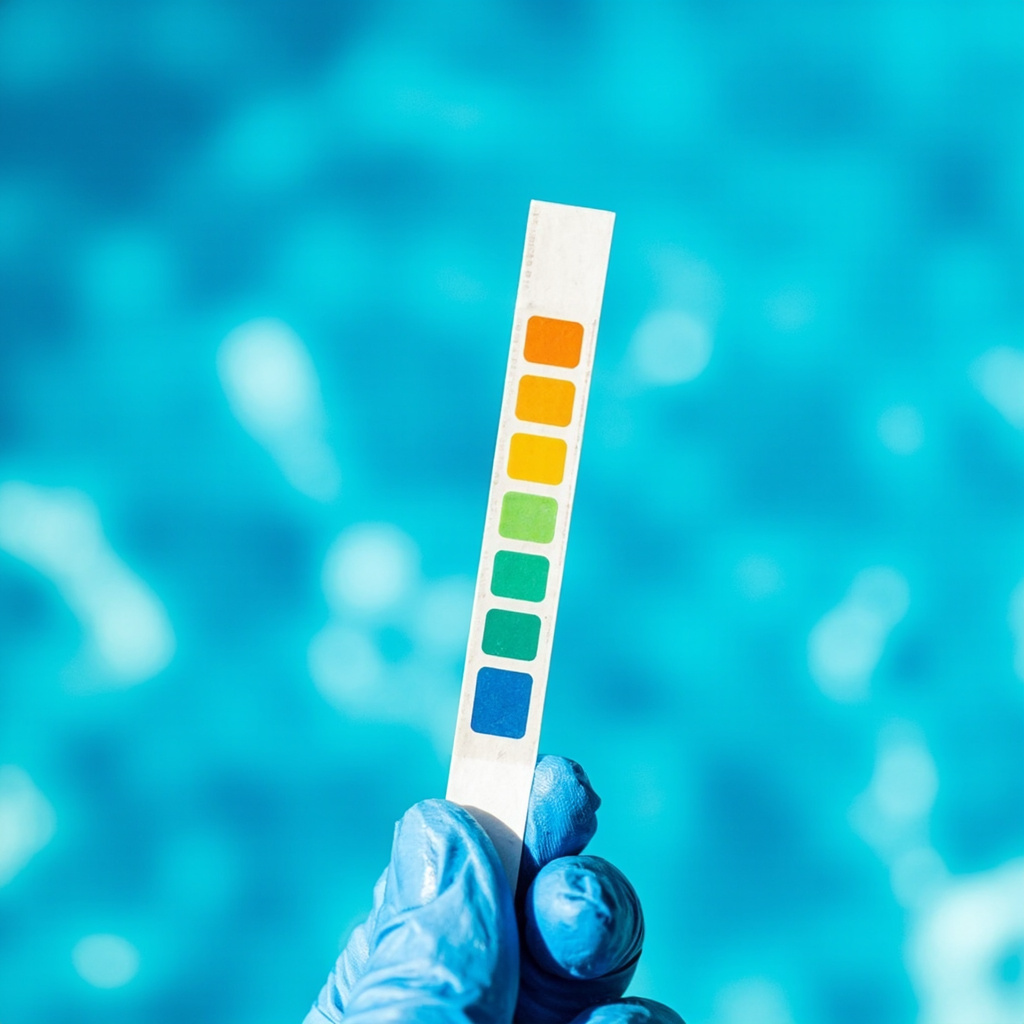
JNW Direct 7-in-1 — 150 strips for under $9. Reads the same seven parameters as the AquaChek Silver. Pad consistency isn’t quite as sharp, but for routine screening at $0.06 per test, it’s hard to beat. Best for owners who test 2–3 times per week and burn through strips fast.
Skip if: You want the most precise color match — the AquaChek Silver has tighter pad quality control.
Skip if: You test less than once a week — you won’t finish 150 strips before they degrade.
Best for saltwater pools
SaySummer 8-in-1 Salt — 125 strips that add salt (sodium chloride) to the standard 7 parameters. Essential for salt cell owners who need to verify salt levels stay in the 2,700–3,400 ppm range. Don’t rely on your salt cell’s “low salt” alarm alone — confirm with a strip. Your cell can read “fine” while actual salt has drifted outside the window.
Skip if: You have a chlorine pool — the salt pad is useless.
Skip if: You already own a dedicated salt tester — duplicate readings waste a pad.
Best basic 4-way (minimalists)
AquaChek Yellow 4-Way — 50 strips reading pH, FC, TA, and CYA. The minimum viable test for a simple chlorine pool. CYA inclusion is the key differentiator — many cheap 3-way strips skip it, and without CYA, you can’t tell if your chlorine is actually protected from sunlight.
Skip if: You have recurring water balance issues — you need calcium hardness and total chlorine readings that 4-way doesn’t offer.
Skip if: You’re opening a pool for the season — get a 7-way for the initial balancing, then switch to 4-way for maintenance.
Best app-connected option
AquaChek Select Connect — 50 strips with Bluetooth app connectivity. The app reads color pads through your phone camera and logs results over time. At $0.44 per strip, it’s the most expensive option here. But if you’re the type who wants to look back at three months of pH trends to figure out why algae keeps returning, the logging feature pays for itself.
Skip if: You just want a quick answer — the app adds steps you don’t need for a 15-second check.
Skip if: You don’t own a smartphone or don’t want to deal with pairing — stick with visual reading.
What you’ll need
To test accurately with strips, you need three things beyond the strips themselves:
-
The right strips for your pool. Chlorine pool? Start with AquaChek 7-Way Silver. Saltwater? Get the SaySummer 8-in-1. Budget tight? The JNW 7-in-1 bulk pack works for frequent testers.
-
Natural daylight. Read strips outside or near a north-facing window. Pool shed lighting shifts colors enough to cause misreads — especially on the pH pad, where half a shade changes the number.
-
The bottle’s color chart. Don’t lose it. Each brand’s chart is calibrated to its own pad chemistry. You can’t match a JNW strip to an AquaChek chart and expect an accurate read.
New to pool care? Start with the first-year pool owner routine — it covers how testing fits into your weekly schedule.
Common mistakes
- Testing with wet fingers — false high readings.
- Not reading the strip fast enough — colors drift after 30 seconds.
- Reading in bad lighting — fluorescent and LED shift color perception.
- Using expired strips — false low readings or no color change.
- Relying on strips for complex problems — confirm with a liquid test.
1. Testing with wet fingers
Moisture from your fingers activates the reagent pads before the strip hits the water. You get false readings — usually high. Grab the strip by the end opposite the pads, and keep your fingers dry. If you touch a pad, toss the strip and grab a fresh one.
2. Not reading the strip fast enough
Pads keep reacting after the recommended wait time. Read at 15–17 seconds — check your bottle for the exact number. After 30 seconds, colors drift and the reading is unreliable. Set a phone timer. Counting in your head isn’t accurate enough.
3. Reading in bad lighting
Fluorescent and LED lights shift color perception. Incandescent bulbs make everything look yellow. Natural daylight — outdoors in shade or near a north-facing window — gives the most accurate color match. This is the number one reason two people look at the same strip and disagree.
4. Using expired strips
Expired pads give false readings — often reading low when the actual level is fine, or showing no color change at all. If your free chlorine reading suddenly looks perfect but the pool is turning green, check the expiration date. Toss any bottle past its printed date or opened more than 6 months.
5. Relying on strips for complex problems
Strips are screening tools. If water is green, cloudy, or has a persistent imbalance you can’t fix, take a sample to a pool store for a liquid or titration test before adding chemicals. A wrong strip reading leads to wrong dosing — and that costs more than the free pool store test.
Safety notes
- Store strips in their original bottle with the desiccant packet inside. Moisture ruins the reagent pads — a damp strip gives a false reading before it ever touches pool water.
- Keep out of reach of children. The reagent chemicals are low-toxicity but not food-safe.
- Don’t use strip readings as the sole basis for adding acid or chlorine. Misreading a strip and then overdosing muriatic acid can etch your pool surface and corrode equipment.
- If a strip reading seems impossible — pH 6.0 in a pool that was fine yesterday — don’t dose based on it. Retest with a fresh strip, or take a water sample to a pool store.
Related
- Pool water testing — the full testing hub: when to use strips vs liquid kits vs digital readers, and what order to read your results
- Weekly pool care — where testing fits in your routine and how often to check each parameter
- Chemical dose calculator — after you test, dose correctly based on your pool volume and current readings
Key takeaways
- A 7-way strip covers most routine pool testing needs for chlorine pools. Saltwater pools also need a salt reading, either on the same strip or from a separate salt test.
- Saltwater pools need a strip that reads salt — standard 7-way strips don’t. Target 2,700–3,400 ppm.
- CYA is essential if you use trichlor tablets. Don’t buy strips that skip it — aim for 30–50 ppm.
- Read strips at 15–17 seconds in natural daylight. Lighting is the number one cause of misreads.
- Expired or moisture-damaged strips give false readings. Toss bottles opened more than 6 months.
- Price per test matters more than price per bottle — a cheap strip that lies costs more than a reliable one.
- Use strips for screening. Confirm complex problems — green pool, cloudy water, persistent imbalance — with a liquid kit or pool store test before dosing.