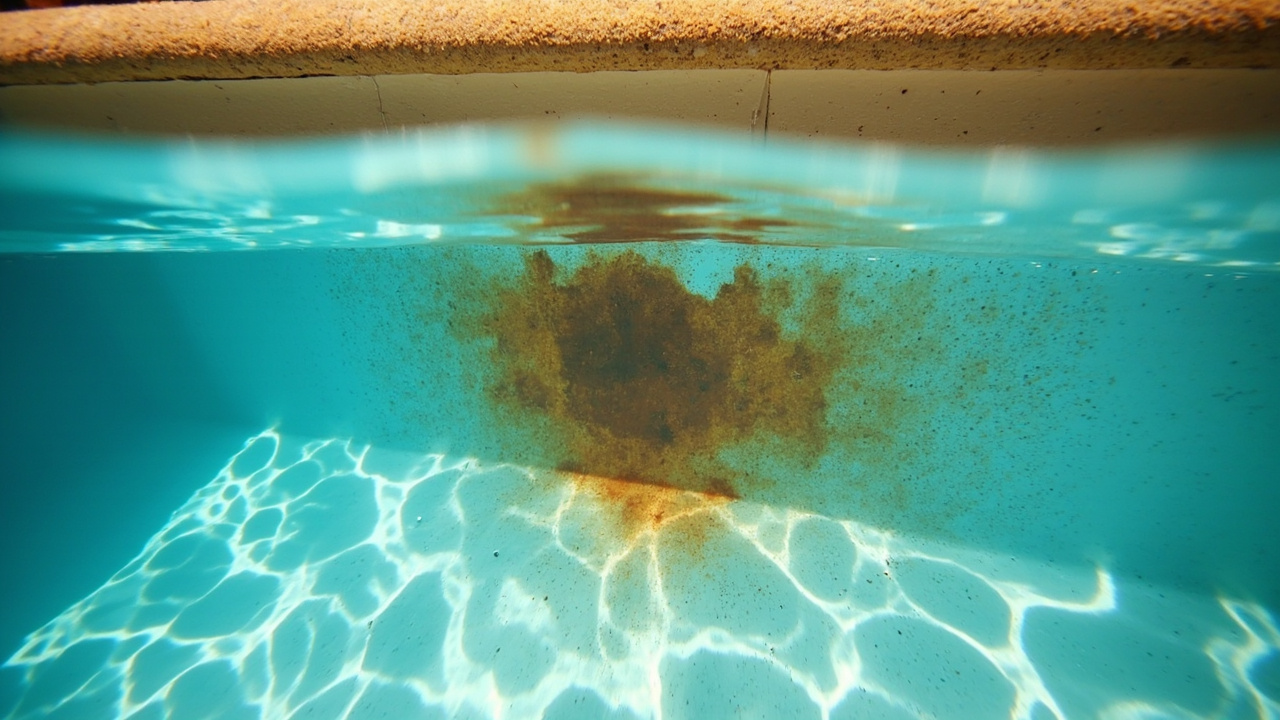
Pool metal stains look like decoration until you realize they’re getting darker and spreading. The fix is two parts: treat the existing stain with a reducing agent (ascorbic acid is the gold standard), and find the source so the stain doesn’t come back in 6-12 months. Skip the source-control step and you’ll redo the treatment every season. Skip the reducing step and the sequestrant alone won’t touch the existing discoloration.
Quick answer
Pool metal stains fall into three types by color: rust-brown = iron, teal-blue-green = copper, purple-black = manganese. Confirm with the vitamin C test — hold a crushed 500 mg tablet on the stain for 30 seconds. If it fades, it’s metal. Treat iron and copper with ascorbic acid + a sequestrant to lock the metal in solution. Find the source — fill water, corroding heater, or old copper algaecide — or stains return in 6-12 months.
What pool metal stains are (and are not)
Metal stains are a specific type of discoloration. They look similar to a few other things, and treating the wrong problem wastes the treatment.
What metal stains ARE
Localized discoloration on walls, floor, or steps that does NOT brush off and is NOT caused by algae. Caused by iron, copper, or manganese oxidizing in the water and depositing on surfaces. Stain color is the giveaway — see the 3-metals section below.
What they are NOT
Not scale — scale is white-grey and rough; metal is colored and smooth. See the pool scale stains (calcium sister hub) for the calcium side. Not algae — algae is solid green water or fuzzy growth; metal stains are localized color patches. See the green pool (algae sister hub) for the algae side. Not dye or chemical residue — algaecide overuse can leave green patches but those brush off. Not phantom — a stain that appears and disappears is usually iron precipitating and re-dissolving as pH shifts.
The 3 metals, by color
Color is the first diagnostic. Three metals cause the vast majority of residential pool stains, and each has a distinctive color and source.
Iron — rust-brown / red-brown
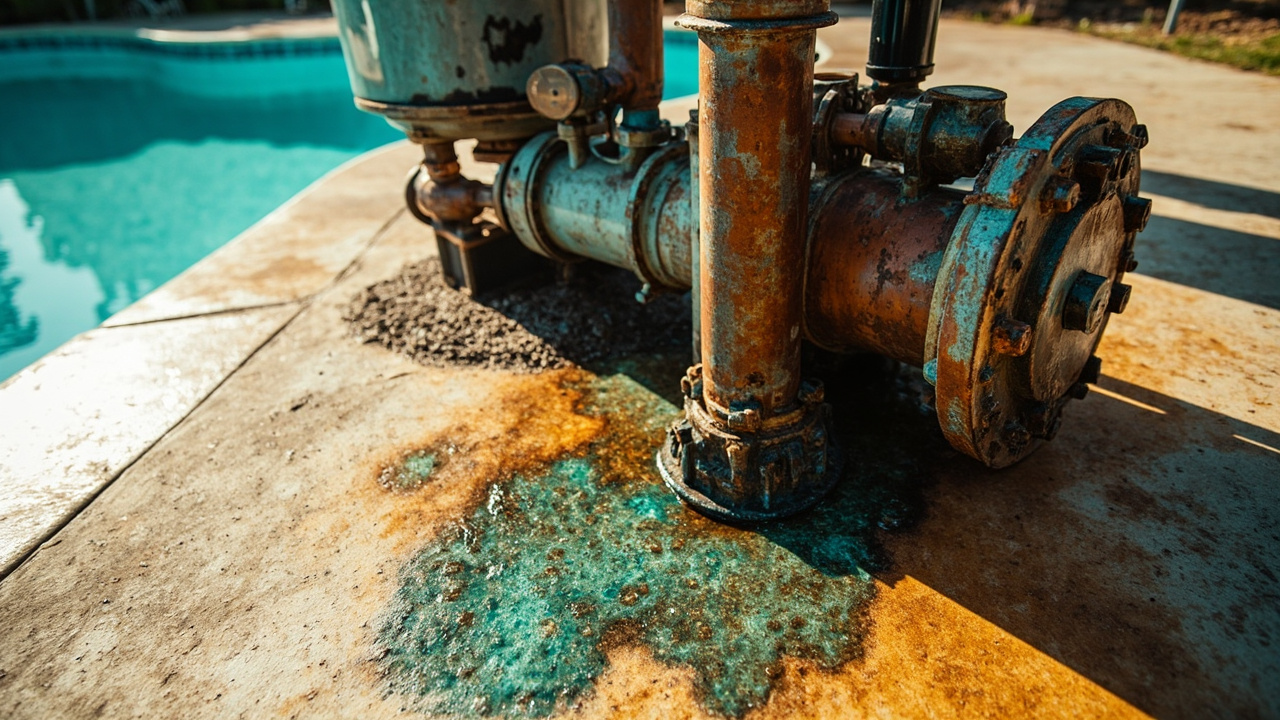
Most common. Source is usually fill water (well water has iron) or corroding steel equipment (old ladders, light niches with rusted steel rings). Tends to concentrate on walls at the waterline first.
Copper — teal-blue-green / blue-gray
Distinct teal color, not green like algae. Source is old copper algaecide (now banned in most states), corroding copper heat exchangers, or copper fill water pipes. Often shows as a gradual color shift across large wall sections.
Manganese — purple-black / dark brown
Rarest but distinctive. Source is usually well water with manganese. Looks almost like oil staining on the wall. Need a lab test to confirm (cheap municipal water report covers it).

Vitamin C test — confirm metal in 60 seconds
A diagnostic only a metal stain will pass. Algae, scale, and dye stains will not respond.
Step 1 — Crush a 500 mg vitamin C tablet
Standard pharmacy vitamin C (ascorbic acid). Cheap; you need 5 for treatment later anyway.
Step 2 — Hold the powder on the stain for 30 seconds
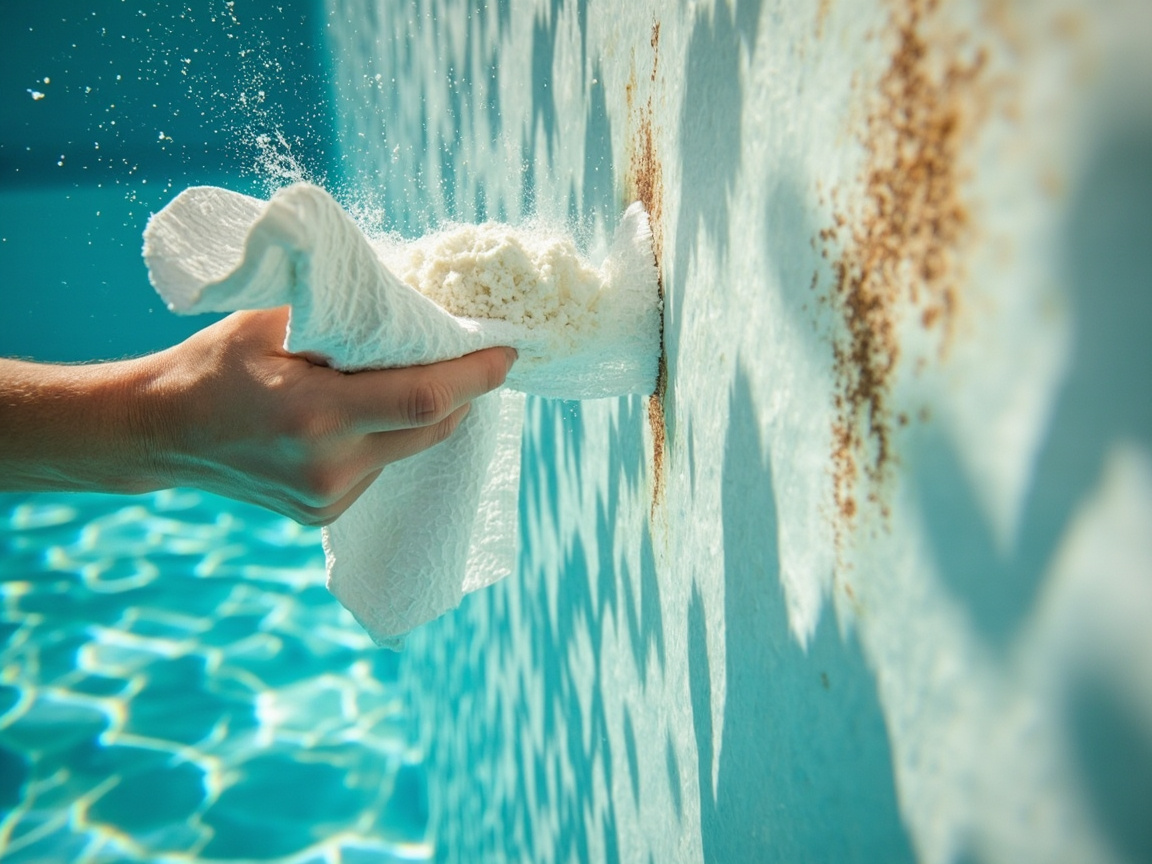
Put it in a white sock or wrap in a paper towel, press on the stain against the wall. Don’t rub.
Step 3 — Read the result
Stain fades to lighter color = confirmed metal. No change = it’s not metal; go to pool scale stains or green pool for the next diagnosis.
Decision tree — what type, what treatment
Walk top to bottom. First “yes” wins. Each branch points to a specific dose and a specific follow-up.
Branch 1 — Vitamin C test confirms iron
Ascorbic acid treatment: 1 lb per 10k gal pool, broadcast over stained surfaces, run pump 24 hours. Then add sequestrant (Clorox Scale, Metal & Stain Control) at 1 qt per 10k gal to lock remaining iron in solution. Sister link: pool pH for pH context.
Branch 2 — Vitamin C test confirms copper
Stronger ascorbic dose: 1.5 lb per 10k gal (copper takes more reducer than iron). Sequestrant is mandatory for copper — copper re-oxidizes fast and re-stains within weeks if not sequestered. Also: stop using copper algaecide.
Branch 3 — Vitamin C test confirms manganese
Same ascorbic dose as iron but expect 2-3 applications over 2 weeks. Manganese is the most stubborn. Add sequestrant and consider partial drain if fill water tests high for manganese.
Branch 4 — Vitamin C test inconclusive / partial fade
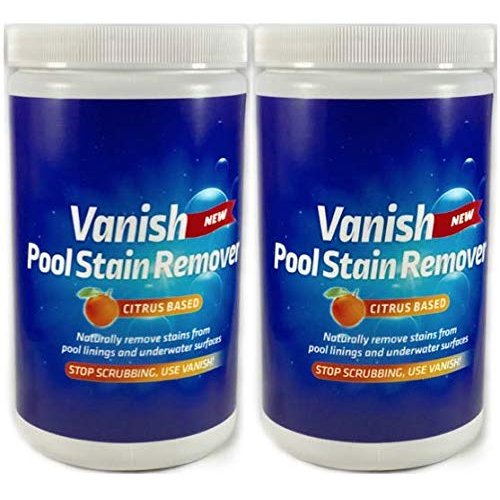
Likely mixed stains — could be calcium over metal, or metal + organic. Try citric acid (Bosh Vanish) — gentler reducer that handles both metal and some organic staining.
Branch 5 — Fill water tested, iron above 0.3 ppm or copper above 0.2 ppm
Source is the fill water. Even after treatment, new water brings more metal. Install a metal-removing pre-filter on the fill hose (about $80) or use a metal-removing fill cartridge. Sequestrant every refill is the alternative.
Branch 6 — No source found, stains return in 6-12 months
Heater core corrosion is the silent source. Old copper or iron heat exchangers leach metal continuously. Get the heater inspected.
What you’ll need
Five products cover the most common metal-stain cases. Start with ascorbic acid and a small sequestrant — you can scale up to bulk if you confirm the source is your fill water.
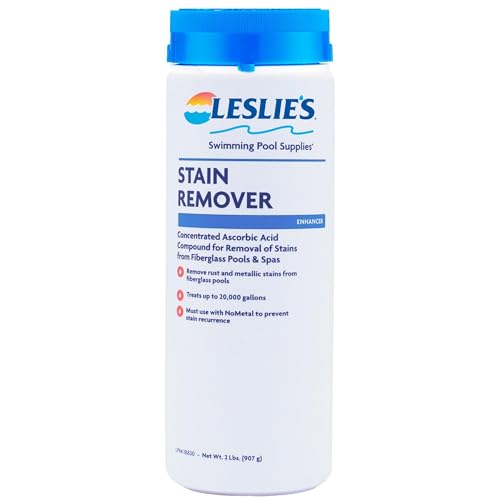
Leslie’s Stain Remover 2 lb (B0F5HP2C2Y)
Primary stain reducer. Concentrated ascorbic acid compound, 2 lb treats up to 20k gal. Confirmed iron/copper treatment. See price on Amazon.
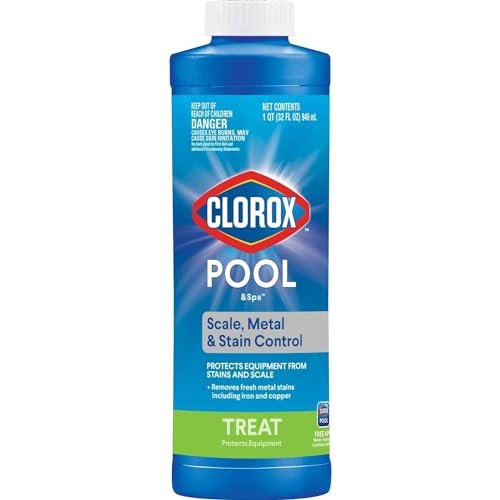
Clorox Scale, Metal & Stain Control 1 qt (B00PZZFOPQ)
Sequestrant — locks dissolved metals so they can’t restain. Mandatory follow-up to ascorbic acid treatment. See price on Amazon.
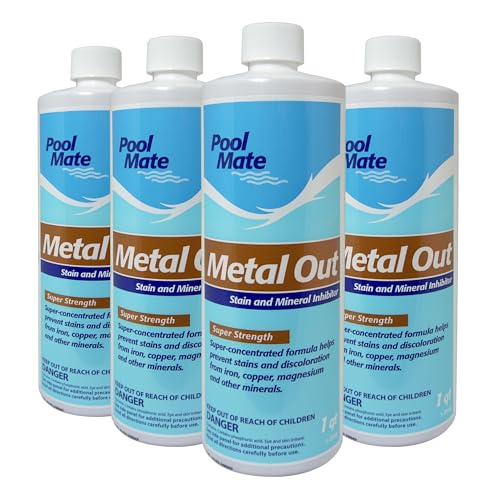
Pool Mate Metal Out 4 × 1 qt (B00IXRY440)
Bulk sequestrant for pools with chronic fill-water metal. Cheaper per ounce than the Clorox quart for season-long use. See price on Amazon.
Bosh Chemical Vanish 2-Pack 4 lb (B07Z3ZHNZC)
Citric-acid alternative for gentle treatment. Slower (4-7 days) but safer near landscaping and easier on plaster. See price on Amazon.
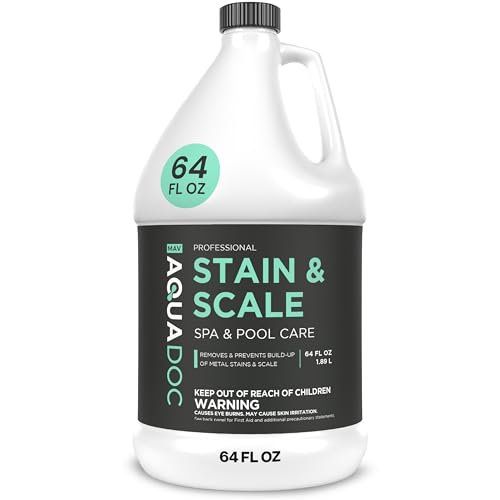
AquaDoc Stain and Scale Remover 64 oz (B0FGQN3VBF)
Spa-safe cross-system stain remover. Also covers calcium scale, useful for hot tubs and small pools. See price on Amazon.
How to remove metal stains — step by step
Six steps, 24-48 hours from start to “stain gone,” with most of the time spent running the pump and backwashing.
Step 1 — Confirm with vitamin C test
Don’t skip. Misdiagnosis wastes 2 lb of ascorbic acid + 1 qt of sequestrant. The 60-second test saves a real-money mistake. Hold a vitamin C tablet (or a few ascorbic acid powder teaspoons) on the stained surface. Iron and copper stains lighten in 30-60 seconds; organic or mineral stains don’t.
Step 2 — Lower pH to 7.0-7.2 if possible
Ascorbic acid works faster at lower pH. Aerate first (run returns up) if pH is high. Sister link: pool pH for the full cycle.
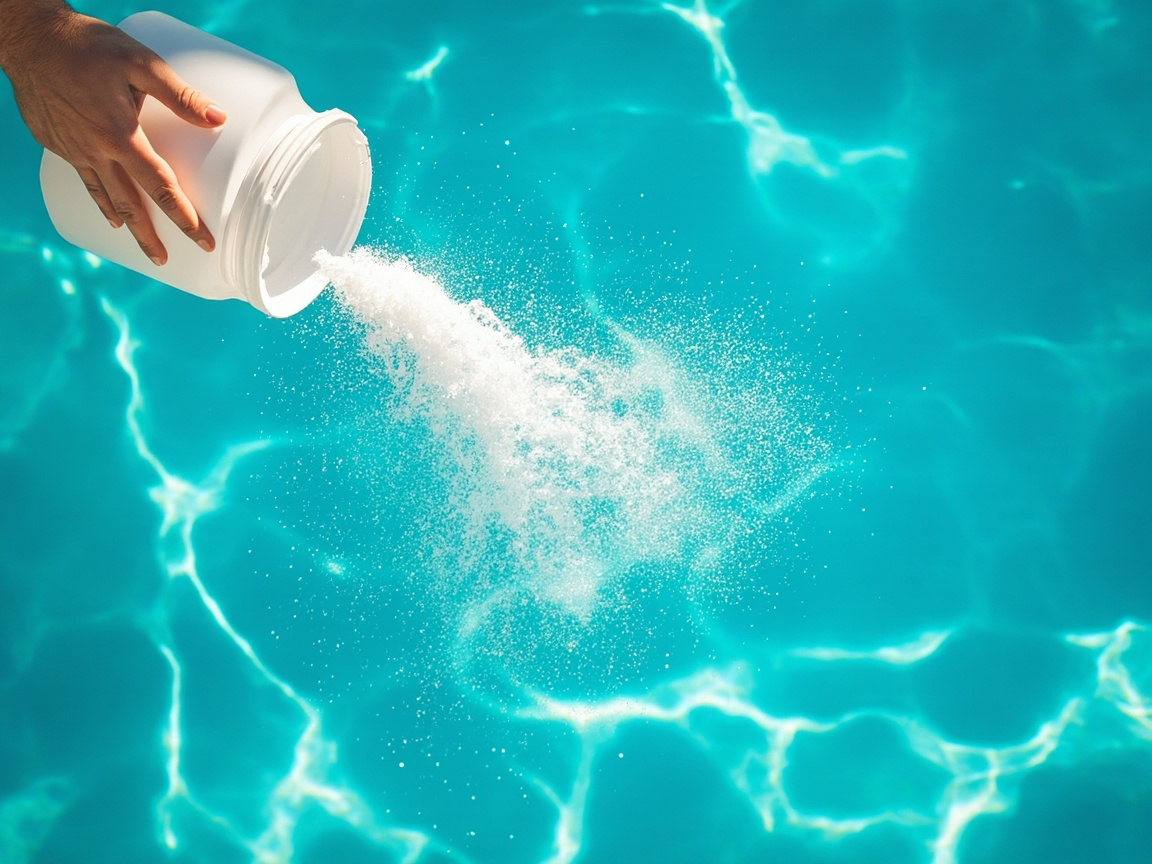
Step 3 — Broadcast ascorbic acid over stained surfaces
1 lb per 10k gal for iron, 1.5 lb for copper. Run pump 24 hours continuously. Filter captures the reduced metal. A 2 lb Leslie’s jar covers a 20k gal iron treatment, no pre-dissolving needed.
Step 4 — Backwash and clean filter
Reduced metal precipitates and gets caught in the filter. Backwash sand/DE or rinse cartridge after 24 hours.
Step 5 — Add sequestrant
1 qt per 10k gal Clorox Scale, Metal & Stain Control. This locks any remaining dissolved metal so it can’t restain. Wait 24 hours after the ascorbic acid dose before adding the sequestrant — they neutralize each other if mixed at the same time. A 1-gallon jug handles most residential pool re-doses for the season.
Step 6 — Test fill water and find the source
Without source control, you’ll redo this in 6-12 months. Test fill water for iron + copper; inspect heater; check for old copper algaecide use. Use the pool water testing framework for the test sequence.
Safety notes — stain treatment
Five rules, each tied to a specific failure mode in stain removal.
PPE — gloves and eye protection when handling ascorbic acid
Pure ascorbic acid is mildly irritating to skin and eyes in powder form. Chemical-resistant gloves + splash goggles.
Never mix sequestrant with chlorine at the same time
Sequestrant binds metals, chlorine oxidizes them. Add sequestrant 24 hours after any chlorine shock, or shock 24 hours after sequestrant. Sister link: pool shock for the chloramine mechanism.
Vitamin C test tablets — keep away from children
Pharmacy packaging looks like candy. The treatment dose (2 lb per 20k gal) is far above supplement doses; accidental ingestion is a call to Poison Control.
Avoid skin contact with citric acid alternatives
Bosh Vanish and similar citric-acid products are skin irritants in powder form. Wear gloves; rinse skin after contact.
Store all stain-treatment chemicals in original containers
Sequestrants and ascorbic acid are not compatible with each other in concentrated form. Cross-contamination in shared containers causes clumping and ineffective dosing.
Common mistakes
Five errors that waste the treatment or make the stain worse.
- Treating metal stains with extra chlorine. Chlorine oxidizes dissolved metal — adding chlorine to metal stain water MAKES the stain worse, not better. Stain treatments reduce the metal, not oxidize it.
- Skipping the sequestrant step. Ascorbic acid removes the existing stain, but without sequestrant the dissolved metal re-oxidizes within weeks. Sequestrant is mandatory, not optional. Sister link: free chlorine for the oxidation chain.
- Draining the pool to fix stains. Draining doesn’t remove metal; refilling with metal-rich water re-creates the stain. Use the no-drain protocol above unless fill water is the confirmed source.
- Confusing copper stains with algae. Teal-blue-green copper stain looks like algae to first-time pool owners. Vitamin C test distinguishes — algae doesn’t fade in 30 seconds.
- Using muriatic acid to “clean” metal stains. Muriatic acid lowers pH but doesn’t reduce the metal. Worse, it can re-dissolve already-applied sequestrant. Wrong tool. Sister link: muriatic acid safety basics for what acid does and doesn’t do.
When to call a pro
Three situations where DIY becomes a service call.
Stains return within 3 months of correct treatment
Source is ongoing (heater corrosion, fill water metal, copper pipes). Service tech can inspect heat exchanger and pressure-test for hidden leaks.
Vinyl liner stains that won’t fade with vitamin C
Could be liner dye migration, not metal. Pro can identify without draining the liner.
Plaster stains with pitted surface underneath
Ascorbic acid removes the stain but if plaster is etched underneath, you need resurfacing. Pro assessment first.
What to buy only if needed
Four conditional branches.
Only if your fill water has iron or copper
Install a metal-removing pre-filter on the fill hose. Cheaper than treating stains twice a year for a decade. Alternative: keep sequestrant on hand and dose every refill.
Only if you have an old copper heat exchanger
Have the heater inspected annually. A leaking exchanger adds copper continuously.
Only if stains cover more than 30% of the pool surface
Skip the spot treatment. Use a full ascorbic acid + sequestrant treatment. May need 2 doses over 2 weeks.
Only if you’re on well water with no lab test
Get a $15 well-water test kit (iron + copper + manganese). The lab number tells you which branch of the decision tree is your real source. Without it, you’re guessing.
Related
- Pool scale stains (calcium sister hub) — different chemistry, similar look
- Green pool (algae sister hub) — diagnostic confusion
- Pool phosphates — high phosphate + metal = stain amplification
Key takeaways
- Color is the first diagnostic. Iron = rust-brown. Copper = teal-blue-green. Manganese = purple-black.
- Vitamin C test in 60 seconds confirms metal. Algae and scale will not respond.
- Ascorbic acid removes the stain; sequestrant prevents it from coming back. Skipping the sequestrant is the #1 reason stains return in weeks.
- Find the source. Fill water, corroding heater, or old copper algaecide. Without source control you redo the treatment every 6-12 months.
- Chlorine makes metal stains worse, not better. Stain treatments reduce metal; chlorine oxidizes it.
- Ascorbic acid is safe on vinyl, plaster, fiberglass, and pebble finishes. Milder than dry acid or muriatic.
- Don’t drain the pool to fix metal stains. The no-drain protocol works; refilling with metal-rich water just re-creates the problem.