
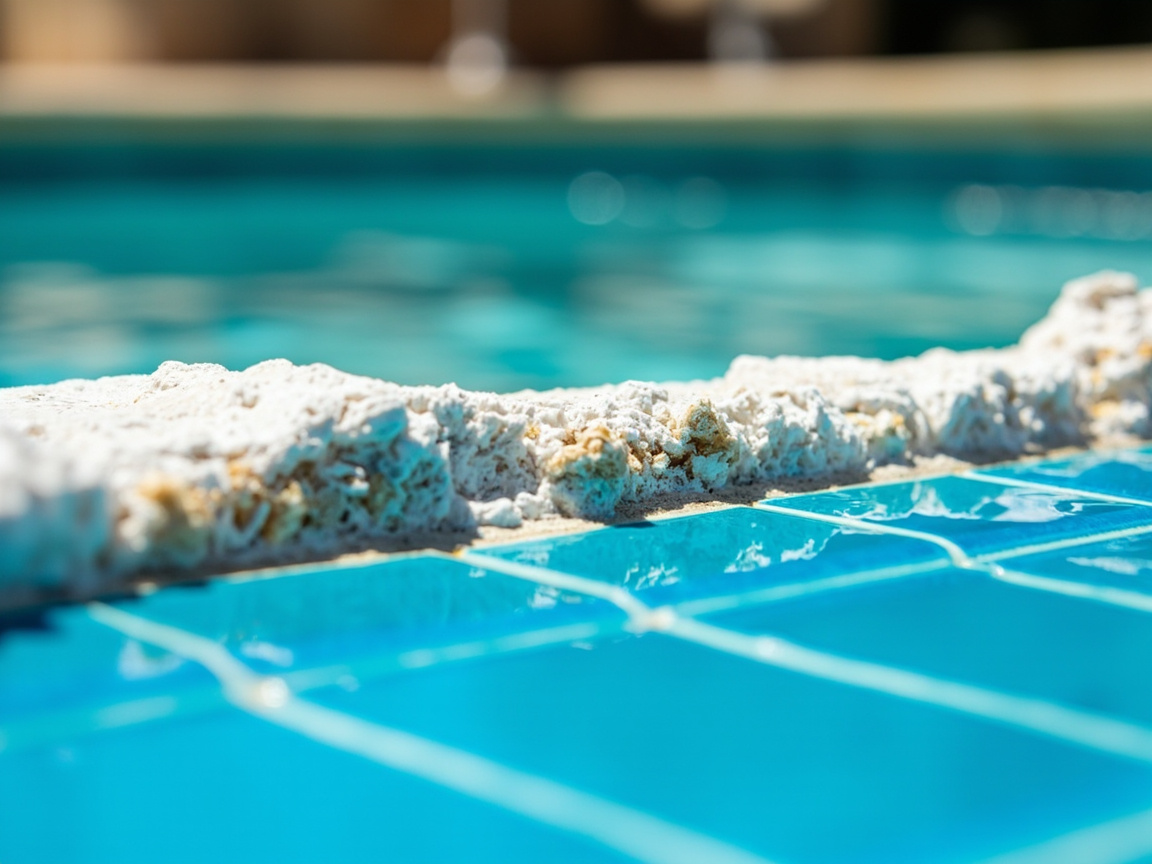
If the waterline tile looks like someone drew a chalk line on it, you have calcium carbonate that fell out of the water over weeks. Ignore it and the crust thickens, the heater loses efficiency, and the salt cell scales over. Test first — without it you’ll etch the plaster or strip the vinyl liner. Done right, scale comes off in a day and stays off for the season.
Quick answer
Pool calcium scale is hardened calcium carbonate (CaCO3) that drops out of water when pH, alkalinity, or calcium hardness is too high and the Langelier Saturation Index (CSI) goes positive. White crust on tile or plaster means the imbalance has been there for weeks. Fix the water balance (pH 7.2–7.4, TA 80–120 ppm, CH 200–400 ppm), then remove the crust with a pumice stone or acid wash keyed to the surface.
What calcium scale looks like
Before you read further, here’s what the white crust on a ceramic tile waterline actually looks like:
What calcium scale is not
Three things look like calcium scale but are not. Identifying which one you have saves the wrong chemical and the wrong removal method.
It isn’t white algae
White (“calcium”) algae is a living biofilm that feels slimy or gritty and rubs off under a brush. Calcium scale is a hard, brittle mineral crust that no amount of brushing removes and chlorine doesn’t touch. If brushing and shocking clears the white material, it was algae.
It isn’t a metal stain
Iron and copper stains tint the surface tan, gray, green, or purple near metal fittings. Calcium scale is uniform white crust. A vitamin C tablet on the stain is the quick test: if it lightens in a minute, it’s metal, not calcium.
It isn’t salt creep or efflorescence
Salt creep is the dry, powdery white residue on the deck above the waterline. Efflorescence is the white bloom on the underside of coping or stone. Both sit above or beside the pool; calcium scale forms inside the pool on tile, plaster, and equipment.
What causes pool calcium scale?
Three forces push calcium out of solution. They can act alone or together, and the visible crust is always the cumulative result of weeks of imbalance.
The Langelier Saturation Index goes positive
The Langelier Saturation Index (CSI) combines pH, total alkalinity, calcium hardness, water temperature, and total dissolved solids. A negative CSI means the water wants to dissolve calcium; a positive CSI means it wants to deposit calcium. Target band is -0.3 to +0.3; scale forms reliably above +0.3 and accelerates above +0.5. The Langelier Saturation Index hub walks through the full math.
Hard fill water keeps topping the calcium up
Every top-off after evaporation or backwash adds the calcium hardness of your fill water. In areas above 250 ppm CH — common in the Southwest, Texas, and Florida — CH climbs steadily through the season even if you never add calcium chloride. Every gallon of 300 ppm fill water adds about 0.6 lb of calcium per 10,000 gallons. A sequestering agent holds the calcium in solution while you figure out the fill-water problem.
Evaporation concentrates everything
Sun and wind evaporate pure water and leave dissolved calcium behind. A pool that loses ½ inch of water per day in July adds the equivalent of several pounds of calcium per month. Topping off with hard tap water closes the loop, and CSI drifts positive within a few weeks.
CSI decision table at a glance
pH, TA, and CH cause cycle
How to test your water before you dose
Test first. The numbers decide everything that follows: which chemical, how much, and what removal method is safe on your surface. The full pool water testing sequence covers FC, pH, TA, and CYA; this section focuses on the five numbers you need to compute CSI.
Reading the drop test on a pool deck
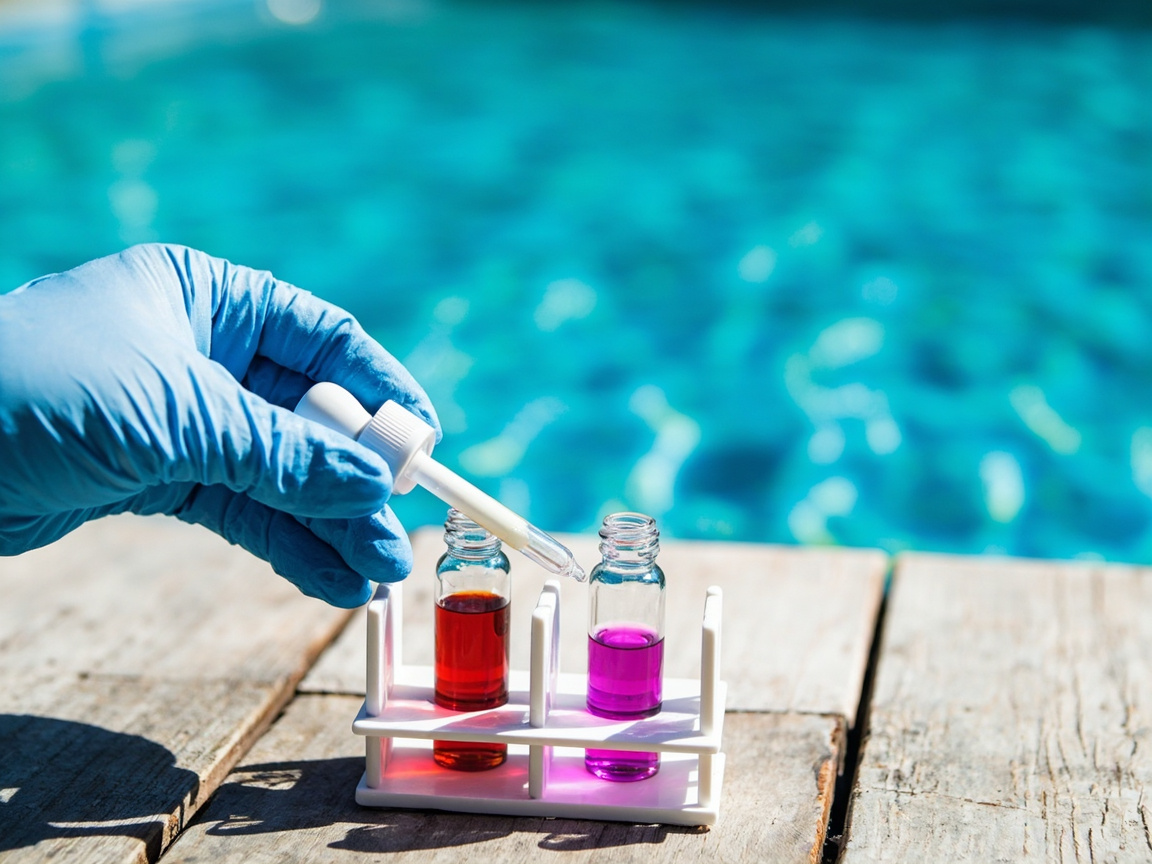
Drop test vs strips for calcium hardness
Liquid drop test kits like the Taylor K-1005 read calcium hardness directly. Test strips that claim to read CH are usually inaccurate above 400 ppm and useless for CSI calculation.
Numbers to record (and how often)
For CSI you need five numbers, not three: pH, total alkalinity (TA), calcium hardness (CH), water temperature, and either CYA (cyanuric acid) or TDS. Test pH and TA weekly in season, CH and CYA monthly, and temperature every visit. Write the numbers down — the only way to spot drift toward scale is to compare this week’s reading to last week’s. Confirm free chlorine is within band first — a heavy chloramine load shifts pH and TA readings.
What you’ll need
Pull these together before you start.
- Pool water test kit that reads calcium hardness — the Taylor K-1005 is the common DIY standard.
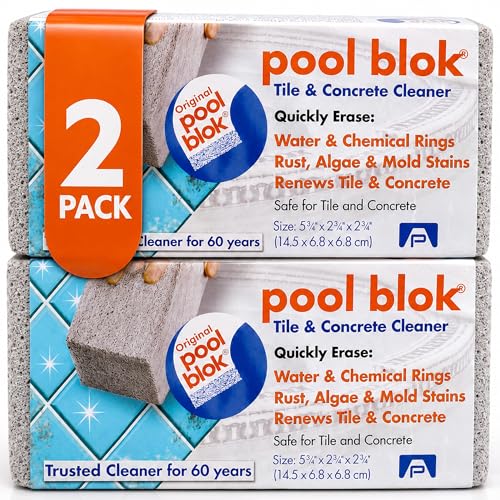
- Pumice stone (one stone per 10 to 20 ft of waterline) — the Pool Blok 2-pack is the standard size; mechanical removal on ceramic tile is the lowest-risk first attempt.
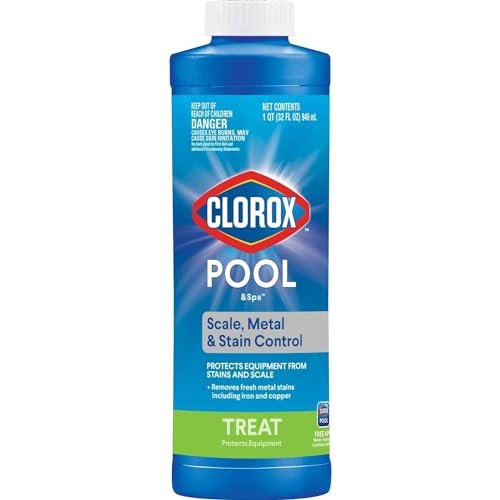
- Sequestering agent (stain + scale inhibitor) — Clorox Pool&Spa Scale Control locks calcium in solution.
- Nylon pool brush (matching your surface) — stiff enough to disturb biofilm, soft enough not to scratch vinyl or fiberglass.
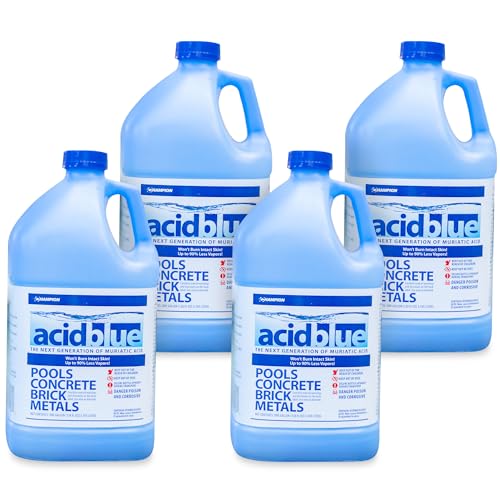
- Muriatic acid (only if everything above fails on plaster) — CPDI Champion Acidblue is the common 4-pack size; reserve for plaster-only heavy scale after balancing is fixed.
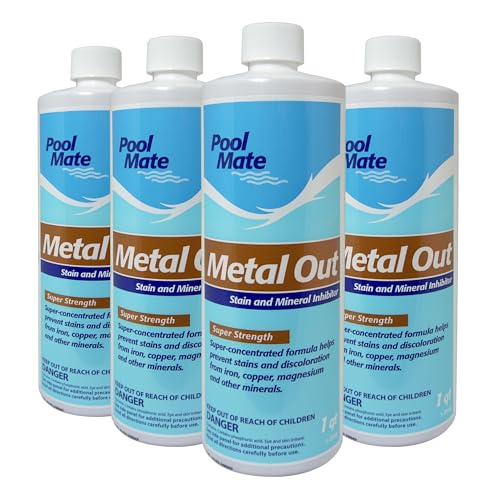
- Pool sequestrant (4-pack for season-long prevention) — Pool Mate Metal Out 4-pack is the standard maintenance size when CH stays above 350 ppm all season.
How to remove calcium scale by surface
The right removal method depends entirely on the surface. A method that is safe on tile can destroy a vinyl liner; an acid that cleans plaster in 30 minutes will etch fiberglass permanently.
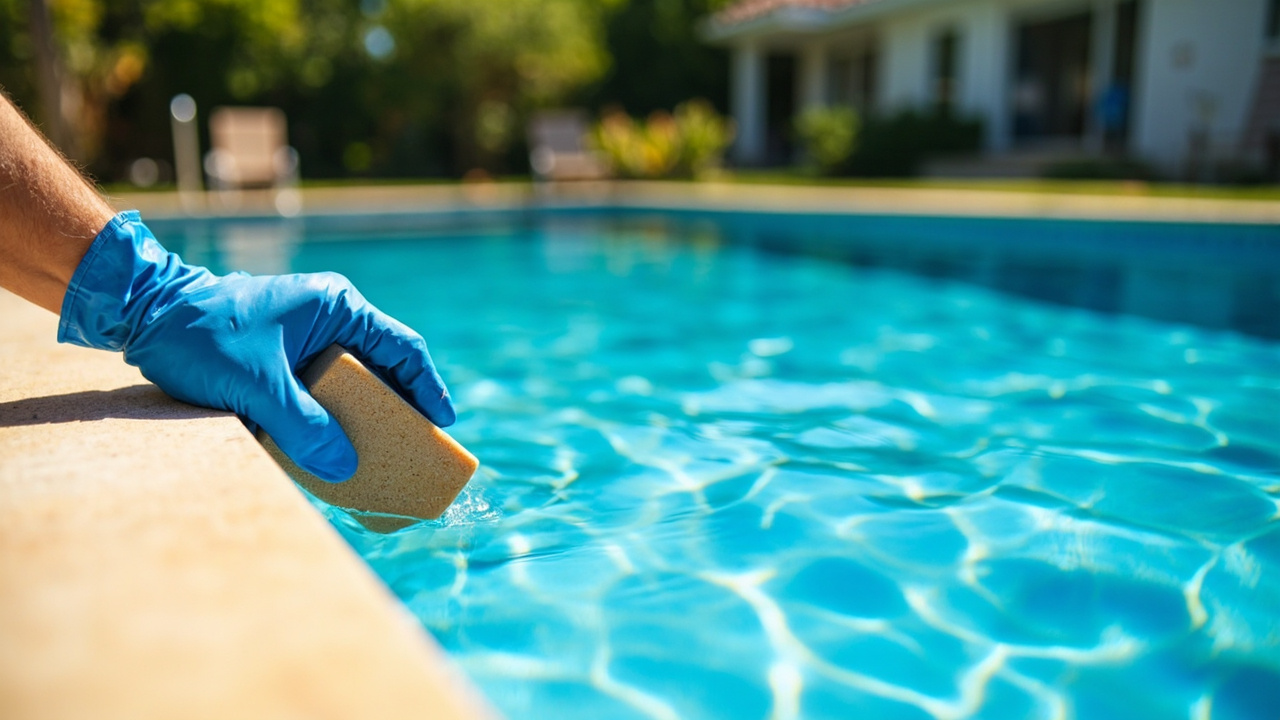
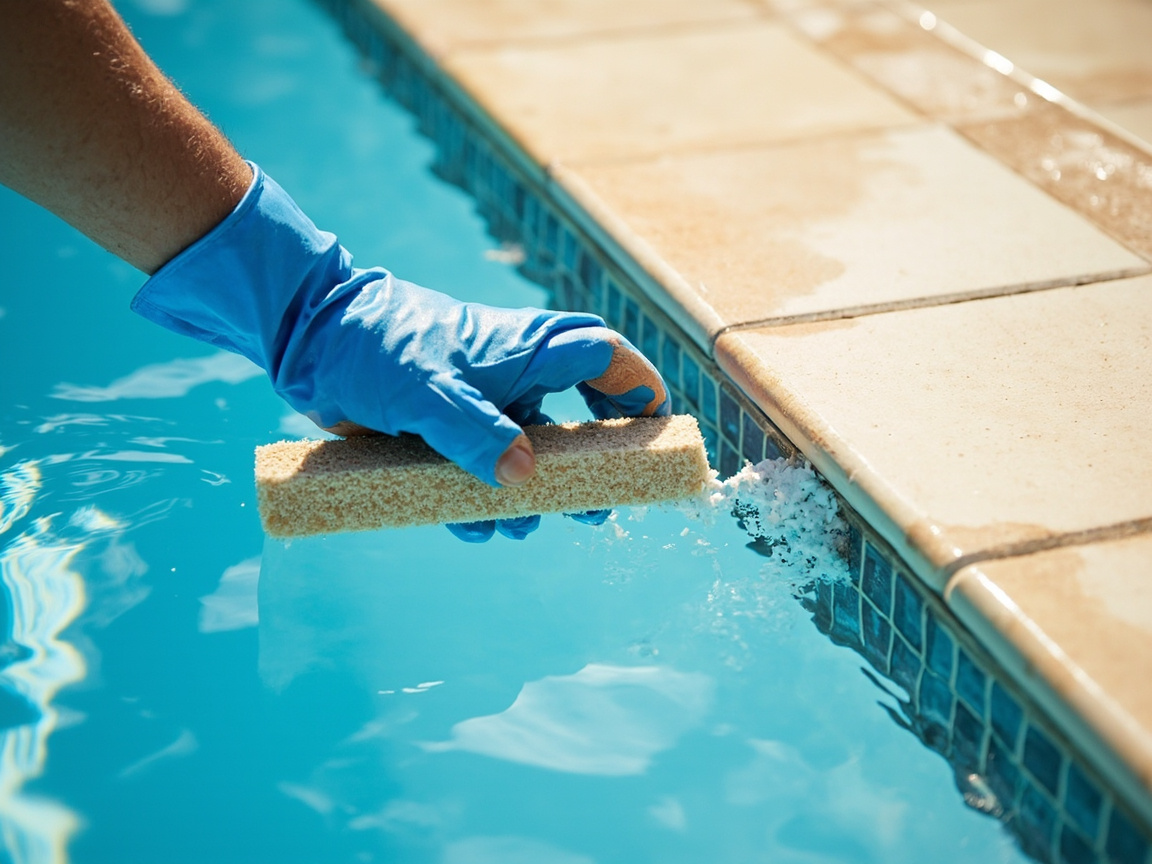
Scrub tile waterline with a pumice stone
A pumice stone rubbed along the waterline removes calcium crust on glazed ceramic tile with no chemicals. Wet the stone and the tile, work in short strokes, and accept that a heavy crust may need 2 to 3 sessions. The Pool Blok 2-pack covers roughly 30 to 40 linear feet of tile. Do not use a pumice stone on a vinyl liner, painted surface, or polished stone — it will scratch. A nylon brush only removes the loose top layer, not true scale.
Acid-wash plaster pools as a last resort
Acid washing dissolves plaster while it dissolves the scale — you trade visible scale for a thin etched layer of plaster. Lower pH to 7.0 and TA below 80 first. Dilute muriatic acid 10:1 with water (always add acid to water, never the reverse), apply a small section at a time with a plastic watering can, let it stop fizzing, and rinse immediately. Most homeowners should not do this — see When to call a pro below.
Treat pebble and quartz finishes with mild acid + brush
Pebble and quartz tolerate dilute acid better than smooth plaster because the aggregate is chemically inert. Use a 20:1 dilution, work in 4 ft × 4 ft sections, and rinse fast. Test in an inconspicuous spot first — some darker pebble blends lighten visibly even with a mild wash.
Avoid acid on fiberglass and vinyl liners
There is no safe acid concentration on fiberglass or vinyl that removes scale without damaging the surface. Use a vinyl-safe calcium remover, a soft brush, and patience. Heavy scale on a vinyl liner often means the liner is at end of life — discuss replacement with a pro before any aggressive treatment.
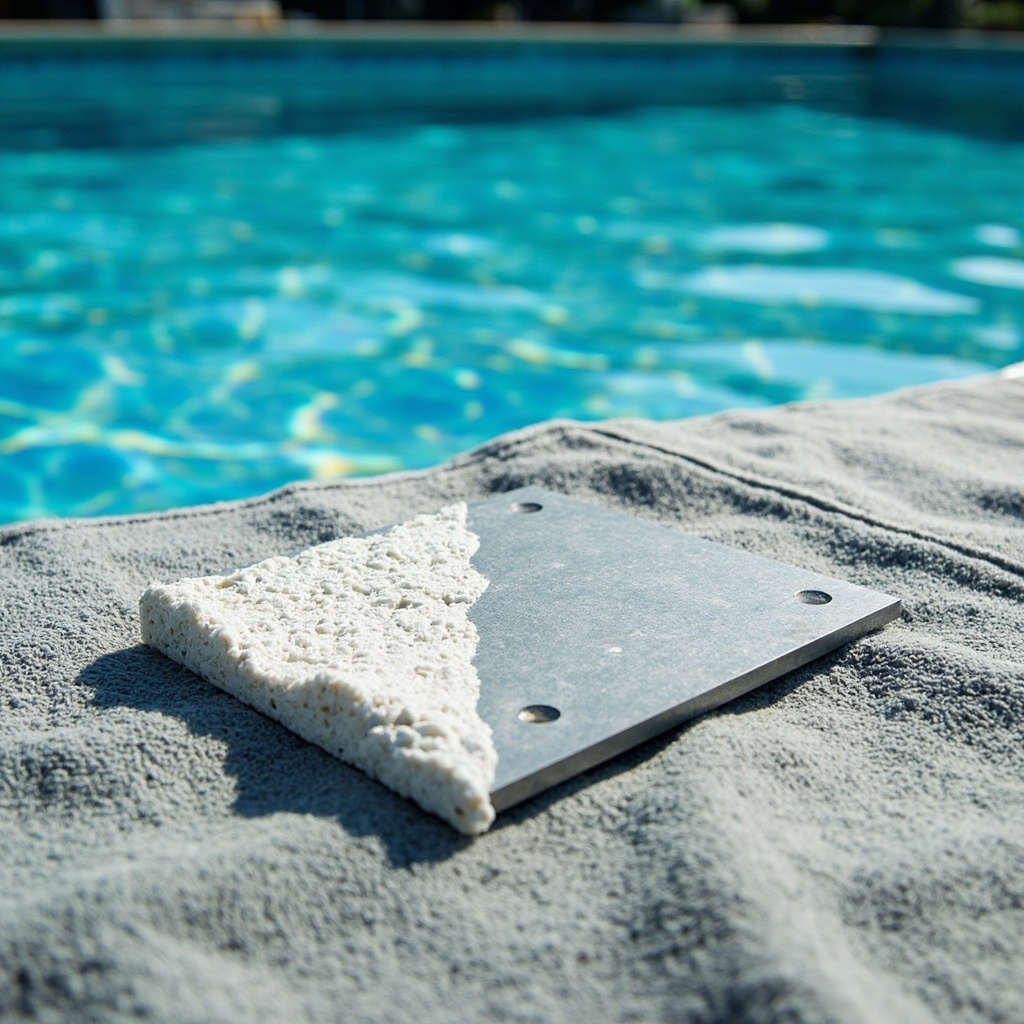
Inspect heater tubes and salt cells professionally
Scale inside a heater tube restricts flow and cuts efficiency 20 to 40% before it fails. Scale on saltwater cell plates reduces output and eventually kills the cell. Both are off-limits for DIY acid — book an annual pro descale ($80 to $150) before the $400 cell or $900 heat exchanger needs replacement. Catch scale early by testing CH monthly and inspecting the cell visually.
Pumice stone on the ceramic tile waterline
Salt chlorinator plate scale close-up
Decision tree
Use this to pick the right path the first time, before you waste chemicals on the wrong surface.
White crust on ceramic tile waterline
Wet a pumice stone and the tile; mechanical removal first. If the crust doesn’t respond after 2 sessions, confirm CSI is below +0.3, then try a pool-scale remover. Don’t reach for muriatic acid on tile — it’ll etch grout and discolor glaze.
White crust on plaster or pebble
Confirm CSI and fix pH and TA first; reserve acid wash for crust that doesn’t respond to a sequestrant + brush cycle. Read the Safety notes section before any acid work. Most plaster scale lifts in 2 to 6 weeks once CSI sits between -0.3 and -0.6 — patience saves the surface.
White crust on vinyl or fiberglass liner
No acid. Use a buffered vinyl-safe remover and a soft brush, then inspect the liner for end-of-life signs (fading, brittleness, wrinkles at the bead). Heavy scale on a 10+ year old liner usually means the liner is ready to be replaced, not scrubbed.
Scale inside the salt chlorinator cell
Pro inspection; don’t soak the cell yourself. The cell plates have a delicate coating that a long acid soak will strip in minutes. Annual pro descaling is $80 to $150 and protects a $400 cell.
Scale inside the heater tubes
Pro descaling; don’t pour acid into the heater. The heat exchanger has electrical elements and copper or cupro-nickel tubing that acid attacks. Annual pro descale costs $150 to $300 and protects a $900 heat exchanger.
If CSI is consistently above +0.3 across two weekly tests, jump straight to the How to prevent calcium scale section — the problem returns within weeks of any removal if the water balance is still wrong.
How to prevent calcium scale
Removal without prevention is a weekly chore. The point of prevention is keeping CSI in the safe band.
Hold CSI between -0.3 and +0.3
CSI between -0.3 and +0.3 keeps calcium dissolved but not aggressive. The free calculators on Orenda’s LSI page or Pool Math give you a single number; the Langelier Saturation Index hub shows the formula if you want to compute by hand.
Run a sequestering agent through the season
A sequestering agent — Clorox Pool&Spa Scale Control or Pool Mate Metal Out 4-pack — binds calcium in solution. Dose weekly when CH is above 350 ppm; dose monthly when CH sits in the 200 to 350 ppm band. Sequestrants degrade in sunlight, so “dosed once in spring” isn’t a prevention program — it’s one dose.
Use soft fill water when source CH is high
If your municipal or well water reads above 250 ppm CH, run it through a hose-end filter (an inline carbon + polyphosphate filter removes 100 to 150 ppm of CH for the season) or fill from a soft-water tap when possible. Every gallon of 300 ppm fill water adds about 0.6 lb of calcium per 10,000 gallons. Pair the soft fill with a shock routine every few weeks so fresh organic demand doesn’t push TA up.
Inspect the salt cell monthly when CH is high
A salt cell in 600 ppm CH water scales twice as fast as a cell in 300 ppm CH water. Inspect the cell plates monthly during heavy-use season, hose off light scale, and run an automatic cell-clean cycle every 60 to 90 days if your chlorinator has one. The saltwater basics hub walks through the full inspection protocol.
Spa and hot tub specifics
Scale dynamics in a hot tub are the same chemistry — CaCO3 precipitating when CSI goes positive — but three factors make hot tubs scale 3 to 5× faster per gallon than a pool.
Smaller volume + higher temperature = faster precipitation
A 400-gallon hot tub at 102°F has the same calcium mass as a 15,000-gallon pool, but every surface is closer to the water and the temperature is 12 to 15°F higher. Calcium solubility drops as temperature rises. Hold spa CSI slightly negative (around -0.3 to -0.1) and dose a seasonal sequestrant to hold the line between drain cycles.
Aeration and jet use drive pH up fast
Blowers, jets, and waterfalls off-gas CO2 and push pH up by 0.1 to 0.3 in an hour. High pH + high TA is the textbook scale recipe. After every spa session, test pH and TA; if TA has crept above 100 ppm, lower it with the protocol in the total alkalinity hub before the next soak.
Drain and refill on a 3 to 4 month cycle
No sequestrant holds a hot tub indefinitely — minerals concentrate fast and the chemistry drifts weekly. Drain and refill every 3 to 4 months (or sooner if CH exceeds 500 ppm mid-cycle). The hot tub water care hub walks through the full drain-and-refill sequence.
What to buy only if needed
Most scale problems resolve with the basics above. Buy the items in this section only when the situation matches.
Acid wash kit only if plaster scale doesn’t respond to pumice or sequestrant
A full acid wash is justified only when the scale is heavy (visible thickness, rough to the touch), the surface is plaster or pebble — never vinyl or fiberglass — and you’ve already corrected pH and TA. Buy the acid, a plastic watering can, and acid-rated PPE from a single supplier so the dilutions and PPE ratings match. CPDI Champion Acidblue is the common 4-pack. Plan for one section at a time and rinse as you go — the acid is active for 30 to 90 seconds.
LSI / CSI calculator subscription only if you want monthly trend tracking
The free calculators cover 90% of what a homeowner needs. A paid LSI app (Orenda Pro, PoolMath premium) is worth it only if you log CSI monthly and want trend graphs across a season. Skip if you test and compute on the day you dose.
Professional descaling only if the heater or salt cell is already restricted
Annual pro descaling costs $80 to $150 and is cheaper than the $400 cell or $900 heat exchanger it protects. Book it the same week you book your annual heater inspection so the technician can measure inlet/outlet temperature differential and confirm scale is the cause.
Common mistakes
These five errors cost the most time, money, or pool surface. Each one is preventable.
- Adding acid without testing TA first. Acid drops pH and TA at the same time. If TA is already at 80 ppm, you’ll push TA so low the water becomes aggressive and starts dissolving plaster instead of dissolving scale. Always confirm TA before dosing acid — and confirm free chlorine and pH are in band before assuming the underlying water is balanced.
- Trusting pH strips to read calcium hardness accurately. Most test strips that include CH are accurate to plus or minus 150 ppm above 400 ppm. CSI computed from a wrong CH number is worse than no CSI at all. Use a drop test like the Taylor K-1005 or a pool-store reading.
- Using full-strength muriatic acid on plaster. Undiluted (or 4:1) muriatic acid etches plaster visibly in 30 seconds — you cannot undo it. Always dilute to 10:1.
- Pouring acid into the skimmer while the pump is running. Concentrated acid passes through the pump and heater before it dilutes, etching every metal surface. Add acid only to the deep end, pump off, with the heater set to bypass.
- Treating scale as a one-time removal instead of a recurring symptom. If you remove the crust but don’t fix CSI, the crust returns within 4 to 8 weeks. The whole point of the test-first protocol is to convert scale from a recurring chore into a one-time cleanup.
When to call a pro
Most calcium scale is a DIY project. These thresholds are when it isn’t.
Keep it DIY if: the crust is on tile or plaster, you can read pH/TA/CH with a drop test, CSI is below +0.6, and you’re comfortable handling dilute acid with proper PPE.
Call a pool professional if:
- Scale is visible inside the salt chlorinator cell or the heater tubes
- The plaster is etched, rough, or has visible cratering beneath the scale
- CSI is consistently above +1.0 even after correcting pH, TA, and CH (suggests a fill-water problem that needs a plumbed solution)
- A full acid wash is the right answer but the pool is more than 20,000 gallons (acid volume + safety grows non-linearly)
- You’re not comfortable handling muriatic acid even at 10:1 dilution
- The pool is vinyl or fiberglass with heavy scale — the wrong acid concentration will destroy the surface
Pro acid wash pricing is typically $300 to $600 for a residential pool; pro descaling of a salt cell is $80 to $150; pro heater descale is $150 to $300. Compare to a $400 salt cell or $900 heat exchanger replacement.
Safety notes
This article involves muriatic acid. Read this section before opening any container.
- Gloves and eye protection are required for any acid work. Acid-resistant gloves (nitrile isn’t enough for muriatic — use butyl rubber), sealed eye protection, long sleeves, closed-toe shoes, and a respirator rated for acid vapor.
- Always add acid to water, never water to acid. Adding water to concentrated acid causes an exothermic reaction that splashes acid out of the container. Pour acid slowly into a plastic bucket of pool water.
- Never mix acid and chlorine in the same container. Mixing produces chlorine gas. Never add acid to a bucket that has held trichlor, dichlor, or cal-hypo shock.
- Add acid to the deep end of the pool with the pump off. Pump-off allows the acid to disperse locally before the circulation system pulls it through the heater. After 30 minutes, restart the pump and run for one full turnover.
- Wait before swimming after any acid work. Confirm pH is back in the 7.2–7.6 range and the pump has run one full turnover (≈4–6 hours for a residential pool) before anyone gets back in. A quick pH test at the deep end is the green light.
- Ventilate any indoor or covered pool area before and during acid work. Muriatic acid fumes are heavier than air and concentrate at floor level.
- Keep a garden hose running and a baking-soda neutralizer within arm’s reach. A baking-soda slurry neutralizes small acid spills. Flush skin or eyes with the hose for 15 minutes before seeking medical attention.
- Store acid locked away from kids and pets. Keep containers in a ventilated outdoor shed, never in a garage open to living space.
- Never mix different chlorine products dry or in a bucket. Cross-contamination between trichlor, dichlor, cal-hypo, and acid produces heat and toxic gas.
Related
For the parameter side of the same problem, see the Langelier Saturation Index hub. When scale is showing alongside other symptoms, the cloudy pool hub covers the most common co-occurring issue. For spa and hot tub owners, the hot tub water care hub explains the volume + temperature effect in detail.
Key takeaways
- Calcium scale is CaCO3 that drops out of pool water when CSI goes positive — pH, TA, or CH has drifted too high.
- The target band is CSI -0.3 to +0.3; scale forms reliably above +0.3.
- Test pH, TA, and CH before you dose anything; compute CSI from the actual numbers.
- Remove scale by surface: pumice on tile, acid wash only on plaster or pebble (10:1, full PPE), never acid on vinyl or fiberglass.
- Prevent scale with a sequestering agent, monthly CSI checks, and an annual salt cell + heater inspection.
- Hot tubs scale 3 to 5× faster than pools; drain and refill every 3 to 4 months.
- Call a pro for acid wash on pools over 20,000 gallons, any salt cell or heater scale, or CSI stays above +1.0.