Quick answer
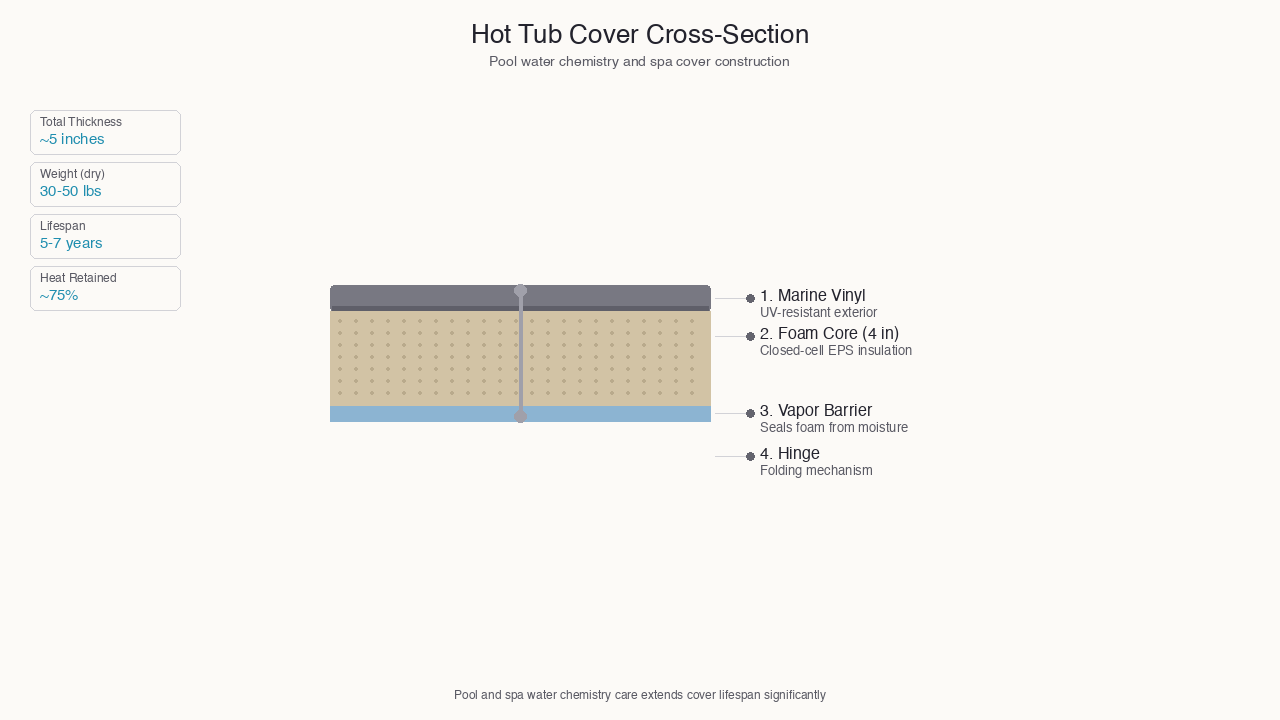
Hot tub cover care means cleaning the vinyl top monthly, conditioning it with a UV protectant every 3-4 months, and removing underside mold before it reaches the foam core. A maintained cover lasts 5-7 years. A neglected one fails in 2-3 years from UV cracking, mold, and waterlogged foam. Three steps — clean, condition, protect — each takes under 15 minutes.
What this is not
This article covers the physical vinyl-and-foam cover that sits on top of your hot tub. It’s not about water chemistry — for chlorine, pH, and alkalinity routines, see our hot tub water care basics guide.
It’s also not about pool covers. Hot tub covers are hinged, foam-core insulation barriers. Pool covers are solar blankets, safety covers, or mesh winter covers — different materials, different care. For pool cover types, see our pool cover basics guide.
Skipping cover care isn’t a budget shortcut — it’s deferred replacement. A $400-800 cover that lasts 3 years without care costs the same as a well-maintained one that lasts 7 years. The math favors maintenance 2:1.
Why hot tub cover care matters
Your hot tub cover is the single most replaced component — and the most preventable expense. Here’s why it fails:
- Replacement cost: $400-800 for a tapered, hinged, 4-inch foam cover.
- Lifespan with care: 5-7 years.
- Lifespan without care: 2-3 years from UV cracking, mold saturation, or foam waterlogging.
- Energy cost: Waterlogged foam loses 60-80% of its insulation value, driving heating bills up 20-30%.
The cover sits above 100°F water year-round. The underside faces constant steam — warm, humid, ideal for mold. The top bakes in UV. Both sides are under attack every day, and neither survives neglect. If you’re new to spa ownership, our first-year pool owner guide covers the equipment basics that complement cover care.
How a spa cover differs from a pool cover
Hot tub covers and pool covers look similar from a distance, but they’re built for different jobs. The construction explains why care routines diverge.
Foam core and heat retention
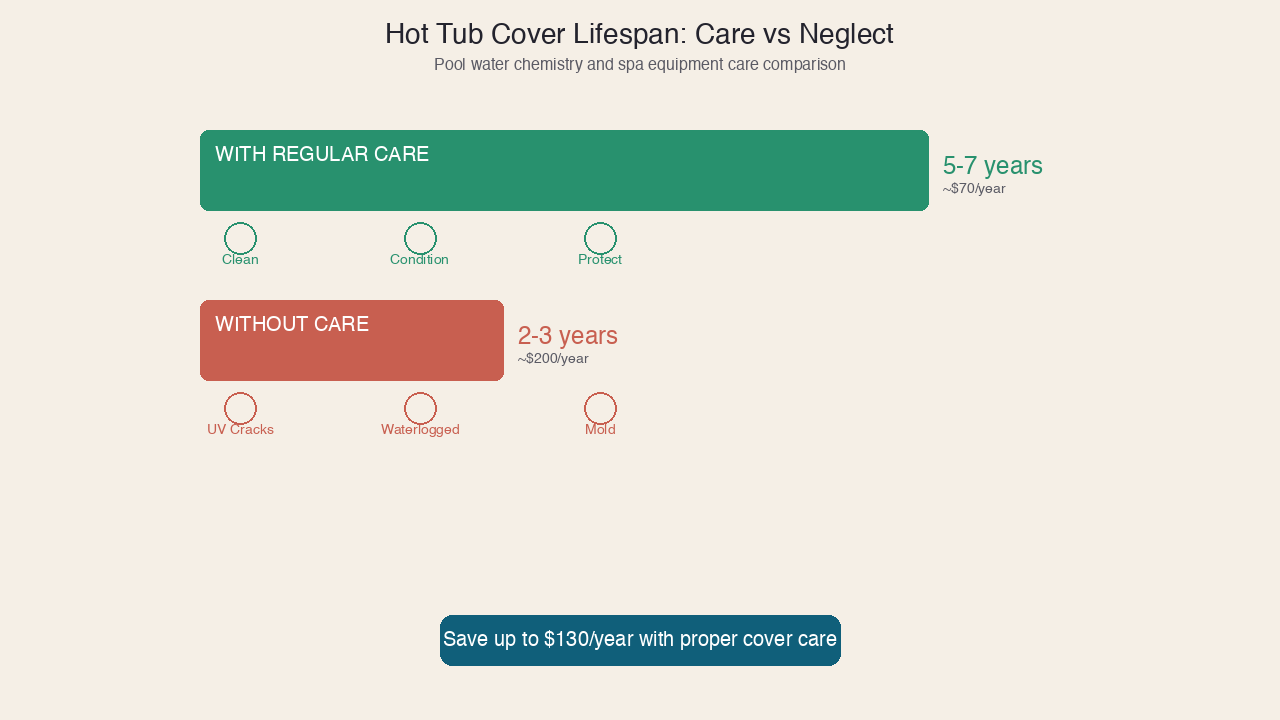
Hot tub covers have 2-4 inch closed-cell foam cores wrapped in vinyl, hinged in the middle, sealed with a vapor barrier. Pool covers (solar, mesh, safety) are single-layer. The foam core is the insulation — once it absorbs moisture, the cover loses 60-80% of its R-value.
Constant heat and humidity
Hot tub covers sit above 100°F water year-round. The underside faces constant steam — warm, humid, and perfect for mold. Pool covers rarely face this because pool water stays below 90°F most of the season.
Vinyl vs polyethylene
Hot tub covers are marine-grade vinyl — they need conditioning like boat seats. Pool covers are polyethylene or mesh, designed for seasonal replacement. Vinyl degrades from UV; polyethylene degrades from chlorine. Different chemistry, different care. For more on why spa and pool maintenance diverge, see our spa vs pool chemistry guide.
The 3-step cover care routine
The core methodology: clean, condition, protect. Each step targets a different failure mode.
Step 1: Clean the exterior — monthly
Use mild dish soap (1 teaspoon per gallon of warm water) or a dedicated spa cover cleaner. Wash the top vinyl with a soft brush or microfiber cloth, working in sections. Rinse with clean water and let it air-dry completely before closing.
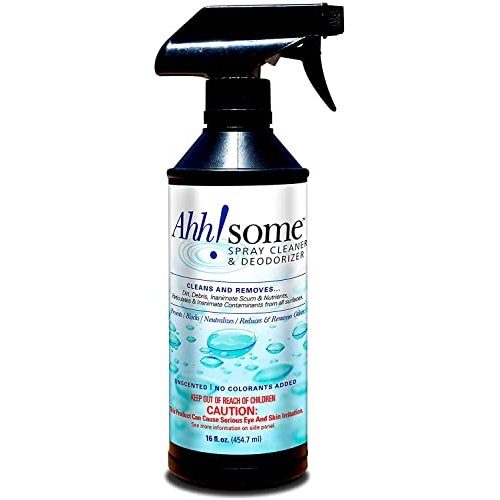
Skip: abrasive cleaners, bleach, petroleum-based solvents, stiff brushes. These strip the vinyl’s protective coating and accelerate UV damage. Don’t use anything you wouldn’t put on a leather car seat. For stubborn grime, the Ahh-Some Hot Tub Shell and Cover Cleaner ($23.95) is foam-free and biodegradable — formulated for the vapor barrier surface.
Step 2: Clean the underside — quarterly
Flip the cover open and inspect the underside (the vapor barrier facing the water). Look for mold, mildew, and chemical residue. Wipe with a 50/50 white vinegar and water solution — bleach-free, non-toxic, and effective against surface mold. Dry completely before closing. Don’t skip this — trapped moisture is how mold gets established.
Step 3: Condition and protect — every 3-4 months
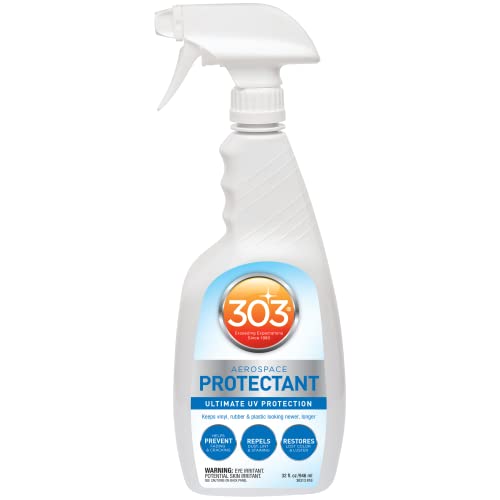
Apply a vinyl conditioner or UV protectant to the top surface. 303 Aerospace Protectant ($23.19, 32 oz) is the marine-industry standard — proven on thousands of boat seats and spa covers. Spray on, spread evenly with a microfiber cloth, let it absorb 5 minutes, then buff off excess.
Don’t condition the underside — it traps moisture against the foam. The top surface only.

Mold and mildew removal
Mold on the underside is the number-one reason covers fail early. The vapor barrier sits inches above 100°F water — warm, damp, and perfect growing conditions.
Early-stage surface mold
If you catch it early (discoloration but no smell), wipe the underside with white vinegar solution. Let it sit 10 minutes, scrub gently, rinse, and dry. Run the hot tub with the cover open for 1 hour after treatment to fully air out the underside.
Established mold with odor
For heavy mold with a persistent mildew smell: remove the cover, lay it flat in a shaded outdoor area, and clean both sides. Use Ahh-Some Cover Cleaner on the underside. If the vapor barrier has failed and mold has reached the foam core, no cleaner will save it — the cover needs replacement.
Prevention — the 15-minute rule
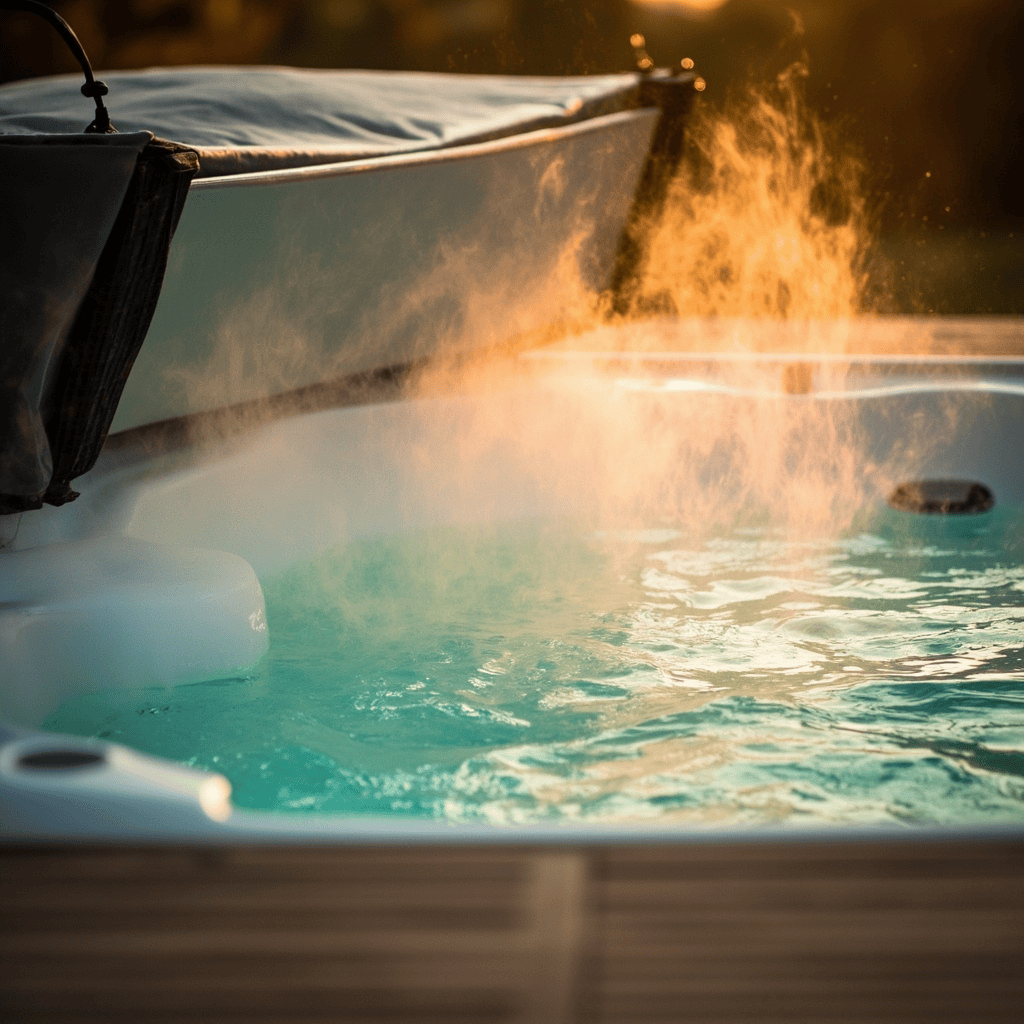
After each soak, leave the cover open 15-20 minutes to let trapped steam escape. This single habit reduces underside mold by 80% or more. It costs nothing and takes zero effort.
Winter cover care
Snow, ice, and freeze-thaw cycles are brutal on vinyl and foam. Here’s how to protect your cover through the cold months.
Snow load management
Clear snow accumulation exceeding 3 inches. A wet, packed 12-inch snow load adds 50-80 lbs of weight — enough to crack foam cores or tear hinges. Use a soft-bristle push broom. Never a metal shovel. For your broader winter prep, see our guide to winterize your pool.
Ice and freeze-thaw damage
Ice forms when melted snow refreezes overnight. Don’t chip ice off the vinyl — it tears the surface. Pour warm (not hot) water to melt the bond, then brush off slush. Repeated freeze-thaw cycles expand micro-cracks in the vinyl, which is why conditioning before winter hits is critical.
Cover cap for extended protection
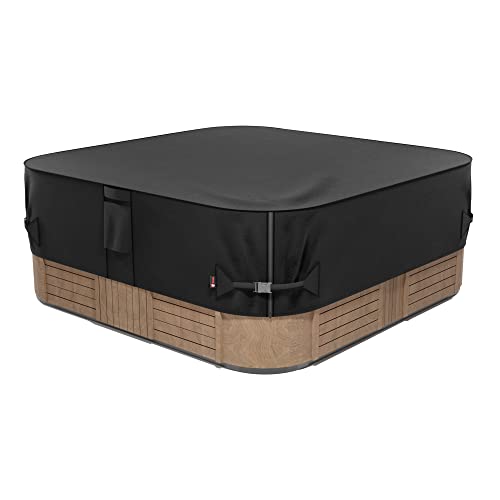
A waterproof cover cap — a fitted tarp-style shield — adds a UV and moisture barrier for $25-50. It extends cover lifespan by 1-2 years in harsh climates. The iBirdie 93x93 inch cap ($50.59) fits most standard hot tubs.

When to repair or replace — decision tree
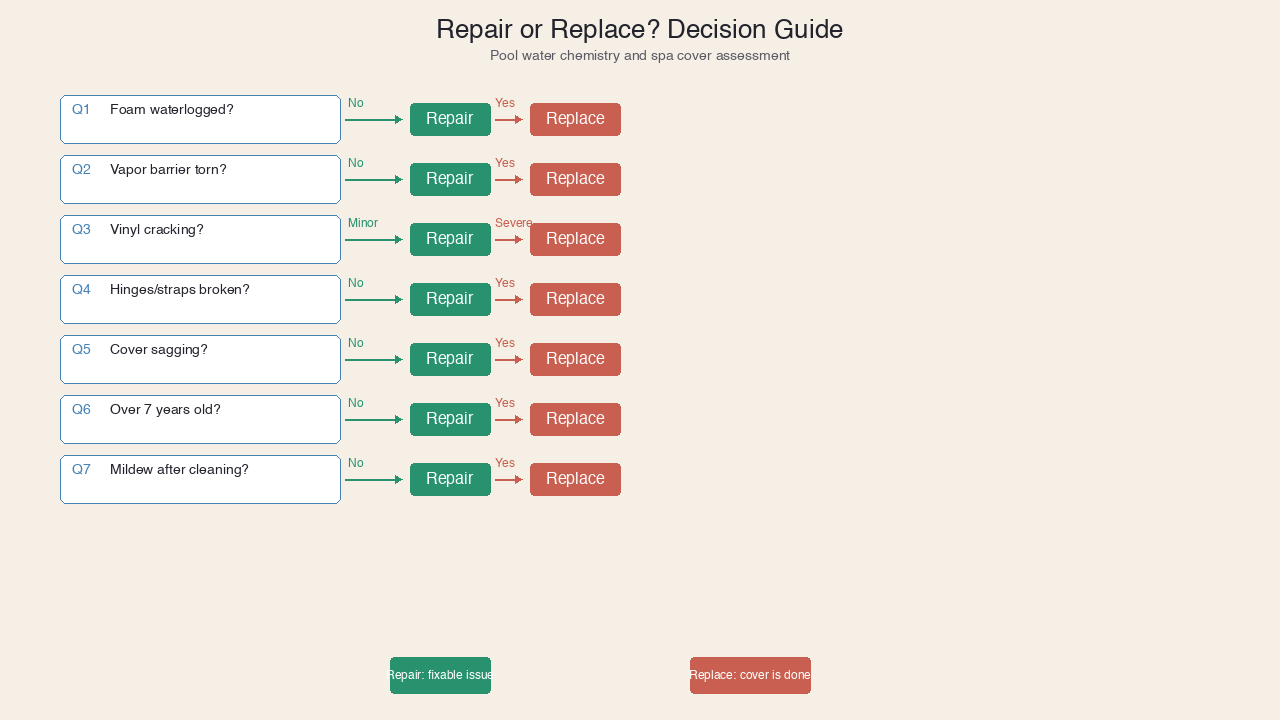
Most cover problems fall into a clear repair-or-replace decision. Work through these questions in order.
Q1: Is the foam waterlogged?
If the cover feels 50+ lbs heavier than when new, the foam is saturated. Replace. Waterlogged foam can’t be dried, and the extra weight stresses hinges and your back.
Q2: Is the vapor barrier torn?
If the thin plastic film sealing the foam is torn or peeling, moisture has a direct path inside. Replace. Once the foam core gets wet, it’s irreversible.
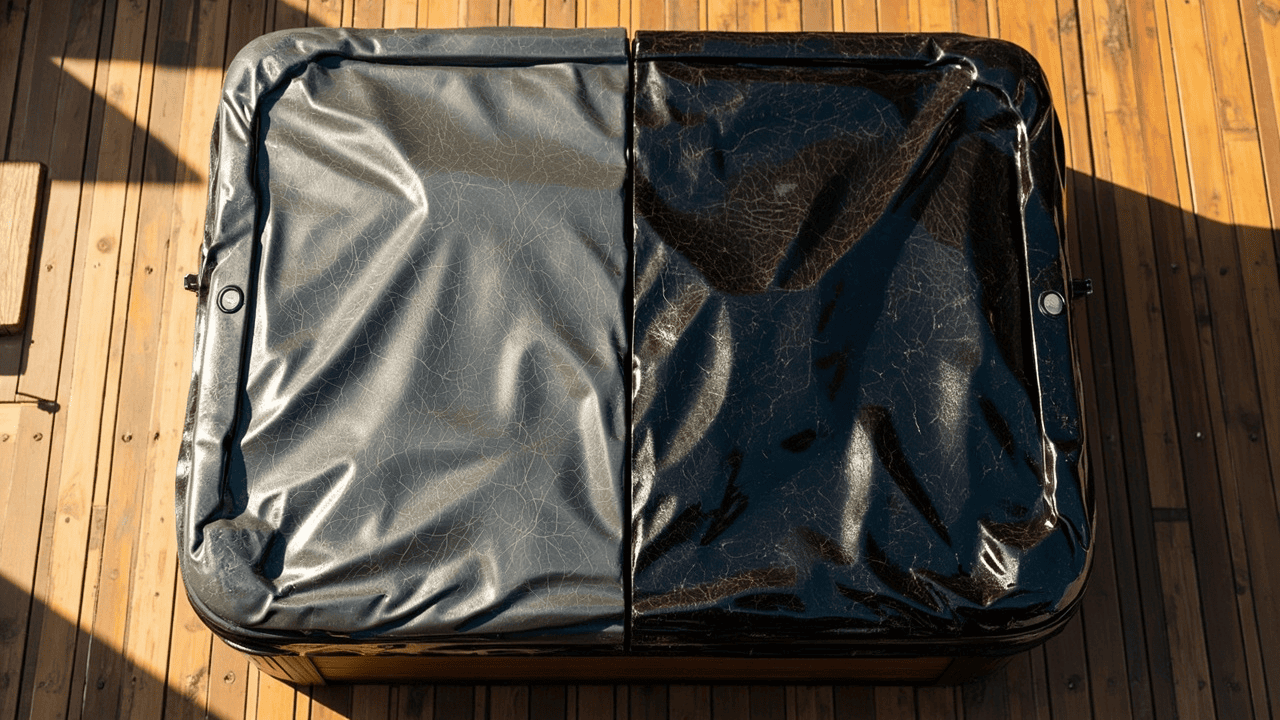
Q3: Is the vinyl cracking?
Small surface cracks at the hinge fold — condition and monitor for 3 months. Deep cracks through the full vinyl thickness — replace. The foam underneath is already exposed.
Q4: Are the hinges or straps broken?
Replacement hardware kits cost $15-30 and take 10 minutes to install. Repair. This is the one cover problem that’s always cheaper to fix.
Q5: Is the cover sagging in the middle?
Sagging means the foam cores are broken internally. Replace. Broken cores can’t support the cover and will accelerate hinge wear.
Q6: Is the cover over 7 years old?
Replace proactively, even if it looks OK. Internal foam degradation and vapor barrier breakdown are invisible until the cover fails.
Q7: Does it smell like mildew after deep cleaning?
If the smell persists after a full vinegar-and-cleaner treatment, mold has penetrated the foam core. Replace. No product reaches inside the foam.
What you’ll need
Five products cover the full clean-condition-protect lifecycle. You don’t need all five — pick based on your situation.
303 Aerospace Protectant — UV protectant
32 oz, $23.19. The marine-industry standard for vinyl conditioning. Apply every 3-4 months to the top surface. Skip it if your hot tub sits in a shaded, covered installation with minimal UV exposure.
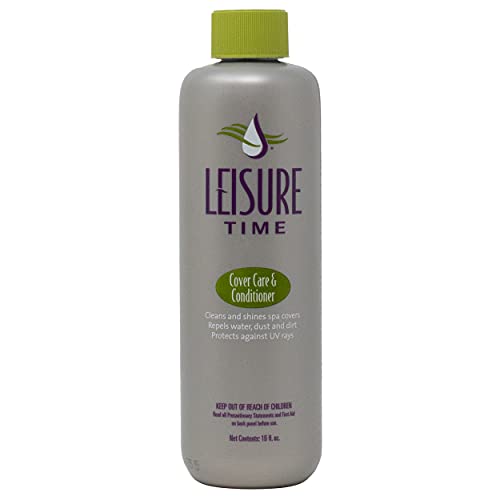
Leisure Time Cover Care and Conditioner — all-in-one
16 oz, $17.36. Cleans light dirt while depositing UV inhibitors. Good if you want one product instead of separate cleaner and conditioner. Don’t expect it to handle heavy mold — it’s a maintenance product, not a treatment.
Ahh-Some Hot Tub Shell and Cover Cleaner — underside cleaner
16 oz, $23.95. Foam-free and biodegradable, formulated for the vapor barrier. Use it when vinegar alone isn’t cutting through established grime.
iBirdie Waterproof Cover Cap — weather shield
93x93 inch, $50.59. Blocks UV and sheds snow. Worth it if you get 20+ inches of annual snowfall or live in a high-sun climate.
REGMICS Cover Lifter — damage prevention
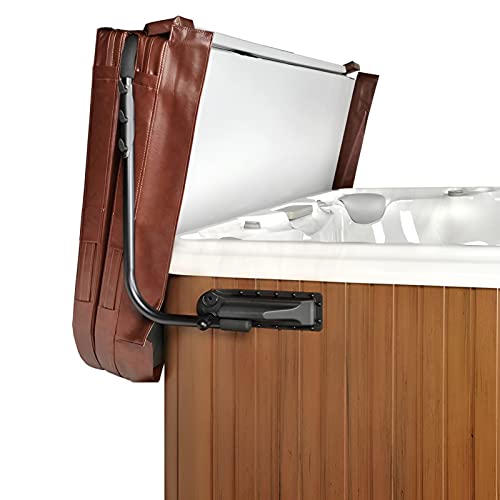
$142.36. Mechanically removes and stores the cover on each use. It prevents the number-one cause of foam-core damage: people dragging, dropping, or leaning the cover against a wall. A lifter pays for itself by preventing one cracked core.
What to buy only if needed
Not every cover situation needs the full toolkit. Here’s what to add based on your specific problem.
If you have recurring mold
If your underside grows mold every few weeks despite regular cleaning, the vapor barrier is likely compromised. A cover cap can buy 6-12 months while you save for a replacement. Don’t waste money on biocidal sprays — they don’t reach the foam core.
If you live in a snowy climate
If you get 20+ inches of annual snowfall, a cover cap is essential, not optional. Without one, freeze-thaw cycles will crack the vinyl within 2 seasons. Pair the cap with a soft-bristle snow brush ($10-15 at any hardware store).
If you struggle to lift the cover
If the cover is physically difficult to remove — heavy, awkward, or causing back strain — a hydraulic cover lifter is a health investment. Waterlogged covers can exceed 100 lbs. A lifter eliminates the injury risk and the drop-damage that destroys foam cores.
If your vinyl is already fading
If the top looks chalky or faded but the foam is still dry, you don’t need a new cover yet. Two applications of 303 Protectant, 30 days apart, can restore the surface UV layer and add 1-2 years of life.
Common mistakes
-
Using bleach or abrasive cleaners. Bleach destroys vinyl UV inhibitors and accelerates cracking. Abrasive powders scratch the surface, creating channels for moisture and UV penetration. Use mild dish soap, white vinegar, or dedicated spa products.
-
Conditioning the underside. Applying conditioner to the underside traps moisture against the foam core. Condition the top surface only. The underside gets cleaned and dried, never conditioned.
-
Closing the cover immediately after soaking. Trapped steam condenses on the underside, feeding mold growth. Always leave the cover open 15-20 minutes after each soak.
-
Ignoring the vapor barrier. The vapor barrier is the thin plastic film sealing the foam core. Once it tears or peels, moisture enters permanently. Inspect quarterly — a torn barrier means the cover is on borrowed time. Don’t try Ahh-Some cleaner as a fix for barrier failure; it only handles surface mold, not core saturation.
-
Using a snow shovel to clear winter debris. Metal or rigid plastic shovels crack vinyl and dent foam cores. Use a soft-bristle broom or a dedicated foam snow rake. One shovel strike can crack a foam core that costs $200+ to replace.
When to call a pro
Call a spa technician if:
- Your cover has integrated electronics (speakers, lighting) and needs repair
- The cover is custom-shaped and needs exact-fit replacement measuring
- The hinge mechanism is structurally damaged — not just hardware replacement
- You’re replacing the cover and want a cover lifter sized and installed at the same time
- The cover is waterlogged and too heavy to remove alone — 100+ lbs with real injury risk
Safety notes
Cover weight hazard
A waterlogged cover can weigh 80-120 lbs. Never flip or remove a saturated cover alone — the sudden weight shift can cause back injury or crush fingers in the hinge. Two people or a cover lifter is required.
Cleaning product handling
Wear gloves when using concentrated cover cleaners. Work in a ventilated area — even mild spa cleaners emit fumes in enclosed spaces. Never mix cleaning products, especially vinegar with bleach — that combination produces toxic chlorine gas.
Electrical awareness
Some premium covers integrate heating elements, lighting, or speaker wiring. Always disconnect power before cleaning near electrical components. Never spray liquid directly onto or near integrated electronics.
Slip hazard
Cleaning products on a wet deck create a serious slip hazard. Rinse the surrounding area after cleaning, and wear non-slip footwear.
Related
- Hot Tub Water Care Basics — the companion guide to water chemistry maintenance
- Spa vs Pool Chemistry — why hot tub water care differs from pool care
- Weekly Pool Care — weekly maintenance routine companion
Key takeaways
- Clean the vinyl top monthly with mild soap; clean the underside quarterly with vinegar solution.
- Condition the top surface every 3-4 months with a UV protectant — 303 Aerospace Protectant is the industry standard.
- Leave the cover open 15-20 minutes after each soak to prevent underside mold.
- Clear snow above 3 inches with a soft broom — never a shovel.
- Inspect the vapor barrier quarterly; once it fails, the foam core is doomed.
- A cover cap extends lifespan 1-2 years in harsh climates.
- Replace waterlogged, mold-saturated, or 7+ year-old covers — no product revives failed foam.