

Your strip reads past 100 on CYA and the water won’t clear. Get a real number, move that fraction of the water, stop the source.
Quick answer
Cyanuric acid doesn’t break down in sunlight, doesn’t evaporate, and no filter removes it, so the only way out is carrying water out of the tub. Test with a drop-count kit, not a strip. Going from 100 ppm to 30 ppm means removing 70% of the water: 280 gallons out of a 400-gallon tub, then 280 back in. Skip CYA reducers — nothing in that aisle takes CYA out of water.
What this is not
Not a pool problem in a smaller tub
A pool holds 30 to 50 ppm of CYA because UV eats its chlorine and CYA pays for it. A hot tub has no meaningful UV load and a much heavier bather load per gallon, so CYA buys nothing. The spa target is 0 to 30 ppm. The cyanuric acid guide holds the pool baseline; this page converts it to 400 gallons.
Not a drain-and-refill reflex
Owners drain whatever is convenient and assume it’s handled. Twenty percent out of a 140 ppm tub lands at 112 ppm — that’s how a pointless second drain gets scheduled. There is a number, and it’s the percentage. Hot tub water care basics said to drain if a previous owner used CYA, with no method attached.
Not something a product can deliver
No filter media removes it, so the enzyme “CYA reducer” can’t be shown to do this. The pool-scale guide calls that aisle a waste of $40, and there’s deliberately no affiliate link on that sentence. High CYA isn’t a cloudiness fix either — it collapses effective chlorine while the strip reads in range. See cloudy water troubleshooting.
Decision tree: how much do you actually drain?
Branch 1 — under 50 ppm, and you feed it trichlor or dichlor
Don’t drain. Stop the stabilized chlorine and re-test in three weeks; a tub at 40 ppm with no new CYA entering drifts down on its own.
Branch 2 — 50 to 100 ppm on a 300 to 500 gallon tub
One session gets you there. Drain the percentage from the table below, refill, rebalance. Budget a day for the reheat.
Branch 3 — over 100 ppm
Get a reading you can dilute: Taylor’s CYA-120 uses 1:4 times 5 above 100 ppm, Palintest’s 1:10 times 10. The real reading usually runs well above the strip.
Branch 4 — over 150 ppm, or a drain you cannot make
Stage it. The staged table below has the arithmetic.
Branch 5 — wrong tub, wrong water, or a cloudy tub
A swim spa holds 800 to 1,200 gallons, multiplying every number here by two or three, and high groundwater turns a big drain into a pop-out risk. A cloudy tub still has live sanitizer demand, so drain last.
How CYA gets in, and how to stop it
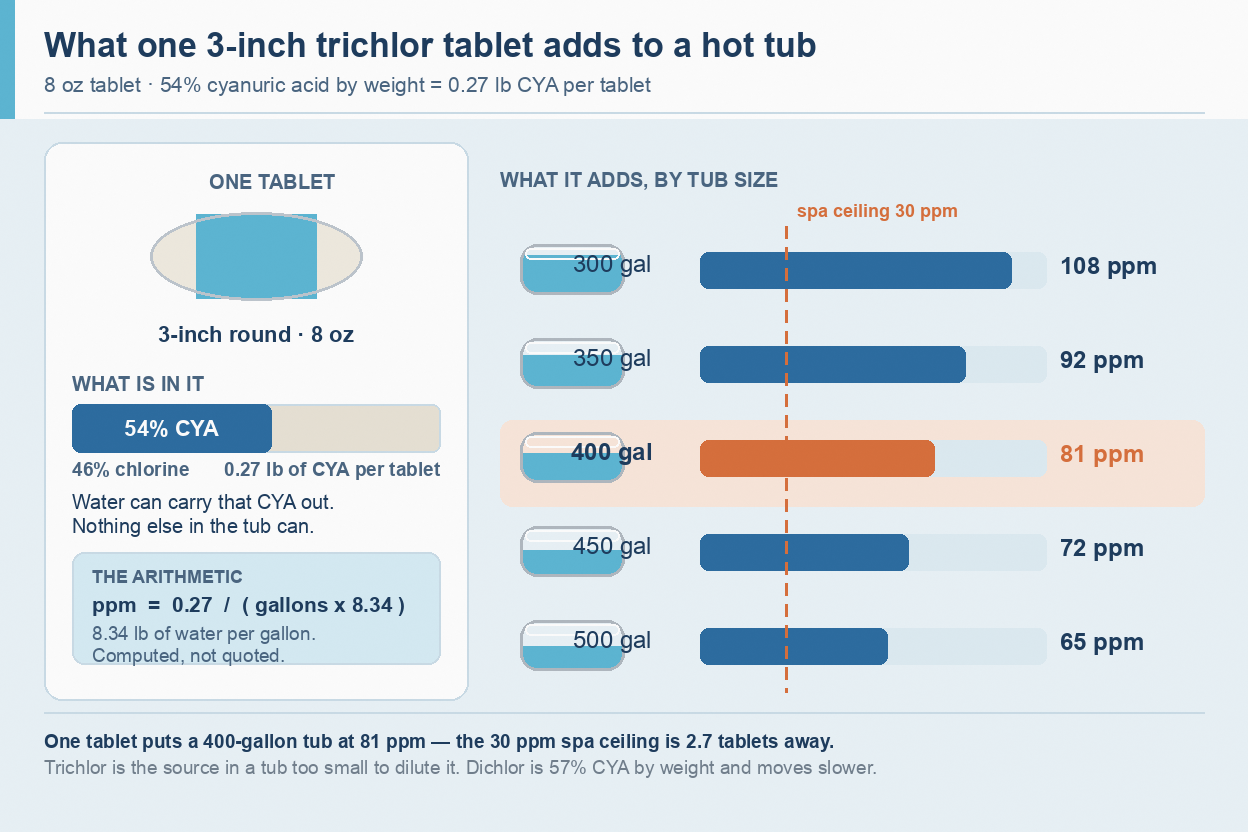
One trichlor tablet is 81 ppm in a 400-gallon tub
Service Industry News worked this out for pools in 2023: water weighs 8.34 pounds per gallon, and a 3-inch tablet weighs 8 ounces. Trichlor is 54% CYA by weight — 0.27 pounds per tablet, which lands at 3.2 ppm in their 10,098-gallon example pool. Run that on a spa and you get 81 ppm in a 400-gallon tub, 108 ppm in a 300-gallon one. Computed, not quoted.
Dichlor does it slower, and health authorities say leave CYA out
Dichlor is 57% CYA by weight per the Montana fact sheet. Sierra Pool & Spa Repair adds the operational version: every 10 ppm of chlorine from dichlor raises CYA about 9 ppm. At 1.5 teaspoons four times a week in a 300-gallon tub, that reaches 100 ppm in about seven weeks. Montana’s food-safety section doesn’t recommend CYA or stabilized chlorine in spas. At moderate CYA, chlorine takes up to a hundred times longer to kill Pseudomonas aeruginosa, the organism behind hot tub itch. Sierra quotes CDC guidance from May 2016 the same way.
Then stop the source and keep watching. One strip and one non-chlorine shock a week cost nothing against a drain day, and pool test strips read reliably at 50 to 100 ppm. The spa vs pool table has the 0 to 30 ppm target.
The drain math: how much water to move
Cyanuric acid doesn’t degrade, so dilution is the only mechanism: refilling with CYA-free water removes exactly the percentage you pulled out.
One session: the percentage and the gallons
Percentage to remove is 1 minus target over current. On a 400-gallon tub, gallons out is the percentage times four.
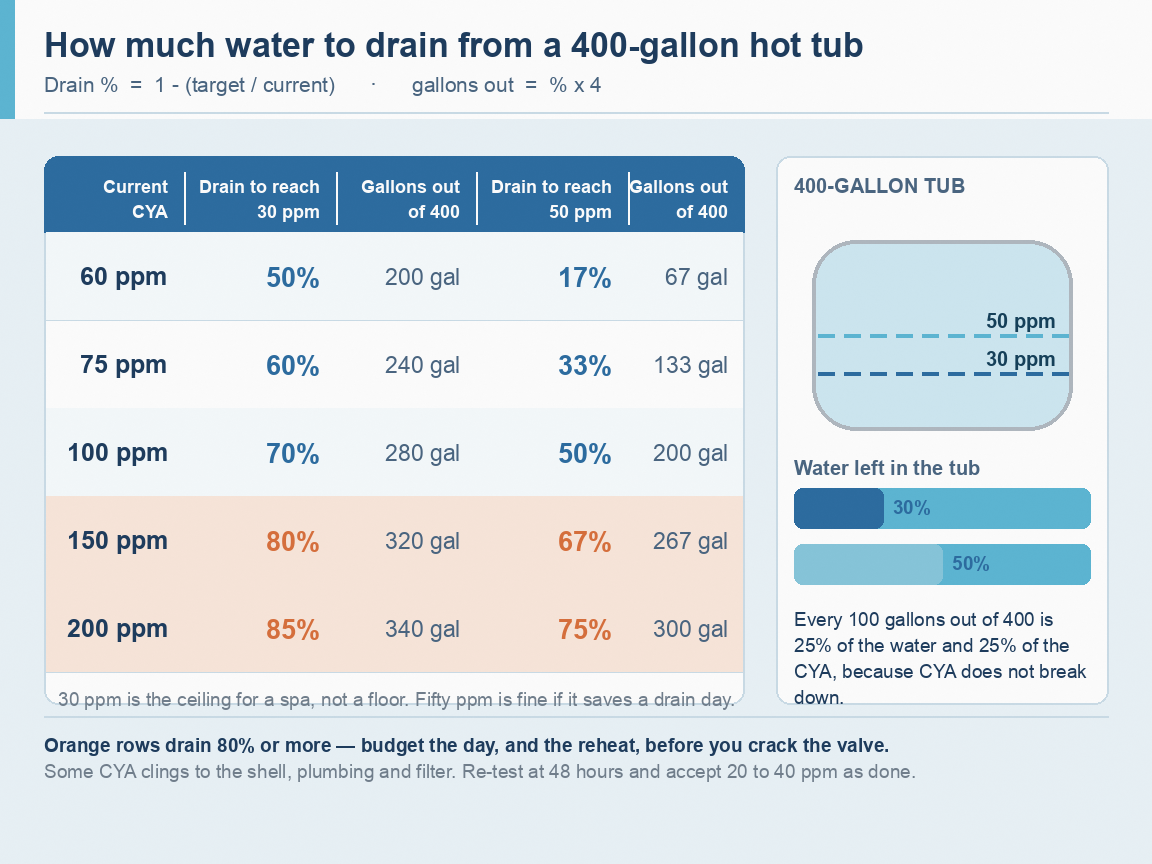
| Current CYA | To reach 30 ppm | Gallons out of 400 | To reach 50 ppm | Gallons out of 400 |
|---|---|---|---|---|
| 100 ppm | 70% | 280 | 50% | 200 |
| 150 ppm | 80% | 320 | 67% | 267 |
| 200 ppm | 85% | 340 | 75% | 300 |
Thirty ppm is the ceiling for a spa, not a floor. Fifty is fine if it saves a drain day.
The percentages multiply, they don’t add
Each session removes a fraction of what’s left, not of what you started with. Staging earns its keep when one session would drain most of the tub, when the drain must wait for a free weekend, or when the plumbing forbids a big drain.
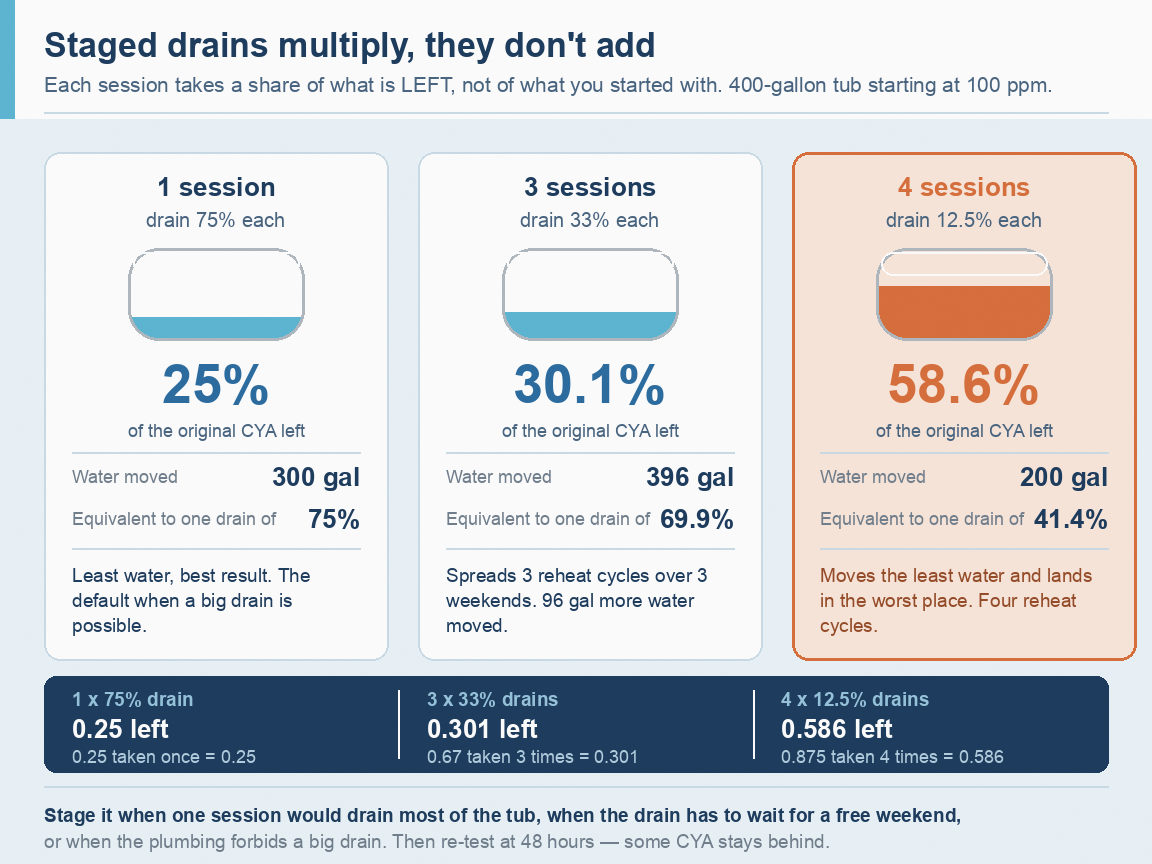
| Plan on a 400-gallon tub | Water moved | CYA left | Same as one drain of |
|---|---|---|---|
| 1 × 75% | 300 gal | 25% | 75% |
| 3 × 33% | 396 gal | 30.1% | 69.9% |
| 4 × 12.5% | 200 gal | 58.6% | 41.4% |
Read the last row: four small drains move the least water and land in the worst place. Some CYA also stays behind, clinging to the tub, plumbing, and filtration — so re-test at 48 hours and treat 20 to 40 ppm as done.
Test it properly, including off the scale
A strip pad cannot make this decision
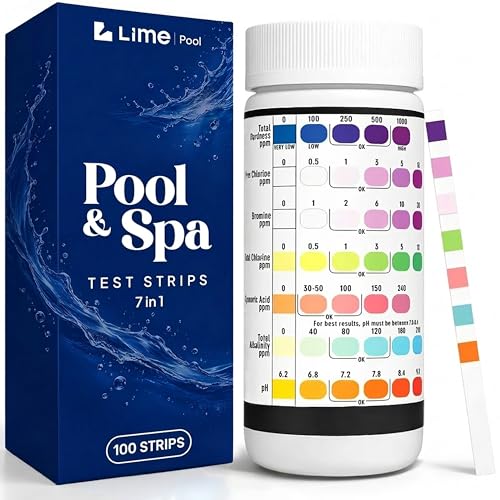
Most 7-way strips run a CYA pad that tops out near 100 ppm, and liquid test kits vs strips covers the accuracy gap. A 400-gallon tub passes 100 ppm from one tablet, so the range where you need a drain is the one a pad can’t resolve. A saturated pad read low is what schedules a pointless second drain. A drop-count kit is the fix.
Dilute past 100, and watch the reagent age
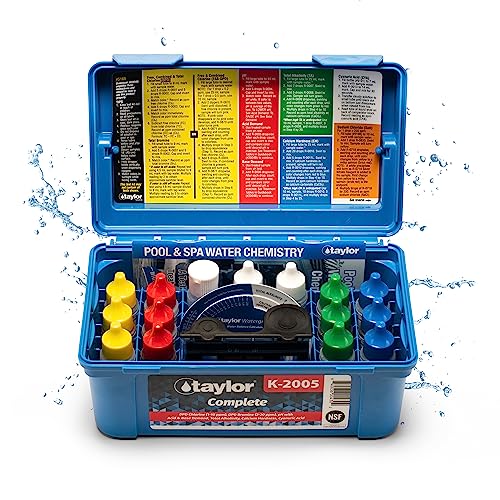
A drop-count test resolves the number and can be diluted. The K-2005-class 9-in-1 DPD kit runs that test alongside the rest of the balance. Under the ceiling, 7-way strips do the weekly monitoring. How to test pool water properly has the rest: melamine CYA reagent expires about a year sealed and six months opened. An old open bottle reads low — the dangerous direction, because it under-drains.
What you’ll need
Taylor Technologies K-2005 DPD, 9-in-1 Complete Pool Test Kit
The reading the procedure runs on, and the only tool here you can dilute past 100 ppm.
7-Way Pool Test Strips - 100 Strips Hot Tub, Spa, Pool Water Testing Kit
The monitoring tool, not the decision tool. Skip a CYA reducer — wrong aisle — and skip a wider strip, which still saturates near 100.
Clorox Pool&Spa Swimming Pool pH Up, 4 lb
Fill water arrives with no total alkalinity, and no sanitizer holds in unbuffered water. That’s why the rebalance order isn’t negotiable.
A filter cartridge and a garden hose, and no link on either
Swap the cartridge if it’s over a year old — no link, because cartridges are dimensioned per model. The discharge point matters more than the hose.
Run the drain-and-refill session, then rebalance
- Test and record CYA, pH, total alkalinity, calcium hardness, and free chlorine. You need the calcium number to pick a sanitizer.
- Stop adding CYA now, before the drain. Trichlor on day two undoes it.
- Breaker off at the box, not the control panel, then pull the skimmer basket and insert the rubber expansion plug so the line doesn’t lock air.
- Hose on the drain valve, routed to a storm drain and away from lawn and plants. Crack the air valves and let it run.
- Watch the level, not the clock. Stop at the percentage from the table, well before the tub looks empty.
- Flush the plumbing while you’re in there — jets full, filter off, pipe-cleaning solution 15 to 30 minutes (Bob Vila’s guide).
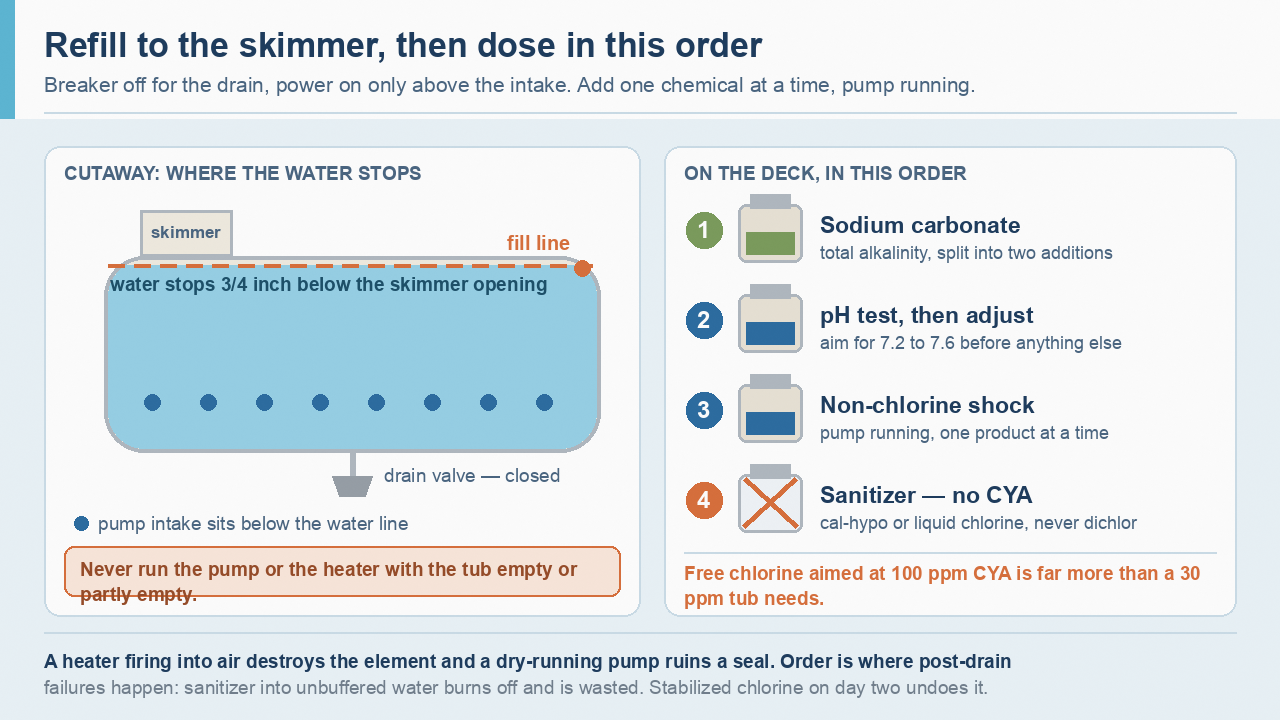
- Valve closed, hose off, cover back on if the tub will sit a few hours, and refill to 3/4 inch below the skimmer opening.
- Work the hot tub startup checklist, then re-test CYA at 48 hours and accept 20 to 40 ppm as done.
The session in one view
Add alkalinity first, in two scoops
Fresh water has no buffer and sodium carbonate drives pH hard, so pH Up goes in split into two additions an hour apart with a test between. The chemical dose calculator handles the gram amount; the split handles the overshoot. Then aim for 7.2 to 7.6 — the pH guide has the mechanism.
Then sanitizer, less of it than you’re used to
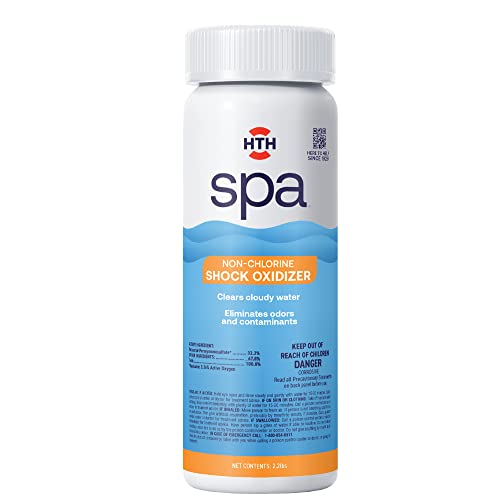
Non-chlorine shock first, then your sanitizer — chlorine demand in unbuffered water is high and much of the dose burns off first. Free chlorine that’s right at 100 ppm CYA is far more than a 30 ppm tub needs, and overdosing puts dichlor straight back in. The free chlorine guide has the ratio; cal-hypo is the CYA-free route.
Common mistakes
- Reading CYA off a pad that maxes out at 100. It saturates exactly where a 400-gallon tub sits after one tablet, so a ceiling read low schedules a pointless second drain. A drop-count kit is the fix.
- Shocking harder when high CYA has stalled the water. The kill time at high CYA is what stopped working, so more chlorine changes nothing.
- Draining “some” without a percentage. Twenty percent out of a 140 ppm tub lands at 112 ppm, and it costs a drain day and a reheat cycle.
- Draining, then putting stabilized chlorine straight back in. A complete drain day that ends where it started.
- Adding percentages across sessions instead of multiplying them. Four 12.5% drains leave 58.6% of the CYA and cost four reheat cycles.
Safety notes
- The water you are draining is chlorinated. Route it to a storm drain or sewer, off the lawn, away from plants, clear of the foundation. Don’t run 280 gallons into a garden bed: nothing you drained is food-safe for plants or livestock.
- Never run the pump or the heater while the tub is empty or partly empty. A heater firing into air destroys the element, and a dry-running pump ruins a seal. Breaker off for the drain, power on only above the intake.
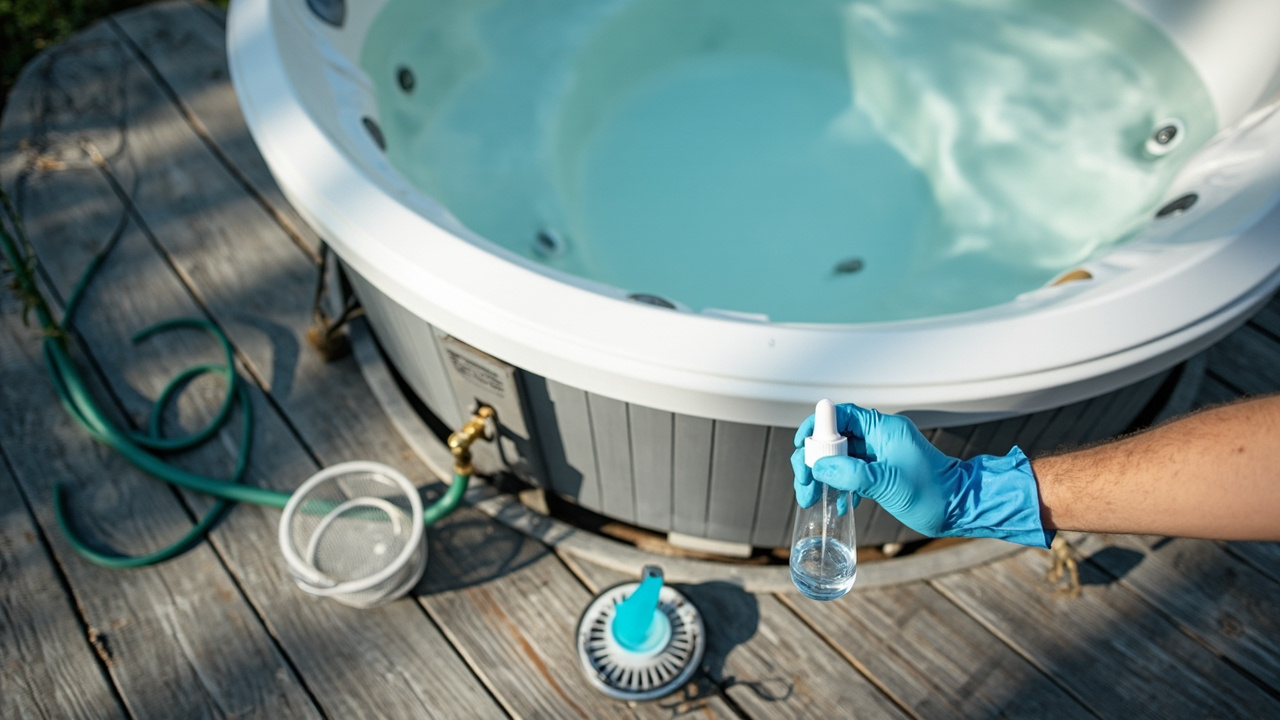
- Eye protection and gloves for the refill dosing. Store every chemical away from children and pets, upright, in the original containers, never in a drink bottle. The four bottles on the deck mid-rebalance are the four a child grabs first.
- Do not mix drain-side and refill-side products, and never combine two dry chemicals — the reaction is violent and releases gas. Add one at a time, fully dissolved, pump running.
- Avoid a second hose or shop vac while the power is on, and treat the water as undrinkable.
When to call a pro
The site or the vessel can’t take the drain
High groundwater against the shell is a pop-out risk, and shells aren’t engineered for full drainage. A swim spa at 800 to 1,200 gallons is the same problem in another shape — every number here assumes 300 to 500 gallons.
Two drain cycles and the number has not moved
Drained per the table, rebalanced, waited 48 hours, and CYA is still where it started. Your fill water carries CYA, the test reads low on aged reagent, or the plumbing hides a source. All three need someone with a fresh kit and a plan.
Itching that comes back after a proper refill
Itching or rash that recurs after a correct drain-and-refill isn’t chemistry. That’s a service tech, not more shock.
What to buy only if needed
Only if calcium hardness is under about 200 ppm
Cal-hypo is chlorine with no CYA attached, which is the point. Skip it above about 200 ppm calcium hardness — it scales a 100-degree tub. For hard fill water, bromine plus non-chlorine shock is the CYA-free path instead.
Only if CYA will not resolve past 100 ppm on a drop test
Then you need the dilution technique and a kit that supports it, not a bigger strip.
Never: a CYA reducer
Named so you don’t spend $40 in the wrong aisle. No link: telling you not to buy something while earning a commission on it loses you fast.
Related
- Spa vs Pool Chemistry — the table whose CYA row is why this page exists.
- Cyanuric Acid Explained — the pool baseline this converts to 400 gallons.
- Hot Tub Water Care Basics — the routine this fits.
Key takeaways
- CYA doesn’t decompose or evaporate, and no filter removes it. The only exit is carrying water out.
- Drain percentage is 1 minus target over current: 100 to 30 ppm means 280 gallons out, 280 back.
- A strip pad that tops out at 100 ppm can’t tell 100 from 160. Use a drop-count kit and dilute past 100.
- One 3-inch trichlor tablet adds about 81 ppm to a 400-gallon tub — that’s why the reading returns.
- Staged percentages multiply, they don’t add; four small drains land in the worst spot.
- Some CYA stays in the shell after a full drain. Re-test at 48 hours; 20 to 40 ppm is fine.
- Rebalance in order — alkalinity, pH, sanitizer — with a free chlorine target lower than before.