
Your saltwater pool is going green, mustard, or black, and you don’t want to wreck the salt cell trying to fix it. The wrong shock scales the cell. The wrong algaecide stains the plaster. The wrong brush tears the vinyl liner. Match the type you see to the right SLG dose, brush with nylon on vinyl and fiberglass, and add polyquat 60 only after FC drops back below 5 ppm.
Quick answer
Saltwater pools get the same four algae types as chlorine pools — green, mustard (yellow), black, and pink. Sodium hypochlorite 12.5% (SLG) is the standard shock because it adds only free chlorine without raising calcium hardness or CYA. Polyquat 60 is the only safe backup algaecide because copper-based algaecides corrode the salt cell. Test salt, FC, pH, CYA first, brush every wall, then shock to 10 to 15 ppm FC — and don’t reopen on a calendar clock.
What this is not
This hub assumes you already understand free chlorine, pH, CYA, and FC vs TC. If those terms are new, start with our pool water testing guide and come back.
This is also not a salt cell install guide. If you are converting from chlorine to salt, see saltwater pool basics for SWG sizing, plumbing, and electrical.
And this is not a replacement for the algae-types guide. The four pool algae types article covers how to identify green, mustard, black, and pink by sight and location. This hub is the saltwater treatment playbook once you have identified what you are fighting.
Why saltwater pools get algae differently
A saltwater pool does not behave like a chlorine pool — the salt cell produces free chlorine slowly, the cell output is sensitive to salt level and scale, and CYA interaction is amplified because saltwater pools run higher stabilizer levels. Each of these is a way for algae to slip through your normal routine.
The salt cell produces chlorine slowly
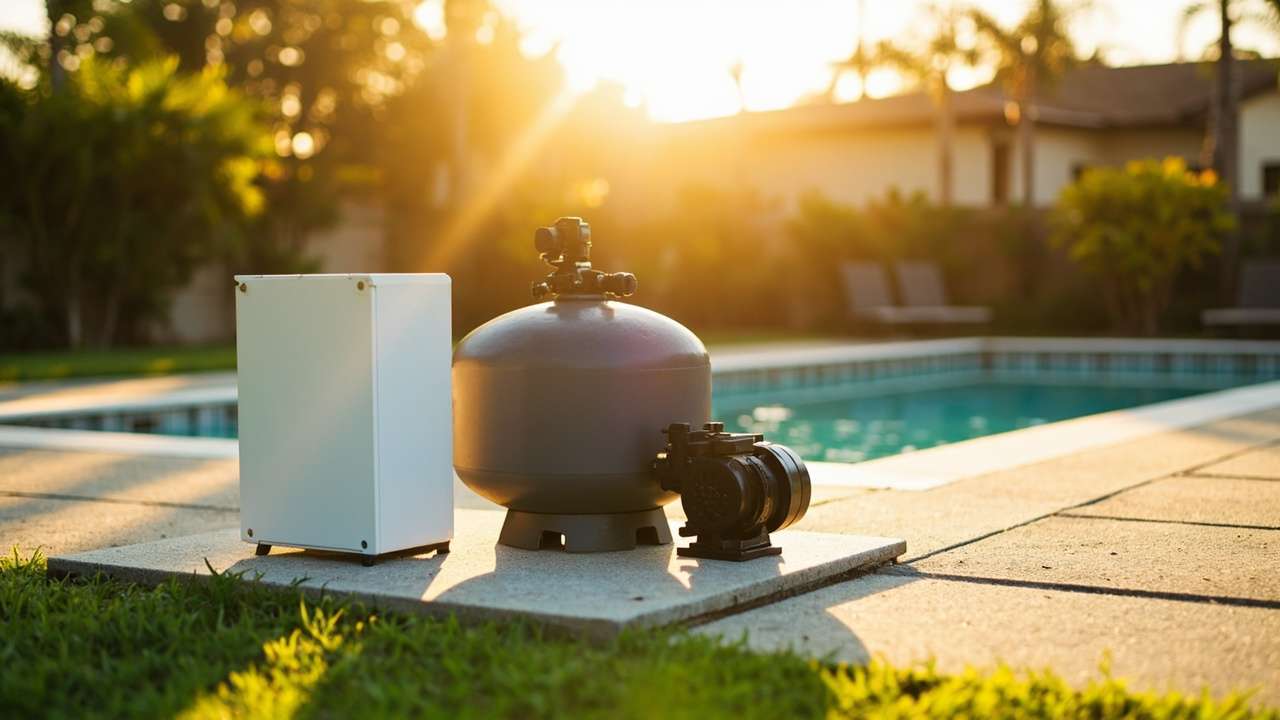
The salt cell uses electrolysis to convert dissolved salt into free chlorine on the cell plates. Output is steady — usually enough to hold 3 to 5 ppm FC on a normal day. In heavy bather load, hot weather, or after a storm, the cell cannot keep up. Algae spores that survive in 1 ppm FC will bloom in 3 to 5 days if FC drops below 2 ppm.
Low salt kills cell output before it kills the pool
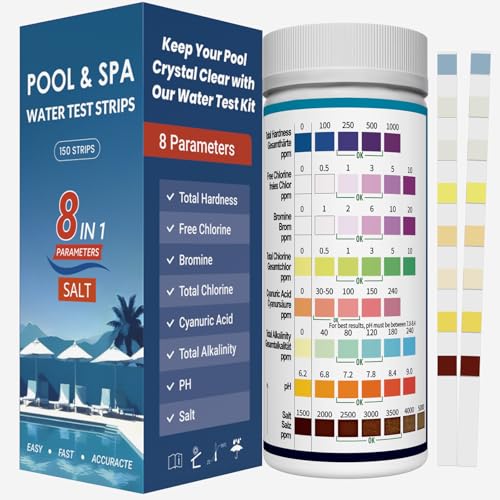
The salt cell shuts off or drops to low output when salt falls below 2,700 ppm. Many owners don’t realize this because the pool still looks clear right up to the moment it doesn’t. The first sign is often green water, not a low-salt reading. Test salt monthly with 8-in-1 strips that read salt ppm alongside FC and CYA — those are the only kind that catch a salt drop early. Add pool salt when readings drop below 3,000 ppm.
Scaled cell means reduced chlorine output
Calcium deposits on the cell plates act as insulation — the salt water cannot reach the plates, electrolysis drops, and FC falls even when salt is in range. Inspect the cell every 3 months and acid-wash when you see white scale. A scaled cell will show full output on the controller but produce 30 to 60 percent less chlorine.
CYA interaction is amplified in saltwater
Salt pools run higher CYA (60 to 80 ppm) than chlorine pools (30 to 50 ppm) because outdoor SWG cells need extra UV protection. The trade-off: at 80 ppm CYA, you need 5 to 7 ppm FC for a 7.5 percent FC-to-CYA ratio. If FC is 3 ppm and CYA is 100 ppm, effective chlorine is almost zero — algae will grow. Confirm pH is 7.2 to 7.6 before shocking — high pH cuts hypochlorite activity by 50 percent or more. Total alkalinity should sit at 60 to 80 ppm in saltwater to buffer pH without pushing it too high.
How to identify the algae in your saltwater pool
Green algae — cloudy water, the most common
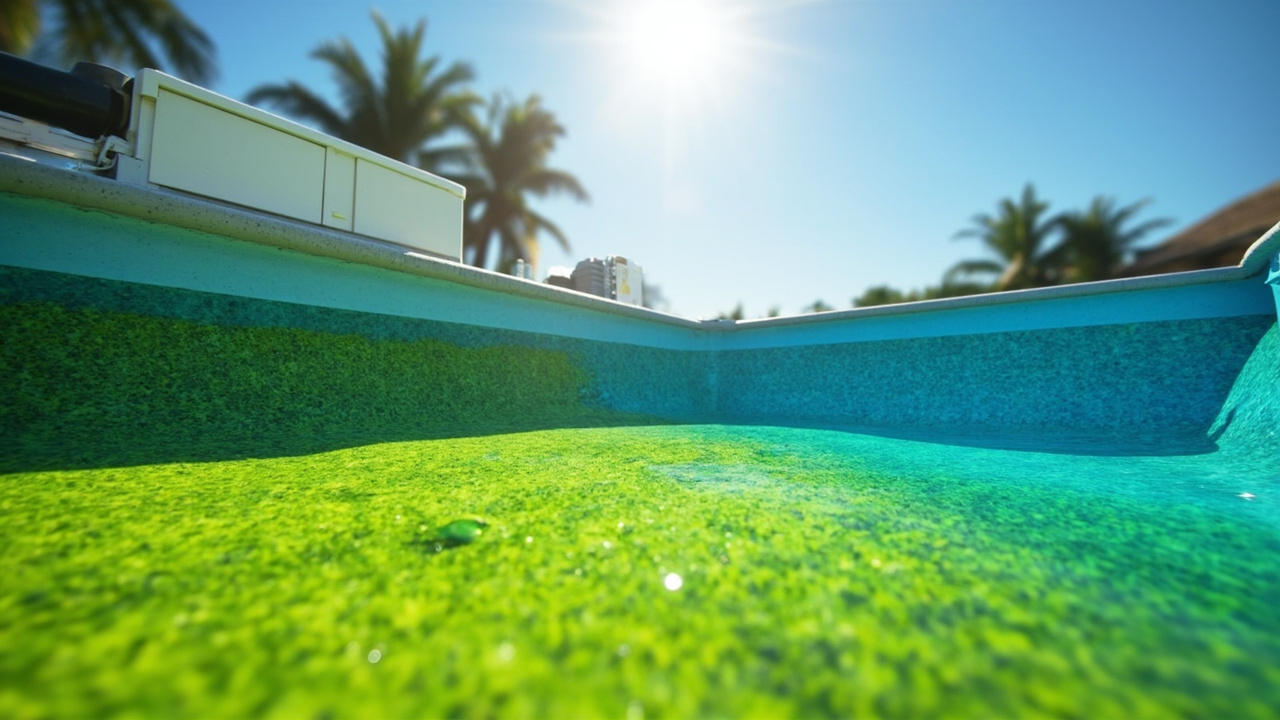
Free-floating in the water column, the entire pool turns cloudy green or yellow-green — the water itself is the algae. Most common in saltwater because the cell cannot keep up during heat waves or storms. Treated with SLG shock to 10 ppm FC.
Mustard algae — yellow powder on shady walls
Yellow-green powder that clings to shady walls, behind ladders, and in steps. Water stays clear but the surface is dusty. Mustard algae are chlorine-resistant in saltwater because they layer on the wall, so brushing alone fails — you need polyquat 60 backup after shocking.
Black algae — dark spots rooted into plaster
Dark blue-green to black coin-sized spots on plaster that resist brushing. Less common in saltwater because higher CYA suppresses it, but it appears when CYA drifts above 100 ppm. Black algae roots into plaster, so chlorine alone fails. Aggressive brushing with a stainless steel brush on plaster only (never on vinyl) plus SLG shock to 15 ppm FC for 3 days.
Pink algae — actually bacteria
Pink, red, or orange slimy film in skimmer lids, light niches, behind ladders, and on pool toys. Not really algae — Serratia marcescens bacteria. Saltwater pools get this less than chlorine pools, but when they do, the cause is usually organics (lotions, soaps, leaves) feeding the bacteria. Scrub all surfaces and shock to 5 ppm FC held for 48 hours.
Decision tree: which type and which shock
Use this branch when you first notice algae. Pick the answer that matches what you see, then jump to the matching treatment section below.
Q1 — Is the water itself cloudy green or yellow-green?
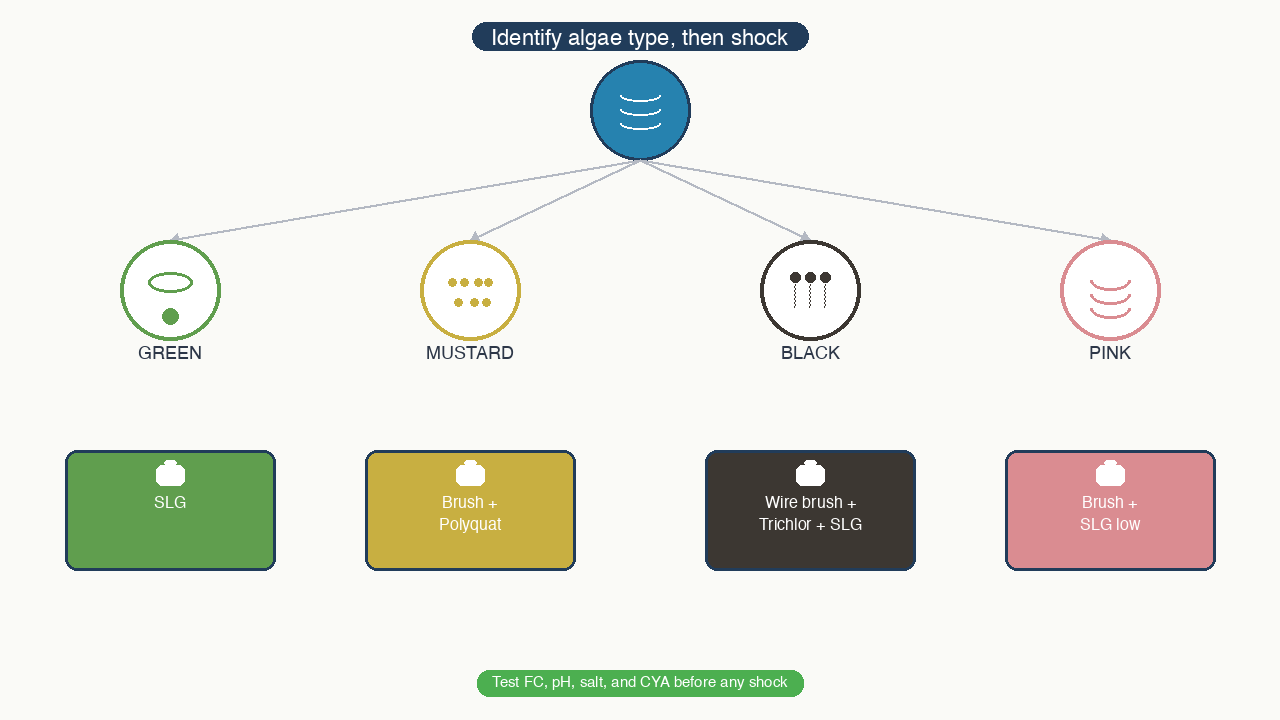
Yes → green algae → SLG shock to 10 ppm FC plus polyquat 60 weekly prevention. Jump to Green algae treatment below.
Q2 — Yellow-green powder on shady walls but water is clear?
Yes → mustard algae → brush plus SLG shock to 10 ppm plus polyquat 60 backup. Jump to Mustard algae treatment.
Q3 — Dark spots on plaster that resist brushing?
Yes → black algae → wire-brush plus SLG shock to 15 ppm FC for 3 days. Jump to Black algae treatment.
Q4 — Pink, red, or orange slime in niches or on toys?
Yes → pink bacteria → scrub plus SLG shock to 5 ppm FC held 48 hours. Jump to Pink bacteria treatment.
Q5 — Unsure or seeing more than one type?
Test salt, FC, pH, and CYA first with Joyzakzak 8-in-1 strips. If you’re still not sure what’s in the pool, default to the green protocol — SLG shock to 10 ppm, brush everything, run the pump 24 hours. Jump to Combined treatment.
Choose the right shock for your saltwater pool
SLG (sodium hypochlorite 12.5% liquid) — the standard
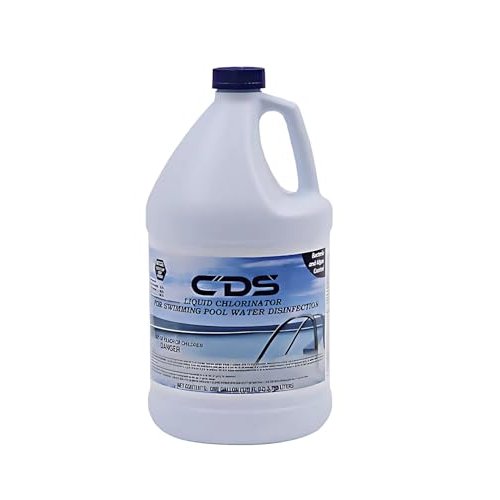
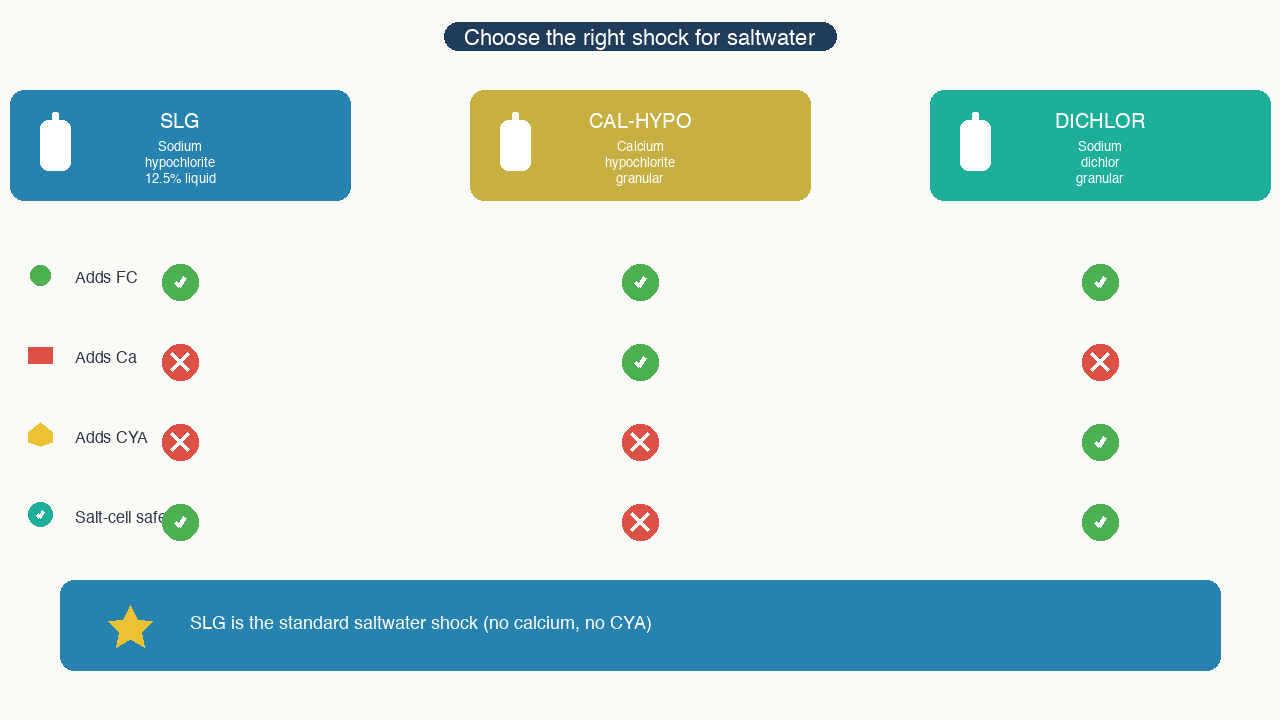
The default saltwater algae shock because it adds only free chlorine without raising calcium hardness or CYA. One gallon raises a 10,000-gallon pool about 12 ppm FC. Pour slowly in front of a return jet with the pump running. Fast-acting, no residue, safe on all surfaces. Use the chlorine dose calculator for your exact gallons.
Cal-hypo shock — not ideal for salt pools
Cal-hypo (calcium hypochlorite) shock works in chlorine pools, but in saltwater pools it adds calcium to water that already has 200 to 400 ppm calcium. Each pound of cal-hypo raises calcium by about 8 ppm per 10,000 gallons. Repeated use scales the salt cell. Skip cal-hypo for saltwater unless SLG is unavailable.
Dichlor granules — backup only
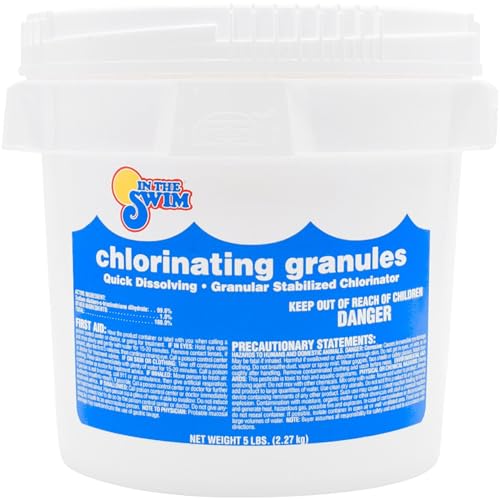
Dichlor (sodium dichloro-s-triazinetrione) works as a backup shock when liquid chlorine is hard to find or the pool is too large for affordable liquid dosing. The In The Swim Sodium Dichlor 5 lb fits that role. The catch: dichlor adds CYA — about 1 ppm per 1 ppm FC shocked. Salt pools already run 60 to 80 ppm CYA; one dichlor shock pushes you toward the 100 ppm lock-up zone. Use dichlor only as backup, never as your routine shock.
Treatment by type
Green algae treatment
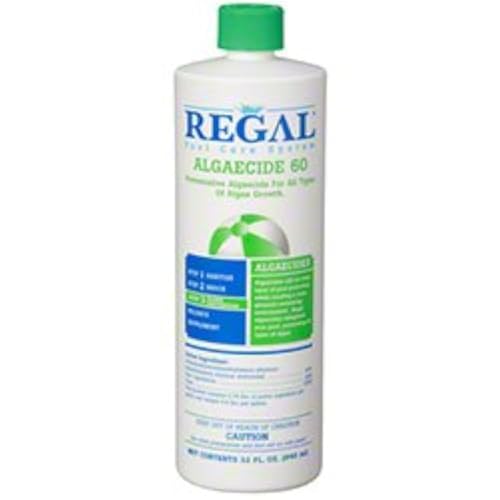
Brush every wall and floor with a POOLAZA 17.5” nylon pool brush to break the algae film. Test free chlorine, pH, CYA, and salt with Joyzakzak 8-in-1 strips before dosing — never shock blind. Pour CPDI Champion 12.5% sodium hypochlorite to bring FC to 10 ppm at dusk. Run the pump 24 hours. Retest FC each morning — if it holds above 5 ppm at dawn, the algae is dying. Repeat shock on day 3 if FC drops below 2 ppm overnight. Add Regal Algaecide 60 polyquat 60 on day 4 as weekly prevention.
Mustard algae treatment
Brush every affected wall plus behind ladders, steps, and skimmer baskets — not just where you see the powder. Pour CPDI 12.5% SLG to 10 ppm FC, then add Regal Algaecide 60 polyquat 60 at label dose after FC drops below 5 ppm. Mustard algae survive on equipment, so clean skimmer baskets, ladders, and pool toys with a 1:10 bleach-to-water solution. Hold FC at 4 to 5 ppm for one full week.
Black algae treatment
Wire-brush each spot aggressively with a stainless steel brush (plaster only — never on vinyl). Place a trichlor tablet in a sock, weighted down on each spot, for 24 hours. Pour CPDI 12.5% SLG to 15 ppm FC. Repeat the brush-trichlor-shock cycle for 3 consecutive days. Skipping the brushing is why black algae return.
Pink bacteria treatment
Scrub all affected surfaces with a POOLAZA nylon brush and a 1:10 bleach-to-water spray. Pour CPDI 12.5% SLG to 5 ppm FC (not 10 — you do not need breakpoint chlorination for bacteria). Hold FC at 5 ppm for 48 hours. Remove and clean pool toys; do not return them until FC drops back to target.
Combined treatment
When you see more than one type or cannot identify what’s in the pool, default to the green algae protocol — CPDI SLG shock to 10 ppm, brush everything, run the pump 24 hours. If you see clear pink slime anywhere, also scrub and hold 5 ppm for 48 hours as in the pink protocol. Polyquat 60 backup works against green, mustard, and black; it does not help pink bacteria.
Why algaecide alone will not fix saltwater algae
Algaecide is a backup, not a fix. Polyquat 60 prevents algae from re-establishing after chlorine does the killing work. Adding polyquat 60 to an active bloom without first raising FC to breakpoint is wasted — the algaecide cannot penetrate the protective biofilm. In saltwater pools, copper-based algaecides stain plaster and corrode cell plates, so reaching for the wrong algaecide makes the problem worse. Always shock first, then add algaecide as prevention. For breakpoint chlorination math, see pool shock.
What you’ll need — the saltwater algae kit
Sodium hypochlorite 12.5% liquid (your main shock)
For a typical 15,000-gallon saltwater pool in active bloom, you need 1 to 2 gallons of 12.5% sodium hypochlorite to reach 10 to 15 ppm FC. The CPDI Champion Pool Shock 12.5% Sodium Hypochlorite comes in 1-gallon jugs, so buy 2 for a one-shot algae kill. Buy pool-grade sodium hypochlorite (NSF/ANSI 60 certified), not hardware-store bleach.
Polyquat 60 algaecide (your backup)
The Regal Algaecide 60 is polyquat 60 — non-foaming, copper-free, salt cell safe. One quart treats up to 15,000 gallons. Add it after SLG shock clears FC below 5 ppm; use weekly for a month to prevent mustard and black algae from re-establishing.
Vinyl-safe nylon pool brush (your physical prep)
A nylon-bristle pool brush like the POOLAZA 17.5-inch is what you need for vinyl and fiberglass saltwater pools. Stainless steel brushes are too aggressive — they tear vinyl liners and scratch fiberglass. Use stainless only for black algae on plaster; use nylon everywhere else.
8-in-1 test strips with salt (your diagnostic)
You need to test salt, FC, pH, and CYA before each shock dose — the Joyzakzak 8-in-1 Pool Test Strips with Salt include salt ppm alongside FC, CYA, pH, and alkalinity in one dip. Saltwater pools need the salt reading that 7-way chlorine-only strips do not provide. Run a fresh strip from a sealed bottle.
Dichlor granular shock (your backup)
For pools larger than 20,000 gallons or when liquid chlorine is out of stock, In The Swim Sodium Dichlor Chlorine Shock Granules is your backup. Dichlor adds CYA, so use it only when SLG runs out or as an extra boost after the main shock.
What to buy only if needed
Buy a DPD liquid test kit only if your strips read ambiguous
Strip colors can be hard to read when the pool is heavily green or after a heavy shock. A Taylor K-2005 or K-2006 DPD liquid kit gives you precise FC, TC, pH, TA, CH, and CYA. Skip this purchase if your strips read clear. Buy only when mustard or black algae persists and you can’t tell if your shock is holding.
Buy a salt cell cleaner only when output drops despite correct salt
If salt is in range (2,700 to 3,400 ppm) but the SWG output dial shows normal while FC keeps falling, the cell is scaled. A muriatic acid wash (10:1 water-to-acid, soak the cell 15 minutes, rinse) is the standard fix. Buy a commercial cell cleaner only if you do not want to handle muriatic acid.
Buy a replacement salt cell only when output stays low after cleaning
Salt cells last 5 to 7 years. If acid washing does not restore output and salt is correct, the cell is at end of life. Replacement cells cost $200 to $600. Skip unless you’ve already cleaned the cell and confirmed output is still low.
Common mistakes saltwater pool owners make
-
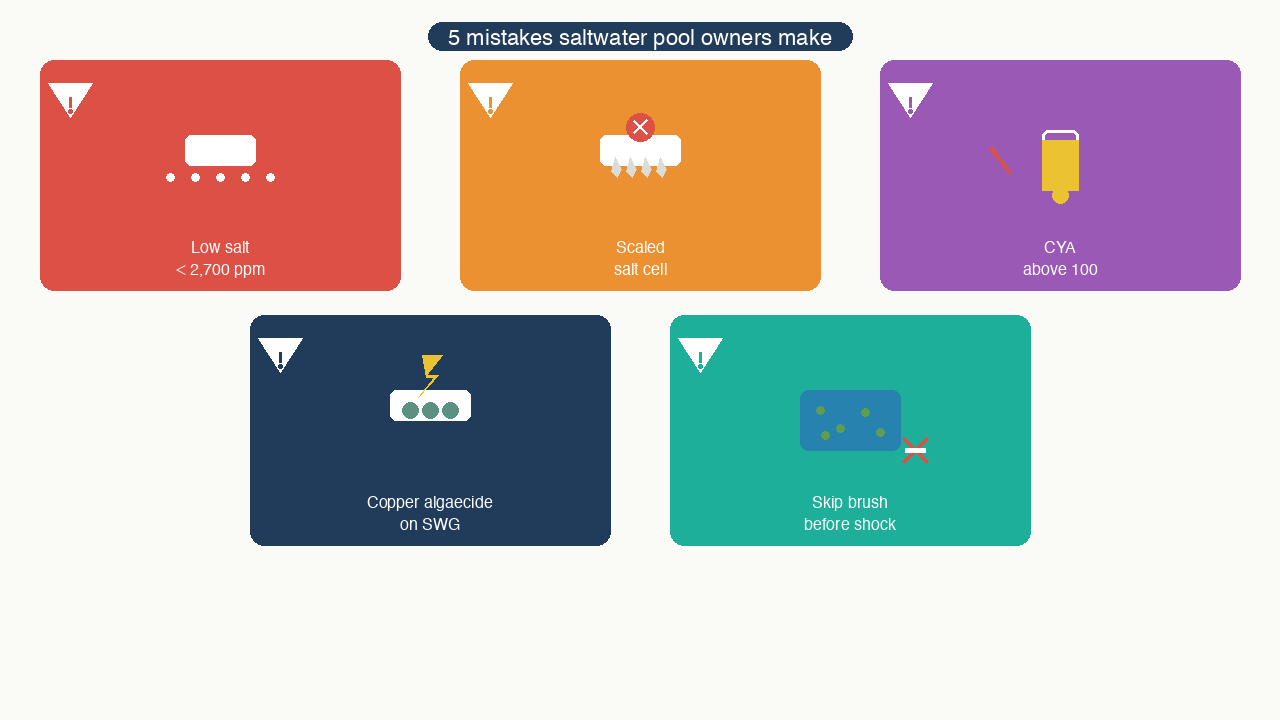
Skipping the salt reading before dosing. Most saltwater algae calls start with the owner shocking the pool and wondering why it does not clear. The salt cell was already running low because salt dropped below 2,700 ppm. Test salt first; add salt to 3,000 ppm before shocking. A saltwater pool with low salt cannot clear algae no matter how much you shock.
-
Using copper-based algaecide to boost treatment. Copper-based algaecides work in chlorine pools but stain the salt cell and discolor plaster in saltwater pools. Copper plating on cell plates eventually destroys the cell. Test copper with a strip — above 0.3 ppm and you will need a metal sequestrant to prevent staining when you next shock.
-
Shocking with cal-hypo because it is what the store had. Cal-hypo is the most common pool-shock SKU at big-box stores, but it is wrong for saltwater pools — each pound adds calcium. Use SLG (sodium hypochlorite liquid) instead. If you only have cal-hypo, use it once but switch to SLG for the second and third shocks.
-
Ignoring high CYA above 100 ppm. Salt pools shocked with dichlor or fed trichlor pucks for years can drift above 100 ppm CYA, where even 5 ppm FC is effectively zero for algae killing. The only fix is partial drain and refill — there is no chemical reducer. Plan for a 25 to 50 percent drain if CYA stays above 80 ppm for two consecutive tests.
-
Forgetting to brush before shocking. The algae biofilm on surfaces is what chlorine cannot penetrate. Skipping the brush leaves the film intact, the shock kills surface algae, the film regrows within 5 days, and the cycle repeats. Brush every wall, floor, step, and ladder before the first shock dose — plan 30 to 45 minutes for an average pool.
When to call a pro
Call a pool service professional when:
- The pool has been green for more than 2 weeks despite multiple shocks — long-standing blooms hide plumbing issues or dead algae under the floor
- Salt cell output stays low after acid washing and FC will not rise above 2 ppm — the cell is at end of life and a licensed SWG tech handles the plumbing and electrical
- CYA is above 150 ppm and you cannot drain and refill safely — a pro can plan a multi-step drain that protects the shell
- You see pink slime plus green water plus chemical smell plus skin irritation — organics overload with possible cross-contamination
- The pool is commercial or a rental — most jurisdictions require a certified pool operator
Safety notes — including #518 chemical shock re-entry rule
Never mix chlorine with acid or other pool chemicals
Adding acid and chlorine at the same time creates toxic chlorine gas. Wait at least 30 minutes between acid and chlorine additions; store them in separate, ventilated areas.
Always add chemicals to water, not water to chemicals
For SLG, pour slowly in front of a return jet. For granular dichlor, pre-dissolve in a bucket of pool water first. Never add water to a container of shock — it can splash concentrated chlorine onto skin and eyes.
Wear eye protection and gloves when dosing SLG
12.5% sodium hypochlorite is industrial-strength. Safety glasses and chemical-resistant gloves are mandatory — have a garden hose running nearby to flush skin or eyes immediately if a splash occurs.
Re-entry gate 1 — wait until FC drops below 5 ppm (FC threshold)
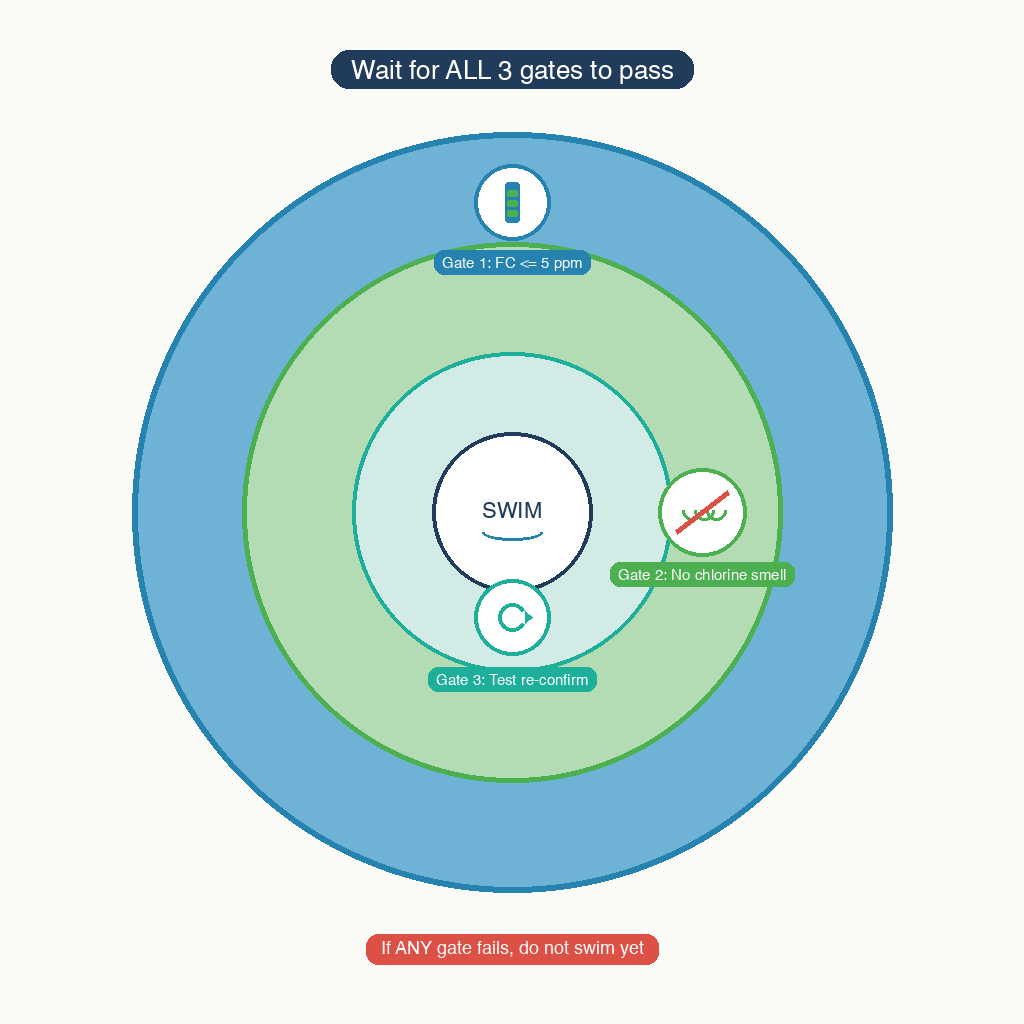
After any 10 ppm SLG shock, wait until a fresh Joyzakzak 8-in-1 strip reads FC below 5 ppm before anyone enters the pool. At 5 ppm FC and above, swimmer discomfort is likely and the chlorine smell has typically not cleared.
Re-entry gate 2 — wait 8 to 24 hours depending on conditions (time-based wait)
Plan to wait at least 8 hours after a 10 ppm SLG shock, up to 24 hours in cold water or full sun. Warm water (above 80°F) and full sun accelerate FC burn-off; cool water or evening dosing slows it. The 8 to 24 hours is a planning range — the test strip is the gate.
Re-entry gate 3 — no chlorine smell cleared (sensory gate)
The strong chlorine smell must be gone before swimming. The smell is not “extra chlorine working” — it is chloramines from chlorine reacting with bather waste. Strong chloramine smell above 5 ppm FC means the pool is not ready, regardless of what a clock says.
Re-entry gate 4 — second test-strip re-confirm 15 minutes later
Run a second test strip 15 minutes after the first to confirm FC is stable. If FC has dropped further (5 ppm to 4 ppm), the pool is ready. If FC has climbed back up, the algae are still consuming chlorine and the pool is not safe. Pump and filter must run for at least 4 hours after the last shock before anyone swims.
Keep chlorine and acid away from children and pets
Store all pool chemicals in a locked, ventilated area at least 5 feet off the ground. SLG jugs upright — never leave a measuring cup or bucket of shock solution unattended.
Never swim during an active shock
If FC is above 5 ppm on a strip, the water is not safe for swimming even if you shocked an hour ago. Wait, test again in 2 hours, and repeat until the gates above all pass.
Related
- The four pool algae types — identify what you are fighting by sight and location
- Saltwater pool basics — how SWG, salt, and CYA interact before any algae treatment
- Weekly pool care — preventive cadence that keeps algae from coming back
Key takeaways
- Test salt, FC, pH, and CYA before any shock — saltwater algae treatment fails when you dose blind
- Sodium hypochlorite 12.5% (SLG) is the standard saltwater algae shock — no calcium, no CYA
- Polyquat 60 is the only safe backup algaecide — copper corrodes the salt cell
- Brush every wall before shocking — chlorine cannot penetrate algae biofilm
- High CYA above 100 ppm locks up chlorine — only fix is partial drain and refill
- Wait until FC drops to 5 ppm or below AND the chlorine smell clears before swimming
- Call a pro if the pool stays green after 2 weeks or the salt cell stays low after cleaning