


Quick answer
You pulled off the winter cover and the water looks rough — gray or green-tinted with debris on the floor. The fix isn’t more chlorine; it’s a specific sequence. Test before you dose, balance in the right order, shock at dusk, run the pump overnight. Skip the test and you’ll waste three bags of shock on water that won’t clear. Saltwater pools add one step: inspect the cell and verify salt ppm before powering on the generator.
What this is not
This guide covers a pool that was closed last fall and reopened in spring. Here’s what it doesn’t cover:
- Not a first-time fill. Brand-new pools and freshly plastered surfaces need a 28-day cure with a separate startup sequence — brush twice daily, no salt for 30 days. That’s a different protocol.
- Not weekly pool care. Opening is a one-day startup. After that, hand off to your weekly pool care routine for the 20-minute in-season maintenance.
- Not winterizing. Closing drains equipment and lowers chemistry for freeze protection. Opening reverses it. The Open/Close Checklist covers both sides.
- Not a green pool rescue. If the water is already green when the cover comes off, you need a different protocol with higher shock doses and longer filter runs. Head to our green pool rescue guide first, then come back here.
Decision tree: which opening path fits your pool
Five branches change your order of operations and the products you’ll need. Check each one before you start.
Inground vs above-ground
Inground pools have a full tile line, multiport valve, main drain, and winter plugs to reinstall. Plan 6–8 hours. Above-ground pools have no main drain and no tile line — fill to mid-skimmer instead. Plan 3–4 hours.
Chlorine vs saltwater
Chlorine pools: balance, shock, run pump overnight, retest at dawn. Saltwater pools add three steps after shock: inspect the salt cell for scale, confirm salt ppm for your water temperature, and don’t power on the generator until FC, pH, and TA are in range. Low pH plus high calcium plates scale on the cell in one afternoon. See saltwater pool basics for the SWCG startup sequence.
Climate zone and freeze risk
Hard-freeze zones (USDA zone 4 and colder): wait until overnight lows stay above 32°F — opening too early risks re-freeze damage to a primed pump. Shoulder zones (5–7): late March to mid-April. No-freeze zones (8+): still use this sequence after a hurricane or travel cover.
Vinyl liner vs concrete or fiberglass
Vinyl: keep CH 200–300 ppm and skip stiff wire brushes that snag the liner. Concrete: target CH 200–400 ppm and scrub the plaster film hard. Fiberglass: CH can sit lower; use a soft brush so you don’t haze the gelcoat.
Clear under cover vs cloudy or green tint
Clear or slightly dull water: stay on this opening path. Cloudy with debris only: skim, circulate 30 minutes, then test. Green tint or black spots on walls: stop and run the green pool rescue protocol first — opening shock doses won’t catch a bloom that already took hold under the cover.
When to open your pool
Open when water temperature and overnight air temperature both stay above 50°F for a week. Algae wake up above 50°F — an idle pool sitting above that mark without sanitizer will turn green.
Use this timing check before you pull tools out of the shed:
- Too early: overnight lows still dip near freezing after you prime the pump.
- On window: days and nights hold above 50°F for about seven days.
- Too late uncovered: no sanitizer while water sits warm — expect green.
- Zone cue: humid zones 8–9 often open late February–March; freeze zones 3–5 wait until late April–May.
- Saltwater cue: you can wait 1–2 weeks longer than a chlorine pool, but only after you test and balance first.
Saltwater owners sometimes delay because the generator catches up fast once chemistry is set. That only works if FC, pH, and TA are already in range before you power the cell.
What you’ll need
Minimum kit for opening day. Three items cover test-shock-balance; the rest are hand tools you may already own.
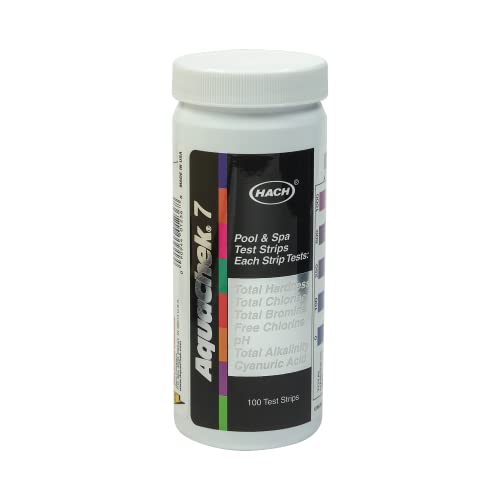
- AquaChek 7-Way test strips — FC, pH, TA, CH, and CYA in one dip. Skip if you already own a liquid kit that covers all five. Don’t use strips past the printed date — humidity ruins them.
- HTH Shock Advanced, 12 x 1 lb bags — cal-hypo at one bag per 10,000 gal. Skip if last season’s sealed cal-hypo is still dry. Don’t substitute dichlor — it adds CYA you can’t remove.
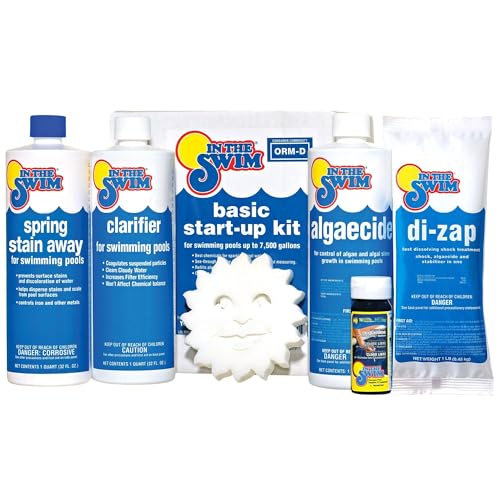
- In The Swim Basic opening kit — shock, algaecide, clarifier, and sun sorb for pools up to 7,500 gal. Skip if your pool is larger (buy components at correct dose). Don’t rely on the kit alone if CYA reads zero — you’ll still need stabilizer.
- U.S. Pool Supply skimmer net, 11.5 ft pole — clears leaves off the cover and skims after refill. Skip if you already own a telescopic pole and only need a net.
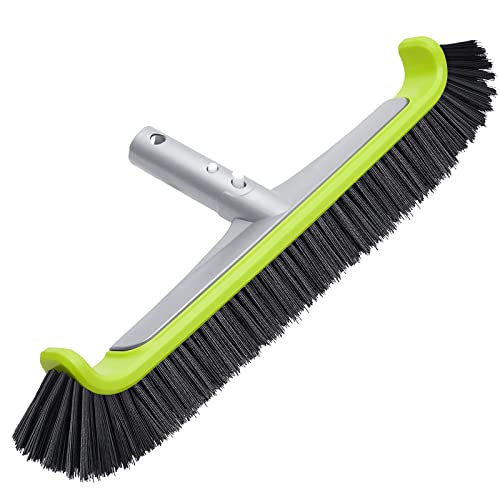
- Sepetrel 17.5-inch pool brush — stiff bristles for the tile line and walls. Don’t use a nylon-only brush on concrete — it won’t break biofilm.
For strip options, see pool test strips.
Pool opening steps
Follow these in order. Skipping Step 5 (the water test) is the number-one cause of green pool two weeks after a “successful” opening.
Step 1: Pump off the cover and remove debris
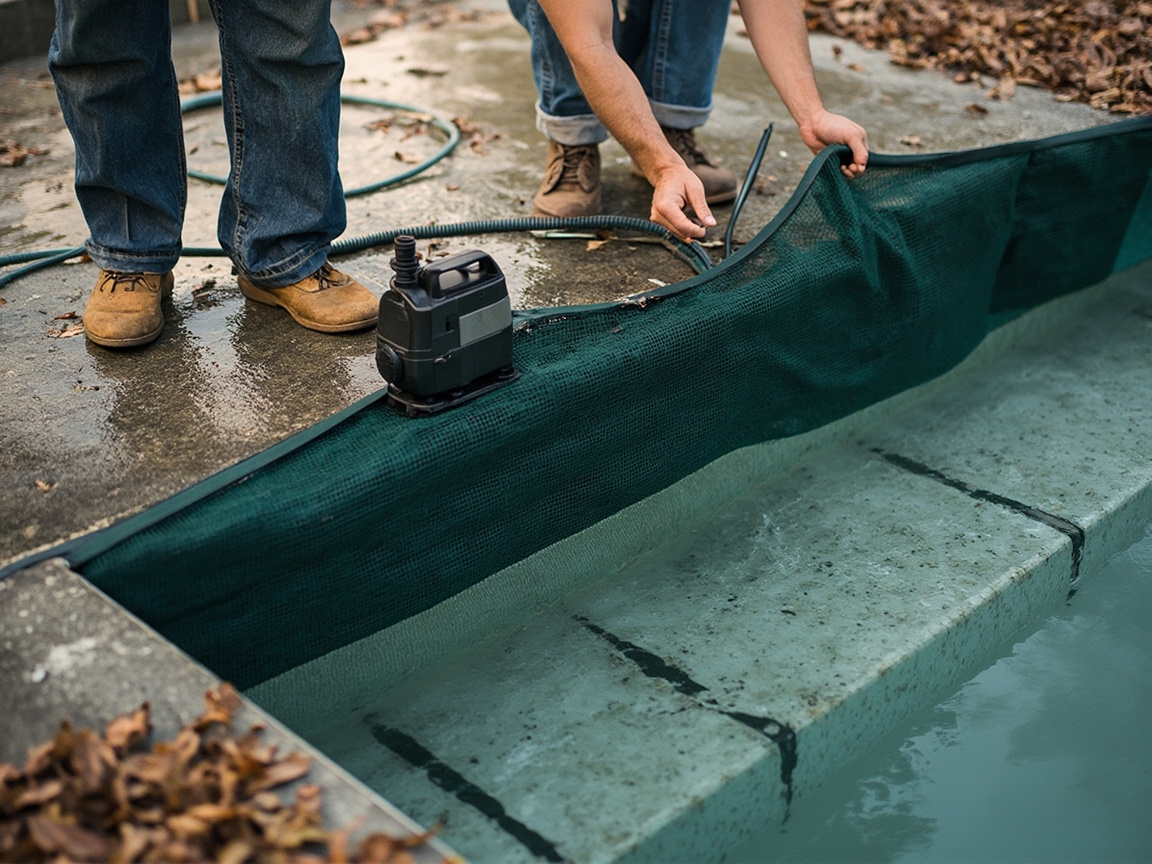
Use a submersible cover pump or siphon to drain rainwater and leaf sludge off the cover before you pull it back. Dumping that water into the pool adds phosphates and metals. Sweep leaves with the skimmer net. Two people fold the cover accordion-style, hose it, dry it, then store with cover powder.
Step 2: Remove winter plugs and reconnect equipment
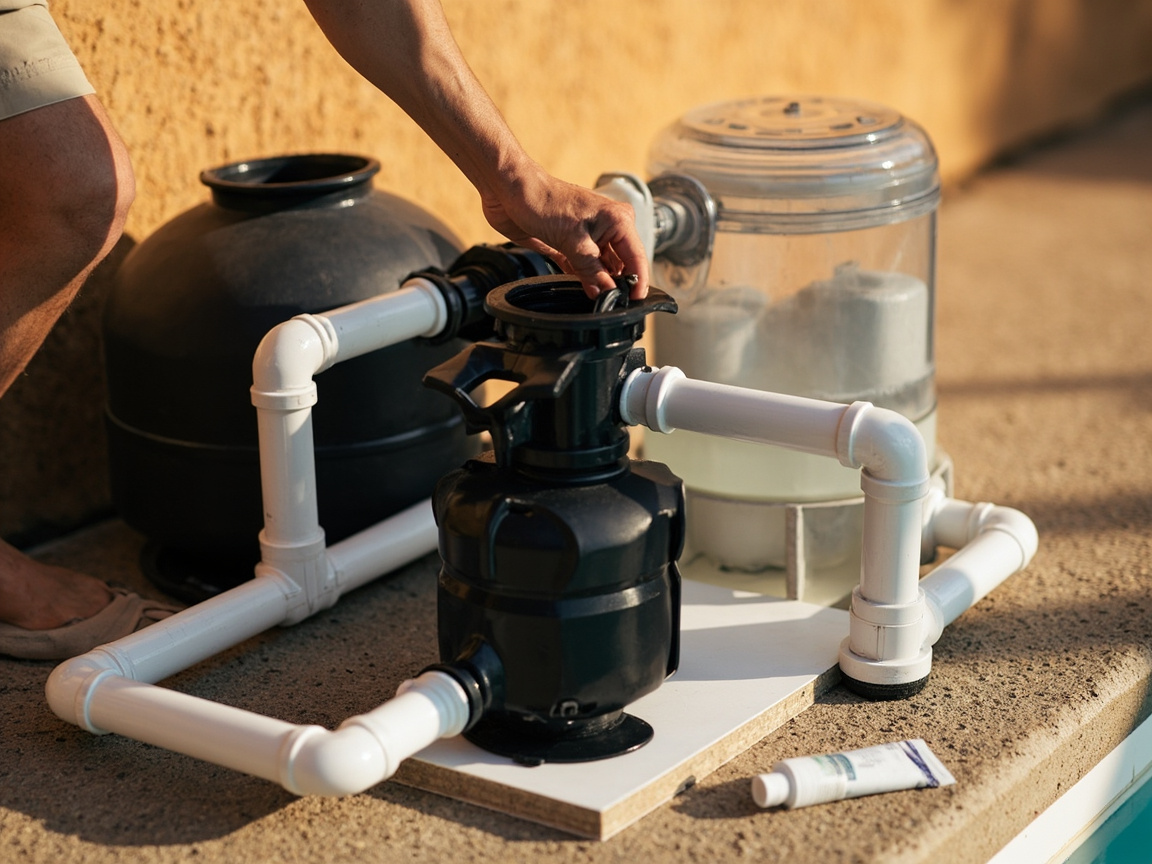
Reinstall return eyeballs, pull expansion plugs, and reconnect the pump, filter, heater, and (for saltwater) the generator lead. Lube pump-lid and multiport o-rings with silicone grease — not petroleum jelly, which swells rubber. On inground pools, reopen the main drain last, after the pump is primed.
Step 3: Fill the pool to the correct level
Fill to mid-tile (inground) or mid-skimmer (above-ground). Too low and the skimmer draws air; too high and the skimmer door won’t work. Use a hose with a backflow preventer.
Step 4: Prime the pump and start circulation
Fill the pump pot with pool water, latch the lid, set multiport to FILTER, open skimmer first then main drain, and start the pump. If it doesn’t catch in 60 seconds, shut off and reprime — running dry burns the shaft seal. Circulate 30 minutes before testing so the sample is representative.
Step 5: Test the water before adding anything
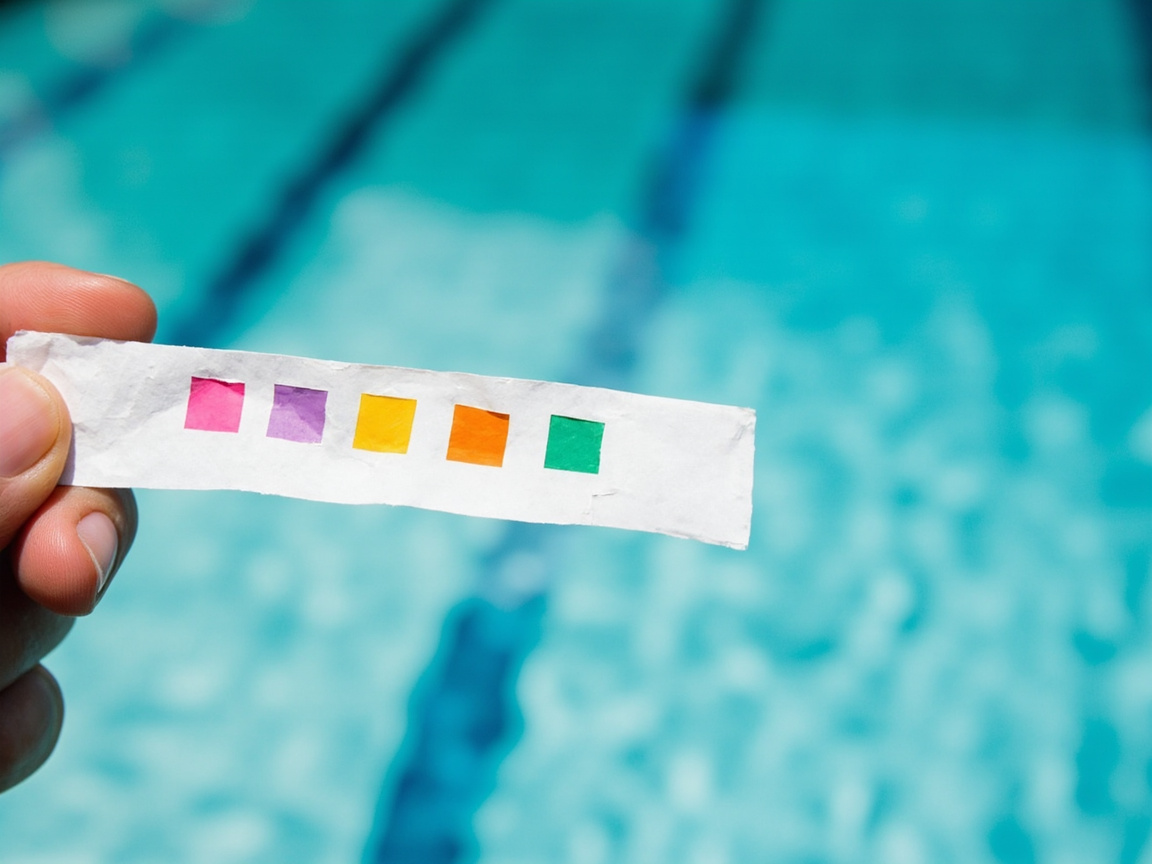
Dip a fresh AquaChek 7-way strip 18 inches down, away from the return. Read FC, pH, TA, CH, and CYA at the bottle’s printed wait time. Record all five. Zero free chlorine means the pool is already heading green. CYA below 30 ppm means chlorine won’t survive the first sunny day. Methods compared: how to test pool water.
Step 6: Balance chemistry in the right order
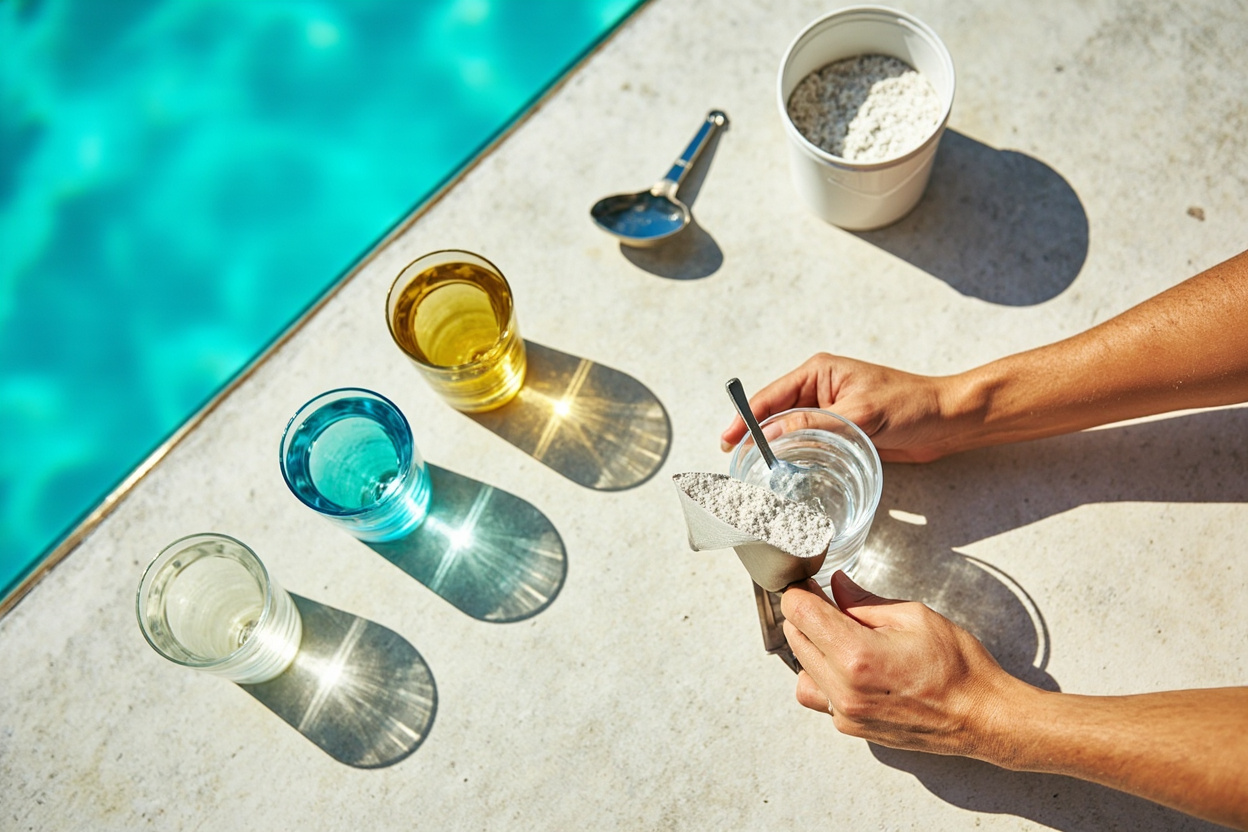
Order matters. Chlorine before TA/pH wastes sanitizer; CYA before you set FC locks the buffer too early.
- Adjust TA first — 80–120 ppm. Raise with baking soda, lower with muriatic acid or sodium bisulfate. Wait 30 minutes, retest. See total alkalinity.
- Then pH — 7.4–7.6. Raise with soda ash, lower with sodium bisulfate. TA usually drags pH, so retest before dosing.
- Then calcium hardness — 200–400 ppm for concrete and vinyl. Skip fiberglass unless below 150 ppm.
- Then CYA — 30–50 ppm chlorine pools, 70–80 ppm saltwater. Dissolve Pool Mate cyanuric acid stabilizer in a skimmer sock; no backwash for 48 hours. Details: cyanuric acid.
- Then FC — 1–3 ppm steady state. Shock comes next.
Exact ounces by volume: chemical dose calculator.
Step 7: Shock at dusk and run the pump overnight
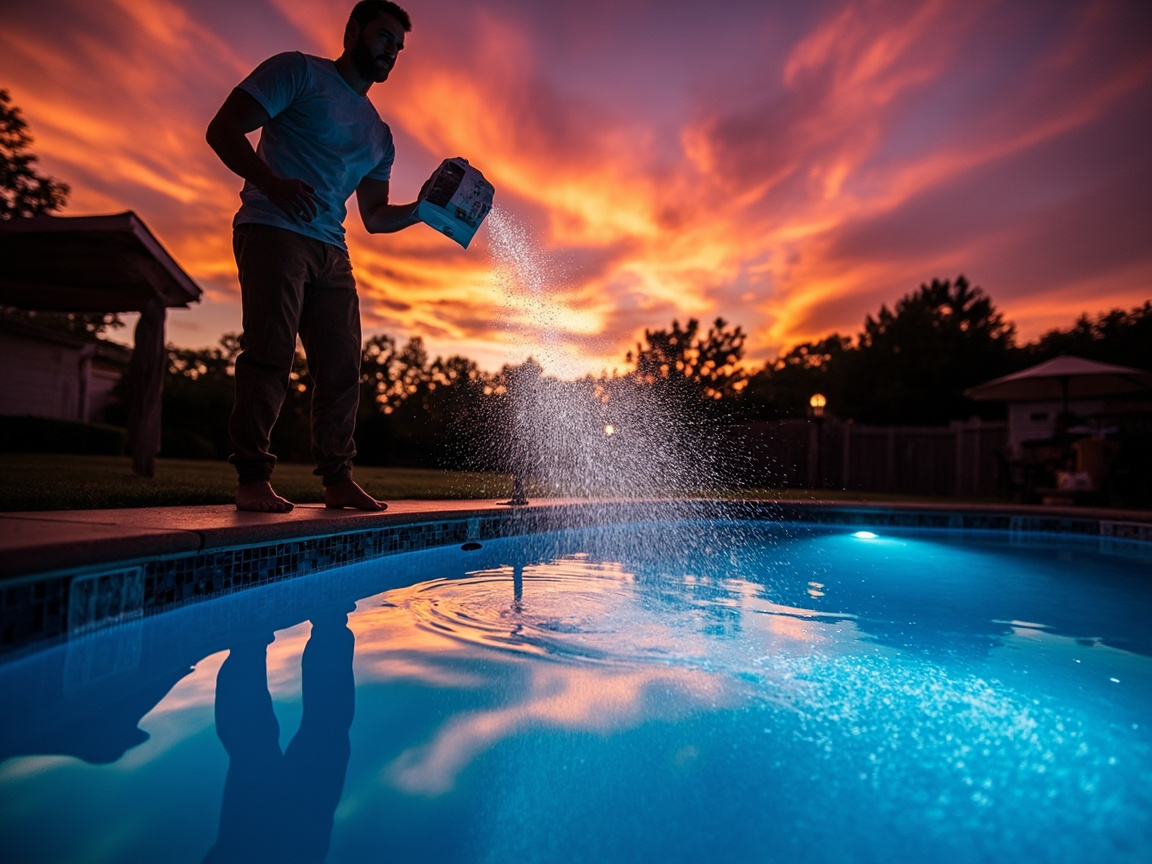
Broadcast HTH Shock Advanced — one 1-lb bag per 10,000 gal — around the perimeter with the pump running. Run 8–12 hours overnight so the filter catches dead organics. At dawn, FC should drop no more than 1–2 ppm; a bigger drop means algae or chloramines are still consuming chlorine. Full chemistry: pool shock.
Step 8: For saltwater pools — inspect cell, verify salt, reactivate
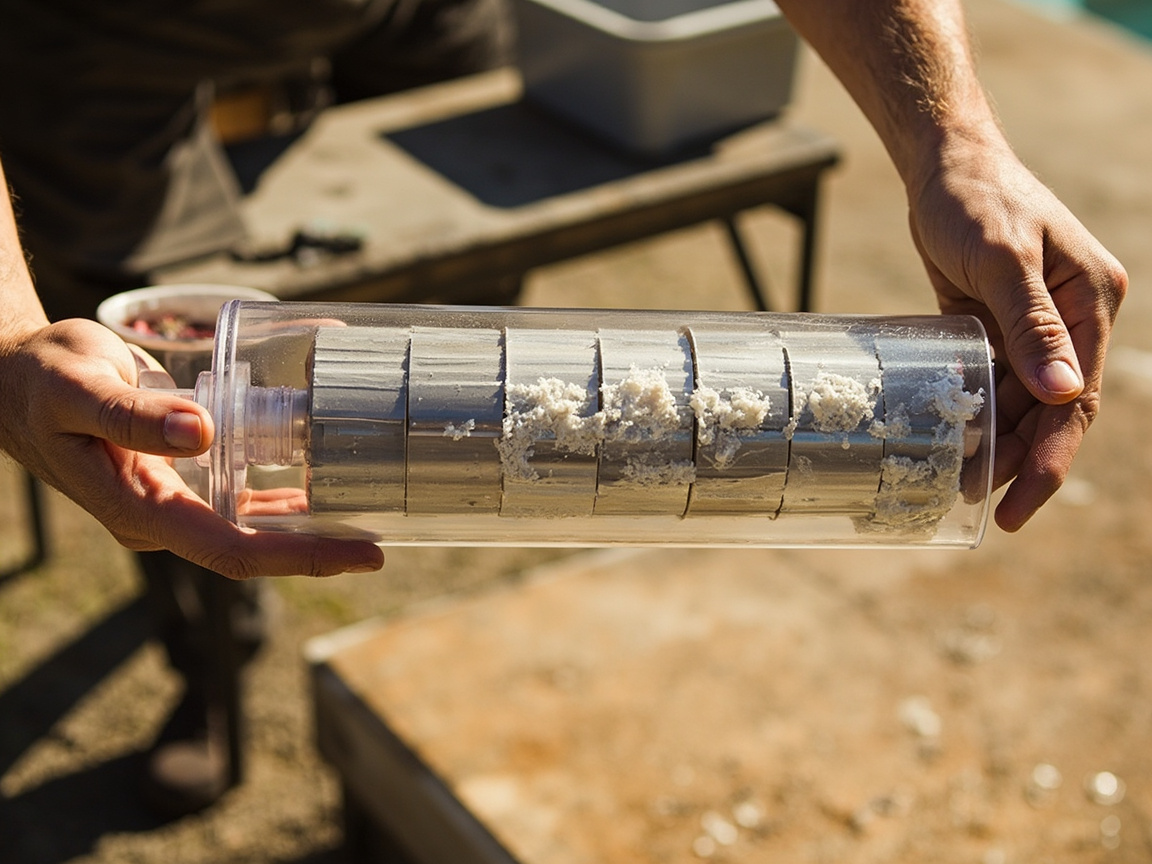
Pull the cell and check for white scale. Acid-wash 1:4 muriatic if scaled (15 minutes max, then rinse). Verify salt with test strips or a meter against the maker’s ppm chart for current water temperature — cool water reads low on the generator display. Power on at about 50% output and tune over 48 hours to hold FC at 1–3 ppm.
Opening-day filter pairing: sand vs cartridge vs DE
Opening day is not the day you rebuild the filter. Match the media you already have: hose a cartridge, backwash sand once, or recharge DE after that first backwash. Then read pressure against last fall’s clean baseline. If the gauge drops and the water is only dull from winter debris, stay here. Year-round clean steps live on the filter-cleaning guide. Leave to pool filter types only if you are replacing the whole unit.
Pressure vs clarity — stay on this page or jump
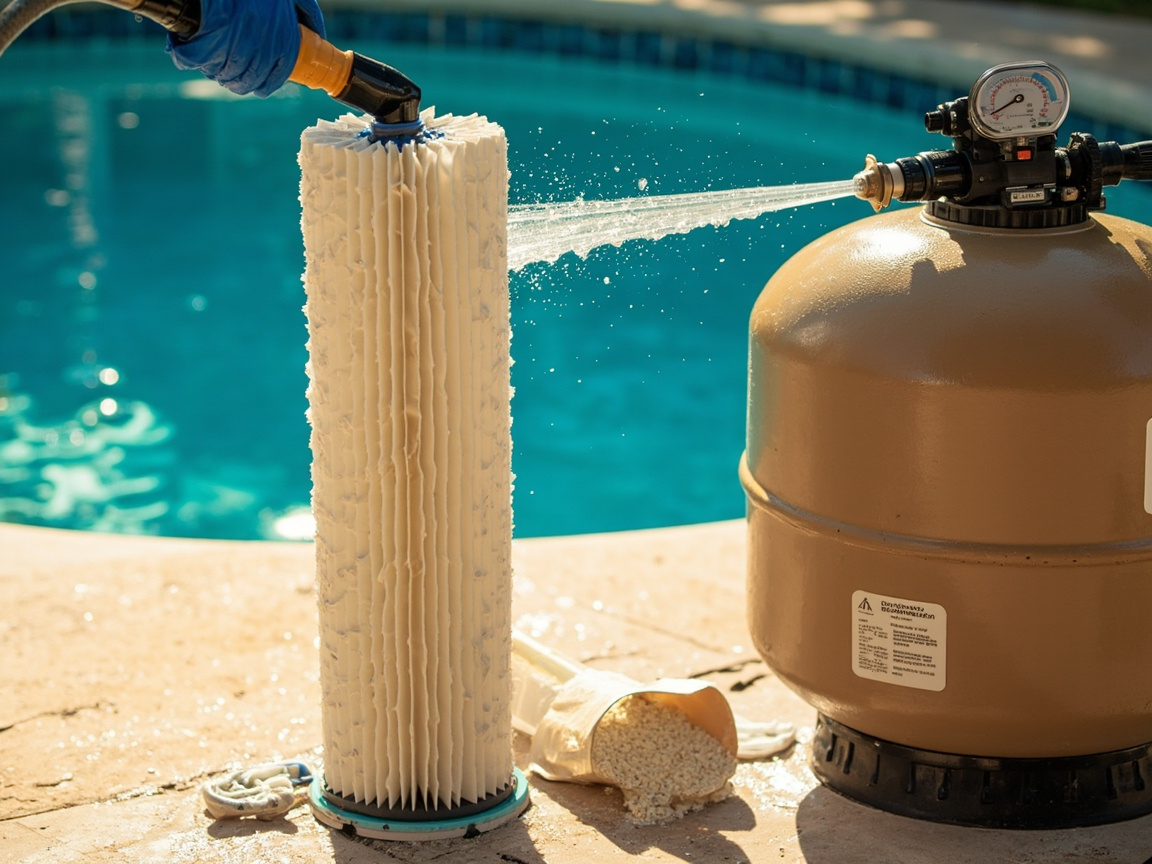
Read PSI after 30 minutes of circulation. Stay here if PSI is at or under 10 over last season’s clean number after one hose or one backwash, and the water is gray from leaves, not green. Jump to green pool rescue if walls are already stained green. Jump to how to clean a pool filter if PSI stays +10 after that one service, flow is weak, or the gauge is stuck at zero.
Cartridge on opening day — hose, inspect pleats, replace vs later soak
Power off, relieve pressure, pull the cartridge. Hose top-down until the water runs clear. If the pleats spring back and have no tears, put it back and mark today’s PSI. A crushed, torn, or oil-black cartridge does not belong in a six-hour open — replace it or leave the soak for the filter-cleaning page. Skip a soak if the pleats look intact after a hose. Don’t dump filter cleaner into a live skimmer while you are still balancing and shocking.
Sand on opening day — one backwash, do not dump media
Set the multiport to BACKWASH, run until the sight glass clears, then RINSE and return to FILTER. Do not dump the sand on opening day. Mud balls, or pressure that climbs back within minutes, is a media change — not this sequence.
DE on opening day — recharge after the first backwash, do not recake mid-open
Backwash or bump per the maker’s plate, then recharge the listed scoops of DE with the pump on FILTER. Do not add a second cake while you are still shocking and running overnight. If DE puffs back into the pool or grids look bare after the recharge, stop and go to filter cleaning for a grid hose-out. Wear a dry mask when you open the DE bag; the powder is a lung irritant.
When to leave for filter-cleaning vs filter-types
Leave this page for how to clean a pool filter when PSI stays +10 after one hose or backwash, cartridge pleats are crushed or torn, sand is mud-balled, DE grids are bare after recharge, or the gauge disagrees with a known-good spare. Leave for sand vs cartridge vs DE types only if you already decided to replace the whole filter.
Safety notes
- Never mix cal-hypo with dichlor, trichlor, or any acidic chemical. The reaction generates chlorine gas and can ignite. Use a dedicated dry scoop, and never reuse a scoop that touched another chemical without rinsing.
- Muriatic acid fumes are corrosive. Add acid to water — never water to acid. Work upwind, wear goggles and nitrile gloves, and store the bottle with the cap vented away from chlorine products.
- Shock can splash back. When broadcasting, stand downwind and pour low to the water. Don’t toss bags.
- Salt cell acid wash: 1 part muriatic acid to 4 parts water in a PVC stand. Soak no more than 15 minutes, rinse with a garden hose before reinstalling. Never reuse the acid bath for pool dosing.
What to buy only if needed
Pull these only if Step 5 or a visual check flags them.
Only if your cover was a leaf trap
A season of wet leaves usually means high phosphates. Test first — above 500 ppb, dose a phosphate remover before the first warm week blooms algae.
Only if CYA read zero
The In The Swim opening kit includes a starter dose up to 7,500 gal. For standalone CYA, use granular and the chemical dose calculator. Saltwater targets 70–80 ppm because the generator runs continuous low FC.
Only if metals showed on the strip
Well water or old copper lines can stain within hours of shocking. Add a Pool Mate metal sequestrant before Step 7 — chlorine oxidizes metals and locks the stain in.
Only if you want post-open insurance
After balance and shock, preventative algaecide helps in the first warm week above 50°F. Clorox Pool&Spa Algaecide + Clarifier is a one-bottle option — skip it if FC held overnight after a correct shock.
Only if your filter pressure won’t drop
Opening pressure 10 psi over baseline usually means winter biofilm. Backwash sand/DE or hose a cartridge. If pressure won’t fall after a backwash, replace the cartridge or recharge DE. Full opening-day media pairing is in Opening-day filter pairing above.
Common mistakes
Opening-day mistakes at a glance
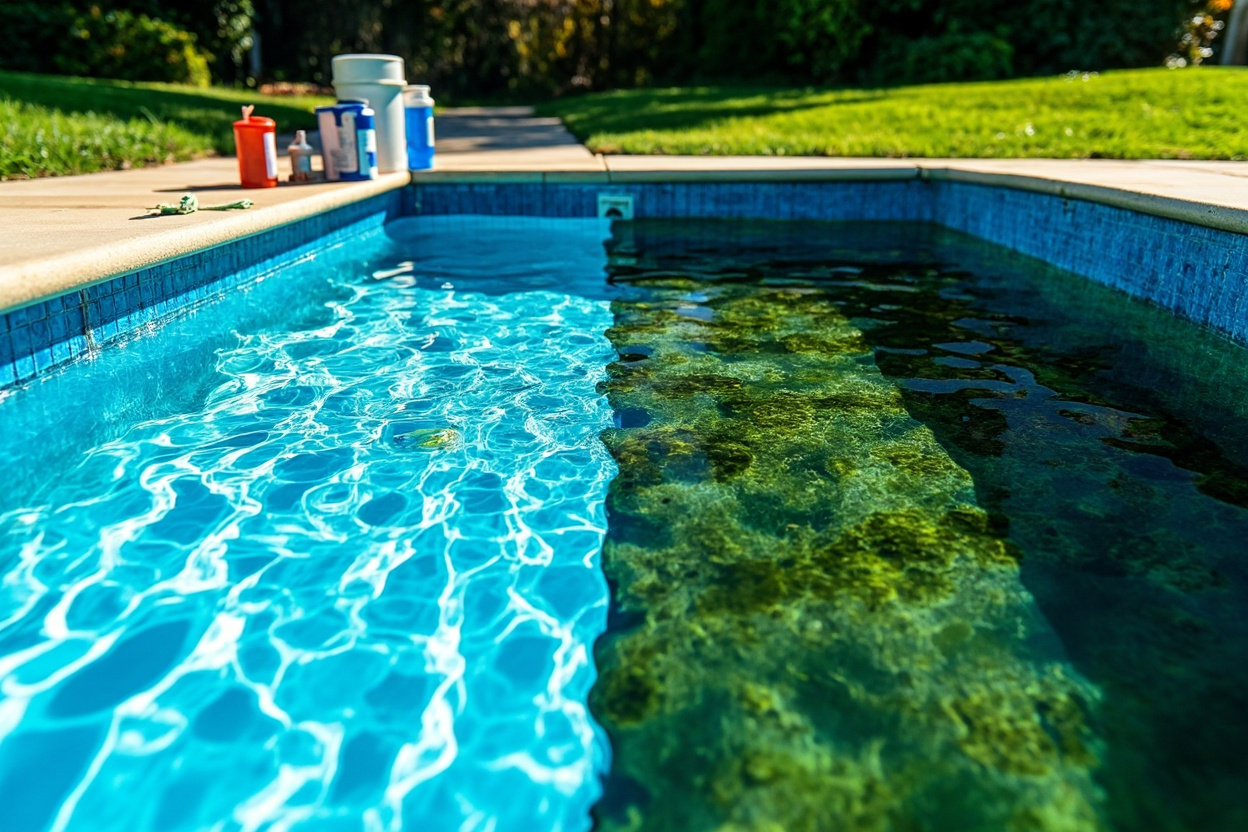
- Skipping the pre-dose test. Untested shock is how you get green water two weeks later. Test FC, pH, TA, CH, and CYA every opening.
- Adding chlorine before TA and pH. Chlorine works at 7.4–7.6 pH. Into 8.2 it mostly wastes; into 7.0 it attacks the liner.
- Powering the salt generator before chemistry is balanced. High CH or pH plates scale on a clean cell in one afternoon.
- Dumping cover water into the pool. That sludge carries phosphates, tannins, and metals. Pump it off first.
- Using last year’s test strips. Humidity ruins opened bottles. Past the printed date, buy fresh AquaChek 7-way strips — a false read costs more than new strips.
When to call a pro
Call a tech if any of these apply:
- Pump won’t prime after three tries, or you hear cavitation — air leak, cracked impeller, or clogged suction.
- Multiport spider gasket is shredded — wrong parts dump waste water into the yard.
- Pool was green more than two weeks before opening — that’s green pool rescue, not a standard open.
- Salt generator keeps a “low salt” or “inspect cell” code after a clean cell and verified salt — possible board failure.
Related
- Weekly pool care routine — weekly chemistry after opening.
- How to test pool water — strip vs liquid vs digital; Step 5 assumes this.
- Green pool rescue — if the pool was already green under the cover.
Key takeaways
- Test before you dose. FC, pH, TA, CH, and CYA — all five.
- Balance in order: TA → pH → CH → CYA → FC.
- Shock at dusk, run the pump overnight. Cal-hypo, 1 lb per 10,000 gal; retest at dawn.
- Saltwater last: inspect cell, verify salt ppm, then power on — never before chemistry is balanced.
- Pump the cover off first so phosphates and metals stay out.
- Opening is not weekly care. Hand off once FC, pH, and TA are in range.
- Opening-day filter pairing: hose a cartridge, one sand backwash, or recharge DE after the first backwash — don’t rebuild the filter today.