

You’re staring at three bags that all say “shock” on the front, and the back of each one tells a different story. Pick wrong and you’ll either overspend on something you don’t need, push your stabilizer so high that chlorine stops working, or waste a dose on a green pool that needed a real recovery plan instead. The good news: once you’ve matched the active ingredient to your water test, the choice takes about 30 seconds.
Quick answer
Pool shock isn’t one product — it’s three jobs under one word. Cal-hypo adds chlorine without CYA. Dichlor adds chlorine with CYA. MPS (non-chlorine) oxidizes without raising FC. Test free chlorine, pH, CYA, and calcium hardness first; then pick by what your water actually needs, not by what the bag says.
What pool shock actually does
A shock dose raises free chlorine (or, for non-chlorine shock, oxidation capacity) high enough to break apart combined chloramines and other organic buildup that daily chlorine can’t reach on its own. In a clean pool, a one-time dose bringing FC to about 5–10 ppm overnight clears a day’s worth of bather waste.
The catch is that “shock” describes a dose size, not an active ingredient. Cross-link to how much shock to add and when to retest for the dose math once you’ve picked a type; this article stays focused on which type to pick.
Cal-hypo: chlorine without stabilizer
Calcium hypochlorite dissolves in minutes, raises FC quickly, and adds no cyanuric acid. The trade-off is calcium: every dose contributes to calcium hardness.
Dichlor: chlorine with stabilizer
Sodium dichlor adds both free chlorine and CYA on the same dose. That’s the reason pool owners reach for dichlor in spring or after a refill when CYA is genuinely low. It’s a problem when CYA is already in range or high, because every dose climbs about 10 ppm CYA per pound per 10k gallons.
Non-chlorine MPS: oxidizer, not sanitizer
Potassium monopersulfate (MPS) is a non-living oxidizer. It breaks down chloramines, sweat, and lotions — but it does not raise free chlorine and does not sanitize ongoing. Use it as a complement, not a substitute. The label’s “swim-ready” wording is about re-entry timing, not a swap for daily chlorine.
What this is not: shock confusions that cost money
Shock is not a daily sanitizer. Daily chlorine — trichlor tablets, liquid, or a salt cell — keeps a 1–3 ppm FC residual going all week. Shock is a one-time larger dose on top of that. For new pool owners building a routine from scratch, the first-year pool-owner routine walks through daily and weekly chemistry before this decision comes up.
Shock is not the same thing as “raise FC.” You can raise FC with chlorinated shock, with non-chlorine shock plus a working sanitizer, or with liquid chlorine — none is universally interchangeable. Read the free chlorine target for the number, then choose the form.
Swim-ready marketing is not permission to skip the test. A “swim in 15 minutes” claim reflects the brand’s re-entry math under specific test assumptions, not yours. Always retest FC before anyone gets in. Trying to fix a balance problem with shock is a waste — if your real problem is alkalinity or pH, address that first through total alkalinity before opening any shock container.
A saltwater pool is not exempt from shocking. The salt chlorinator handles daily FC, but a salt cell can’t produce chlorine fast enough to clear a contamination event. You still shock the pool manually — see saltwater pool chemistry basics.
What good enough means
“Choose the right pool shock” doesn’t mean find the strongest bag. It means pick the smallest decision that accounts for your current water, your pool system, and the unintended side effects each product carries.
Start with the job, not the brand
Routine oxidation on a clean pool, a heavy bather-load cleanup, and a green-water recovery are different jobs. If the water is visibly green, see how to recover a green pool first — algae recovery is its own sequence and the product alone isn’t the answer.
Match the side effect to your next test
Every active ingredient carries a side effect: cal-hypo adds calcium, dichlor adds CYA, MPS adds neither chlorine nor stabilizer but also doesn’t sanitize. Track CYA for dichlor; track calcium hardness over time for cal-hypo. Cross-check your pH before any chlorine shock — extreme pH makes the dose less effective.
Keep the system constraint visible
Above-ground and inground pools pick shock types the same way; pool system (chlorine vs saltwater) is what changes the constraints. Saltwater owners can’t skip the CYA and calcium checks before reaching for cal-hypo or dichlor on repeat.
Decision tree: choose the shock family
Work through these five branches in order. Each one narrows the choice until you’ve either landed on a family or found a “test first” reason to pause. The product appears in Our picks by scenario only after you’ve reached a branch — picking a product before reaching a branch is how most of the common mistakes happen.
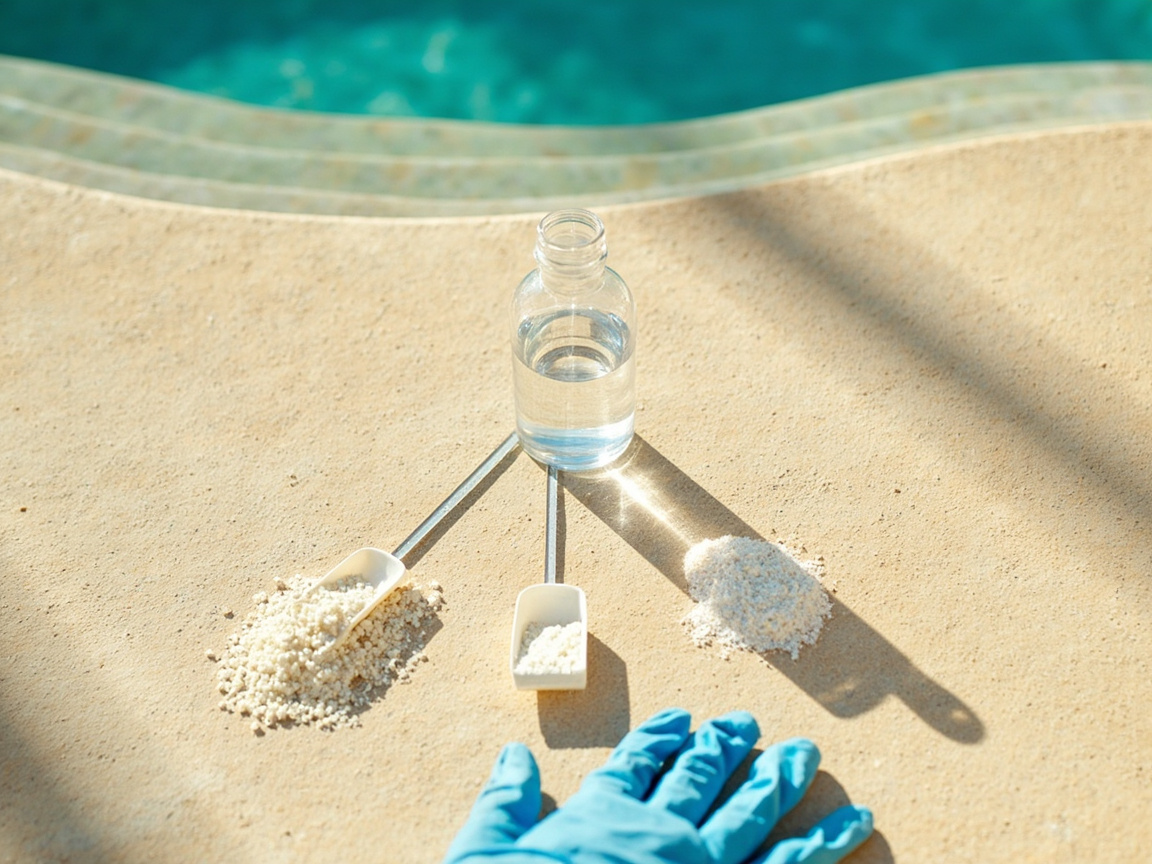
Branch 1: Have you tested FC, pH, CYA, and calcium hardness recently?
- No. Test first — see test FC, pH, and CYA before choosing a shock.
- Yes. Record the numbers and move on. If pH is below 7.2 or above 7.8, fix pH first.
Branch 2: Is the pool saltwater or chlorine?
- Saltwater. Cal-hypo contributes calcium that scales the salt cell; dichlor contributes CYA that locks the cell’s output. See saltwater pool chemistry basics.
- Chlorine. Continue through the same CYA and calcium branches.
Branch 3: Is CYA low enough that adding more is intentional?
- CYA is low (around 20–30 ppm) or you’ve just refilled. Adding CYA is on purpose. Dichlor becomes a real option — see the CYA trade-off — about 10 ppm CYA per pound per 10k gal per dose.
- CYA is in range (30–50 ppm) or unknown. Skip dichlor; the side effect outweighs the convenience.
Branch 4: Is calcium hardness already high or trending high?
- Yes, CH is above 400 ppm or you’ve seen scale on tile. Repeated cal-hypo makes the scaling worse. Compare In The Swim Chlorine-Free Shock (MPS) for routine oxidation, or rotate to liquid chlorine for chlorine doses.
- No, CH is in range or low. Cal-hypo is on the table — see the cal-hypo routine pick below.
Branch 5: Is this routine oxidation or a contamination event?
- Routine oxidation with sanitizer in range. MPS can fit if the label allows the pool system and you understand it’s an oxidizer, not a sanitizer.
- Visible contamination, failing sanitizer residual, or algae. Use a chlorine-based plan and see how to recover a green pool for the algae case.
Features that matter before you buy
Three dimensions drive almost every shock choice: whether the product raises FC, whether it raises CYA, and whether it adds calcium. Brand-specific numbers sit on the label.
| Decision feature | Cal-hypo | Dichlor | Non-chlorine MPS |
|---|---|---|---|
| Adds free chlorine | Yes | Yes | No |
| Adds CYA | No | Yes | No |
| Adds calcium | Can contribute | No | No |
| Best fit | Chlorine oxidation or recovery | Low-CYA, intentional stabilizer | Routine oxidation, sanitizer in range |
| Main skip condition | Calcium plan can’t absorb repeats | CYA is high or untested | Algae recovery or low sanitizer |
Read the active ingredient, not the marketing label
“Pool shock” on the front tells you the dose form, not the active ingredient. Turn the bag over and look for calcium hypochlorite, sodium dichlor, or potassium monopersulfate.
Watch the unintended addition
Dichlor’s main decision is the CYA it adds. Cal-hypo’s main decision is the calcium. MPS’s main decision is what it doesn’t do — it doesn’t replace your sanitizer. None of these side effects are bad on their own. They become problems when you keep buying the same product without testing for the side effect it’s been quietly adding.
Pool size and surface do not change the type
Volume changes the dose, not the family. Both a 10,000-gallon plaster pool and a 25,000-gallon vinyl pool decide between cal-hypo, dichlor, and MPS using the same five branches above.
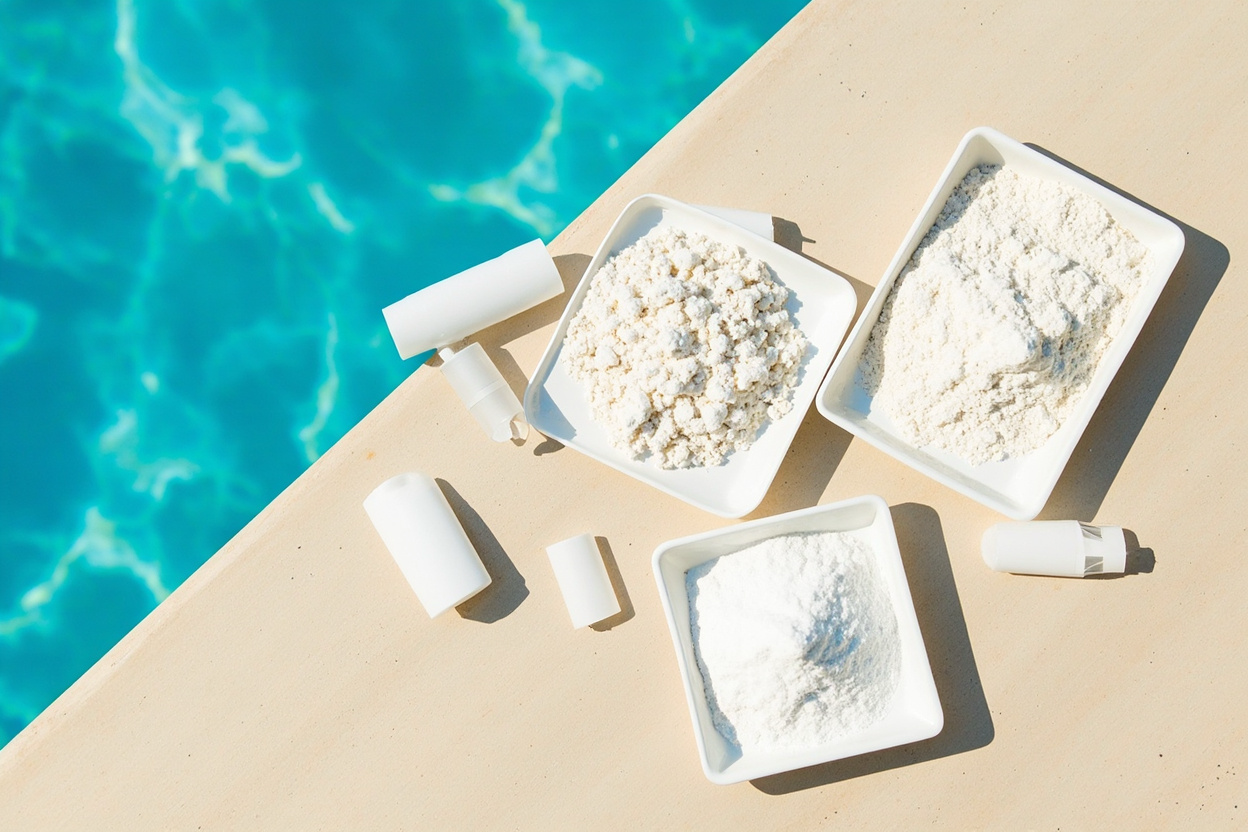
What to skip
”Pool shock + algaecide + clarifier” 3-in-1 products
You’re paying for additives you may not need. Buy the active ingredient you actually want and add algaecide separately only when there’s algae to fight.
MPS as a sanitizer when FC is dropping
If the test strip shows FC dropping week to week, MPS won’t fix that. It oxidizes what’s already in the water; it doesn’t replace the chlorine residual the water needs. See free chlorine target for the number your pool is trying to hold.
Mixing different chlorine products “to be safe”
Stacking a dichlor dose with a cal-hypo dose “for good measure” is a safety hazard. Pick one, dose it, retest, and adjust.
What you’ll need before choosing
Test results come first because the choice is driven by numbers.
Test kit and recent readings
- A kit or strips that read FC, pH, CYA, and calcium hardness — see pool test strips.
- Current FC, pH, CYA, and CH written down within the last week.
- Pool volume in gallons (a known number).
- The product label for whatever bag you’re holding.
Product candidates by family
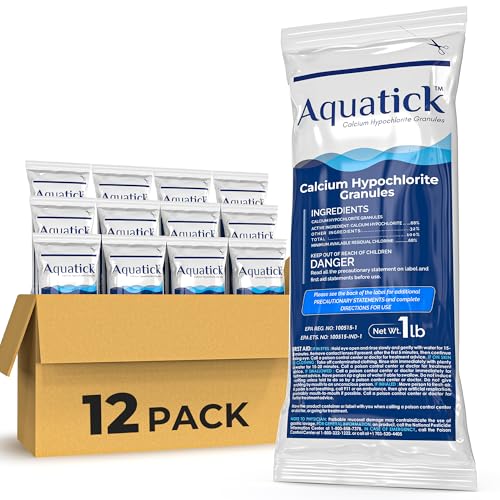
- Cal-hypo (routine): HTH 52037R Cal Hypo Formula.
- Cal-hypo (heavier recovery): POOLACC 68% Cal-Hypo.
- Dichlor (low-CYA): In The Swim Sodium Dichlor only after CYA is tested.
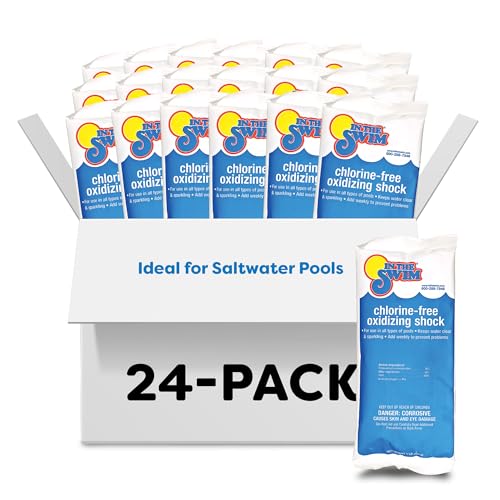
- MPS (routine): In The Swim Chlorine-Free Shock.
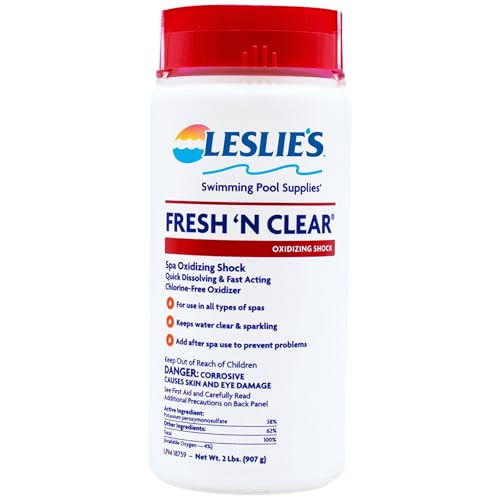
- MPS (small pool): Leslie’s Fresh ‘N Clear.
Our picks by scenario
The “best shock” depends on which branch of the decision tree you’ve landed on. Pick by scenario.
Routine oxidation on a standard chlorine pool
Pick: Cal-hypo at 65–73% available chlorine.
Cal-hypo raises FC fast, doesn’t add CYA, and is the cheapest shock per pound of available chlorine. A standard routine dose is 1 lb per 10,000 gal to raise FC about 10 ppm — check the chemical dose calculator for your volume. HTH 52037R Cal Hypo Formula in the 12 × 1 lb pack covers most backyard doses for a season.
Skip this if: calcium hardness is above 400 ppm and trending up.
Heavier recovery on a chlorine pool
Pick: Higher-strength cal-hypo (68–73%).
When you need breakpoint chlorination or an algae-recovery dose, you want one bag that delivers the ppm raise without stacking multiple doses. POOLACC 68% Cal-Hypo is the mid-strength workhorse. Pair the dose with the green pool recovery plan when there’s visible algae.
Skip this if: CH is at or above 500 ppm — switch to liquid chlorine to avoid scaling the heater.
Low-CYA pool or after a refill
Pick: Dichlor, only if adding CYA is intentional.
Dichlor is the right answer when CYA is genuinely low (under 30 ppm) and the test confirms it. In The Swim Sodium Dichlor is the labeled pick here. Read the CYA trade-off — about 10 ppm CYA per pound per 10k gal per dose.
Skip this if: CYA is over 30 ppm, unknown, or trending up. Past 50 ppm, the chlorine dichlor delivers becomes progressively less effective.
Saltwater pool with CYA already in range
Pick: Cal-hypo for occasional chlorine doses, MPS for routine oxidation.
Cal-hypo works when CH allows; MPS works when you want an oxidation pass without raising calcium or CYA. For a midsize salt pool, HTH 52037R handles the occasional dose. For routine oxidation, In The Swim Chlorine-Free Shock keeps the calcium and CYA side effects out. See saltwater pool chemistry basics for how the salt cell handles daily FC.
Skip this if: you don’t have a current CYA and calcium reading.
Calcium-sensitive pool or freshwater fill
Pick: MPS (non-chlorine) for routine oxidation.
When calcium hardness is high and your fill water isn’t going to drop it, MPS becomes the routine oxidation tool. It adds neither calcium nor CYA and breaks down chloramines between chlorine doses. In The Swim Chlorine-Free Shock in the 24 × 1 lb case is the routine pick. For smaller pools, Leslie’s Fresh ‘N Clear fits one or two doses at a time. Pair the choice with weekly pool care so the oxidation pass lines up with your existing routine.
Skip this if: FC is dropping or algae is present. For the recovery dose when algae does appear, POOLACC 68% Cal-Hypo is the cal-hypo workhorse to switch back to once calcium chemistry allows it.
Small pool, want a non-chlorine routine
Pick: Small-package MPS.
Smaller above-ground pools and most plunge pools don’t burn through a 24-pack in a season. A 2-pound tub of Leslie’s Fresh ‘N Clear gives you a few oxidation passes between refills without product going stale in storage.
Skip this if: the pool uses a salt system that already produces the chlorine residual you need.
Safety notes (read this)
Cal-hypo and dichlor are strong oxidizers. MPS is milder but still a chemical. Read this section before opening any container.
- Never mix different chlorine products dry or in a bucket — heat and gas can build fast.
- Never pour shock through a skimmer that feeds an automatic chlorinator or salt cell — residual trichlor in the feeder plus incoming shock can react inside the plumbing.
- Add chemical to water, not water to chemical, when pre-dissolving. Pouring water onto cal-hypo can splatter concentrated solution back at you.
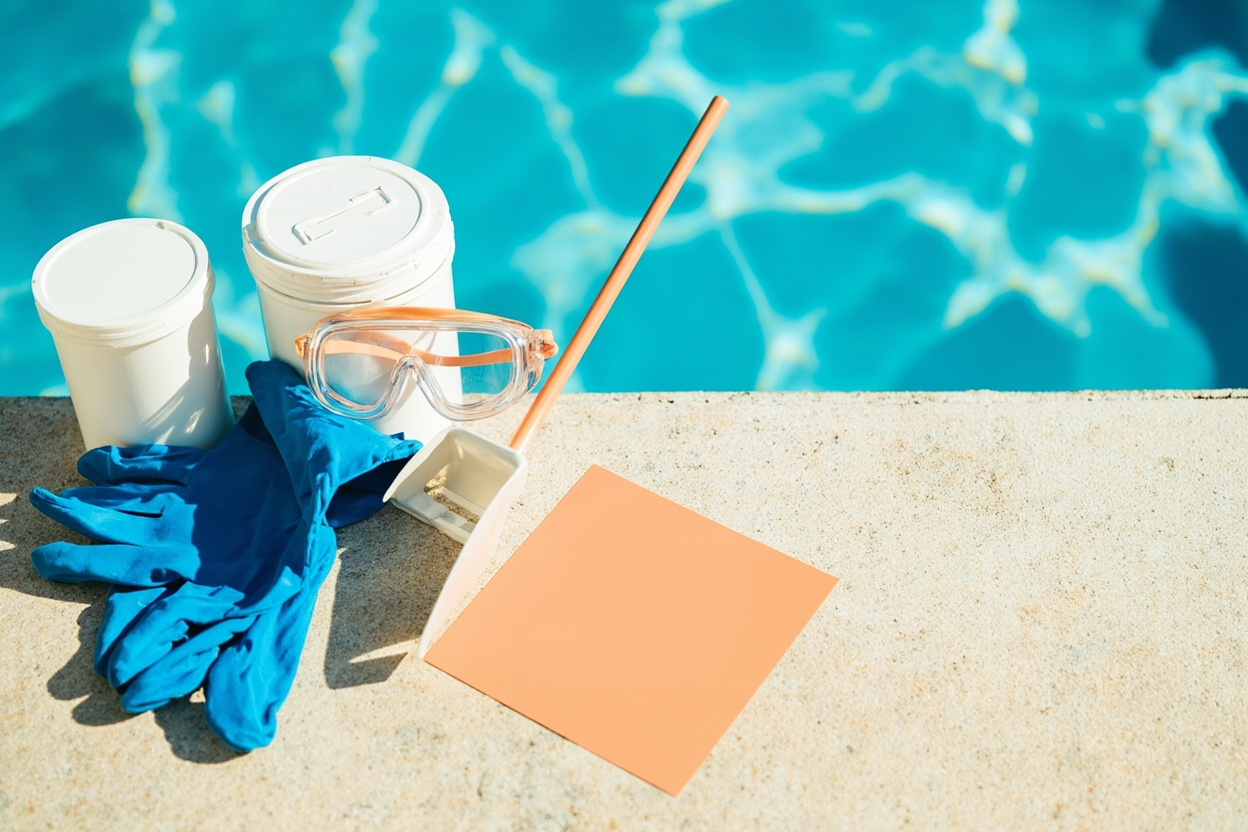
- Wear gloves and eye protection. Don’t breathe the dust when you open a container — chlorine dust irritates lungs and eyes fast.
- Store containers closed, dry, and locked away from children, pets, food, and any incompatible chemicals.
- Follow the product label for circulation, retesting, storage, and swim re-entry. An affiliate product’s “swim-ready” claim is not a universal rule — your test result is.
Common mistakes
Five failures happen over and over on the “which shock should I buy” question. Each is fixable with a single test or label read.
- Choosing by the word “shock” alone. The owner skips the active-ingredient read and grabs the cheapest bag. The side effect — CYA, calcium, or neither — climbs quietly over a season.
- Using dichlor when CYA is already high. The owner sees “no calcium” and reads it as “no side effects.” Dichlor’s side effect is CYA. Read CYA and rotate off when CYA climbs.
- Using cal-hypo repeatedly without watching calcium hardness. The owner fixes chloramine smells every week. Scale starts showing on tile and the heater.
- Using MPS as a sanitizer or algae cure. The owner reads “non-chlorine shock” and assumes it replaces chlorine. It oxidizes; it doesn’t sanitize. Pair it with a working sanitizer — see daily chlorine types.
- Dosing before measuring volume and current chemistry. The owner copies a neighbor’s dose. Volume, label strength, and FC and CYA all change the dose. The chemical dose calculator and the pool shock execution guide beat a copied number every time.
When to call a pro
Stays on the product-choice side. Some situations are outside a product decision.
Keep DIY if: you can test the water, identify the pool system, measure volume, follow the label, run circulation, and retest.
Call a pro if:
- Pump or filter won’t prime, or you suspect electrical issues.
- Persistent black algae after a label-compliant shock sequence.
- Salt cell output has dropped and you can’t tell whether the cause is CYA lock, scale, or a worn cell.
- Structural leak or major water loss.
- You’re not comfortable handling chlorine shock, pre-dissolving, or storing the chemicals safely.
Related
- How much shock to add and when to retest — the execution deep dive once you’ve picked a type
- Test FC, pH, and CYA before choosing a shock — the testing sequence that drives every branch above
- Recover a green pool — the algae-recovery sequence when shock alone isn’t the answer
Key takeaways
- There is no single “best pool shock” — pick by your water test, not by brand familiarity.
- Cal-hypo adds chlorine and calcium, but not CYA — ideal when CYA is in range and calcium allows.
- Dichlor adds chlorine and CYA — use only when adding stabilizer is intentional and low.
- MPS oxidizes without raising FC or CYA — a complement to a working sanitizer, never a replacement.
- Saltwater pools use the same families with extra CYA and calcium checks before repeating a type.
- The first move is always a current test, not a new bag.
- Never mix chlorine products, never pour through a chlorinator-fed skimmer, retest before anyone swims.